
Key Takeaways for Enclosure Assembly Programs
- Sheet metal enclosure assembly combines cutting, forming, hardware installation, finishing and inspection to deliver production-ready builds that meet functional and environmental requirements.
- Partners with vertical integration, ISO/AS certifications, scalable capacity and DFM support remove vendor handoffs that create delays and quality issues.
- The six-step assembly flow of material prep, hardware insertion, forming, welding, finishing and final inspection supports consistent results from prototype through mid-volume production.
- DFMA guidelines such as reducing part count, using self-locating features and controlling tolerance stack-up prevent common scaling failures in enclosure programs.
- Start consolidating an enclosure assembly program with a single accountable partner that controls fabrication, finishing and assembly under one roof.
Quick Partner Evaluation Framework for Enclosure Programs
Four criteria separate transactional vendors from partners that can own an enclosure assembly program. Vertical integration means the partner controls fabrication, finishing and assembly in one facility. Certifications confirm that documented quality systems support repeatable production for regulated sectors. Scalability ensures that programs can move from prototype to mid-volume runs without high minimums. DFM capability shows that engineering teams engage before production to catch tolerance and manufacturability issues while changes remain low cost. A partner that satisfies all four criteria removes the coordination overhead that fragments most programs.
Apply this four-point framework to the next enclosure program.
6-Step Sheet Metal Enclosure Assembly Flow for Production
This six-step sequence shows how mid-volume enclosure programs differ from prototype builds. Each stage must support repeatability, inspection checkpoints and consistent quality, not just one-off execution. This structure helps successful prototypes scale without rework or schedule risk.
- Material preparation and cutting. Sheet stock is selected and cut to flat blank geometry using laser cutting, CNC turret punching or shear. Laser cutting is the standard method for prototypes and small-to-medium volumes because it requires no tooling and reads complex profiles directly from DXF files. Turret punching is preferred for high-density repetitive hole patterns at higher volumes.
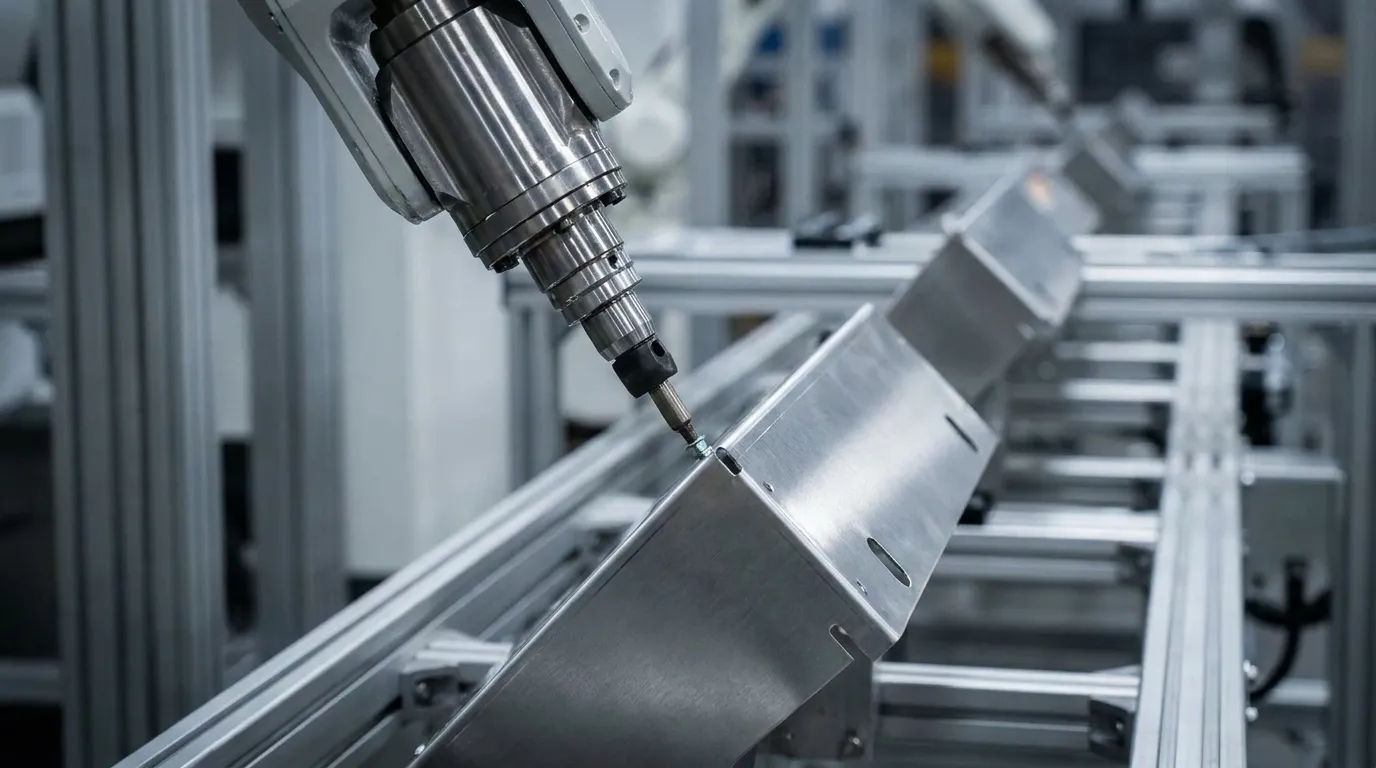
- Punching, hole operations and hardware insertion. Mounting holes, ventilation slots and threaded inserts such as PEM self-clinching fasteners are pressed into the flat blank before forming. Designs must provide sufficient clearance for press-tool installation of standoffs, nuts and studs used for PCB mounting and panel attachment.
- Forming. Panels are bent on a press brake to create the three-dimensional enclosure shape. Bend radius, material springback and bend sequence are controlled at this stage to prevent dimensional shifts that affect downstream assembly.
- Welding and joining. Seams, gussets and reinforcements are joined using MIG, TIG, stitch or CMT welding depending on material, thickness and IP rating requirements. Post-weld cleanup and grinding are required before surface treatment can be applied.
- Surface finishing. Surface treatment, including powder coating, electroplating or anodizing, is performed after all forming and welding operations are complete. Finish selection determines corrosion resistance, appearance and electrical properties. Coating thickness is treated as a dimensional variable because it affects final fit in tight-tolerance interfaces.
- Final assembly, inspection and packaging. Hardware, brackets, gaskets and electromechanical components are integrated using documented work instructions. Dimensional, finish, hardware and functional checks are completed before the build is packaged for delivery or downstream integration.
Joining Methods and Hardware Installation Best Practices
Joining method selection depends on application, material, geometry, service requirements and production volume. The primary options for sheet metal enclosures are welding, self-clinching fasteners, rivets, tab-and-slot features and adhesive bonding.
MIG welding is favored for speed and versatility, while TIG welding offers precise control for thin-gauge materials. For panels that require continuous sealed seams, such as high-IP-rated waterproof enclosures, CMT welding minimizes distortion while maintaining structural integrity. Stitch welding is preferred over continuous welding for thin materials or long seams because it reduces heat input, fabrication time and distortion risk.
When welding alone cannot provide sufficient alignment control, tab-and-slot connectors interlock parts to improve self-location and alignment, particularly when brackets will later be welded. Slots are filled and ground for an invisible external finish. Spot-welded flanges are cost-effective for high-volume production but require specialty tooling and fixturing that make them less practical for smaller runs.
Blind rivets are common in electronics and transportation enclosures for one-sided access applications. Structural adhesives distribute stress evenly, minimize corrosion and fill gaps in applications where welding or mechanical fastening is unsuitable.
Design-for-Assembly Guidelines for Scaling Production
DFMA applied during the concept phase costs a fraction of late-stage changes. These guidelines target the most common scaling failures in enclosure programs.
Reduce part count. Parts that do not move relative to each other should be combined wherever possible. Consolidation lowers assembly steps, tolerance stack-up and failure points.
Use self-locating features. Once part count is minimized, remaining parts should position themselves during assembly. Design parts to be self-locating using tabs, slots, chamfers and lead-ins so geometry positions parts and reduces reliance on fixtures. This supports repeatability when programs move from prototype to production.
Control tolerance stack-up early. Many assembly failures originate from tolerances that were never evaluated together across multiple parts. To prevent cumulative error, use intentional datums as fixed reference points that control alignment without chaining tolerances across components.
Apply tight tolerances only where functionally required. Unnecessary tight tolerances add setups, slower feeds and inspection time. Reserve precision callouts for mating, sealing and connector-alignment surfaces.
Standardize hole sizes, threads and gauges. Standard gauge thicknesses improve material availability and simplify purchasing. Nonstandard gauges limit supplier options and increase total cost.
Design for top-down assembly. One-direction, gravity-assisted, top-down assembly improves speed, safety and repeatability in production.
Inspection and Testing Checklist for Production Enclosures
A production-grade enclosure inspection program covers four categories.
- Dimensional verification. Confirms that critical features such as hole locations, flange heights, bend angles and overall envelope fall within specified tolerances. Inspection criteria must account for coating thickness because powder coating adds measurable material per side, which affects fit in tight-tolerance interfaces such as U-channels and hinge assemblies.
- Finish verification. Confirms coating adhesion, color and coverage. For enclosures that require EMI performance, this step also verifies that grounding points and conductive surfaces were properly masked during coating, because effective EMI shielding requires maintaining a continuous Faraday cage with conductive gaskets on access panels and properly treated grounding points.
- Hardware verification. Confirms that all self-clinching fasteners, standoffs and inserts are fully seated, correctly torqued and dimensionally aligned. GD&T-based checks such as positional tolerance and perpendicularity are critical for inserts, nuts and studs that must align correctly for fit and function.
- Functional verification. Covers gasket compression, IP sealing integrity, connector alignment and any electromechanical integration points. Inspection checkpoints confirm dimensional alignment, fastening integrity and finish quality before assemblies move to the next manufacturing step.
Common Assembly Pitfalls and Practical DFM Fixes
Panel warping from welding. Thin panels distort when heat input is not controlled. The fix is specifying stitch welding for thin-gauge seams and using fixturing to hold geometry during the weld sequence. Welding alignment is maintained through fixtures, sequenced welding and in-process inspection checks.
Connector misalignment. Poor connector alignment is one of the most common enclosure mistakes that hurts electronics reliability. The DFM fix is designing self-locating tab-and-slot features that position panels before fastening and remove reliance on operator judgment.
Tolerance stack-up at assembly. When tolerances are chained across multiple parts without intentional datums, cumulative error causes fit failures at final assembly. The fix is evaluating stack-up during design review and applying tight tolerances only to functional interfaces.
Coating interference with hardware. Powder coat applied over threaded inserts or grounding points creates functional failures. The fix is specifying masking requirements on drawings before finishing operations begin.
Incorrect bend sequence. A bend sequence that creates interference with the press brake tooling forces rework or secondary operations. A DFM checklist should verify that bend sequences are feasible without interference before release.
Moving from Prototype to Mid-Volume Runs with Agile Cells
Programs in data center, energy storage and reshoring sectors often require partners that can absorb volume changes and mixed SKUs without the rigidity of large contract manufacturers.
Agile production cells are flexible manufacturing configurations that adapt to changing volumes and evolving bills of materials. Unlike fixed production lines that require high minimum volumes to justify setup costs, agile cells support mixed-SKU programs and volume ramps without long onboarding cycles.
Integrated quality systems that span fabrication, finishing and assembly provide traceability across the full build. When a single partner controls all three stages, quality issues are detected and resolved within one production environment rather than surfacing after a handoff to a downstream vendor.
Discuss how agile production cells can adapt to program volume requirements and mixed-SKU needs.
Frequently Asked Questions
What certifications should a sheet metal enclosure assembly partner hold?
ISO 9001:2015 is the baseline quality management certification for precision fabrication and assembly programs. For aerospace, defense and high-reliability infrastructure programs, AS9100D certification adds requirements for risk management, configuration control and full traceability. Partners serving regulated industries should also maintain ITAR registration and compliance with UL and CSA standards where applicable. Fabcon holds these certifications and registrations and supports programs across data center, energy, medical and aerospace sectors.
What volume ranges does a vertically integrated partner like Fabcon support?
Fabcon is purpose-built for prototype through mid-volume production programs. Agile production cells allow the facility to scale with a program’s needs without the high minimums or rigid onboarding processes associated with large contract manufacturers. This structure fits programs that start at prototype quantities and grow into recurring production runs, as well as high-mix programs with multiple SKUs running concurrently.
How does total program cost differ from piece-part pricing when evaluating enclosure assembly partners?
Piece-part pricing from a low-cost job shop rarely reflects the full cost of a fragmented program. When fabrication, finishing and assembly are split across multiple vendors, the program absorbs coordination overhead, shipping between vendors, quality disputes, rework from tolerance handoff errors and schedule delays. Total program cost accounts for all of these factors. A vertically integrated partner that controls the full build under one roof compresses timelines, reduces vendor management burden and catches quality issues before they propagate.
What DFM support should engineering teams expect from a fabrication partner?
As noted in the partner evaluation framework, capable partners engage before production begins. Beyond the initial tolerance and manufacturability review, this engagement should include evaluation of stack-up across mating parts, recommendations for self-locating features that reduce fixturing requirements and review of finish callouts that could interfere with hardware or sealing surfaces. Fabcon’s engineering team collaborates with customer technical teams during this phase to align the design with production realities before any tooling or capital is committed.
How does single-partner accountability affect quality traceability?
When one partner controls fabrication, finishing and assembly, quality records are generated and maintained within a single quality management system. Every part carries traceability from raw material through final inspection, with no gaps created by vendor handoffs. This structure is particularly important for programs in aerospace, medical and energy sectors where regulatory requirements demand documented traceability. Fabcon’s certified quality systems apply integrated inspection and traceability across the full build.
Conclusion: Consolidate with a Single Accountable Partner
The evaluation framework introduced earlier, covering vertical integration, certifications, scalability and DFM capability, separates partners that can own a full program from those that fragment it across vendors. Fragmented vendor chains often struggle with tolerance control, schedule risk and accountability when issues arise.
Fabcon’s 220,000 square feet of vertically integrated manufacturing space in two U.S. facilities, aerospace-grade certified quality systems and agile production cells address each criterion directly. Fabrication, finishing and light electromechanical assembly operate under one roof, one quality system and one accountable partner.
Consolidate an enclosure assembly program with Fabcon as a single accountable partner.