
Key takeaways for sheet metal DFM success
- Sheet metal DFM guidelines reduce rework by following bend radius rules like 1× material thickness minimum and 3× thickness for flange lengths.
- Material selection such as aluminum for corrosion resistance and carbon steel for strength improves enclosure performance in data centers and EVs.
- Hole placement that uses minimum diameter equal to material thickness and ≥2× thickness from bends prevents distortion during forming.
- Design for assembly features like hemmed edges, slot-and-tab joints and self-clinching fasteners simplify production and improve reliability.
- Fabcon’s vertically integrated expertise supports DFM success, and a free DFM design review from Fabcon accelerates manufacturing.
Why DFM drives better sheet metal enclosures
Sheet metal DFM reduces costs, shortens lead times and minimizes design iterations. Modern enclosures for data centers, electric vehicles and medical devices require complex thermal management, electromagnetic compatibility and scalable manufacturing. Digital twin simulation tools reduce physical trials and shorten new product introduction cycles. Fabcon’s early DFM collaboration aligns designs with manufacturing constraints and prevents late-stage redesigns that delay market entry.
Essential sheet metal bending rules for reliable forming
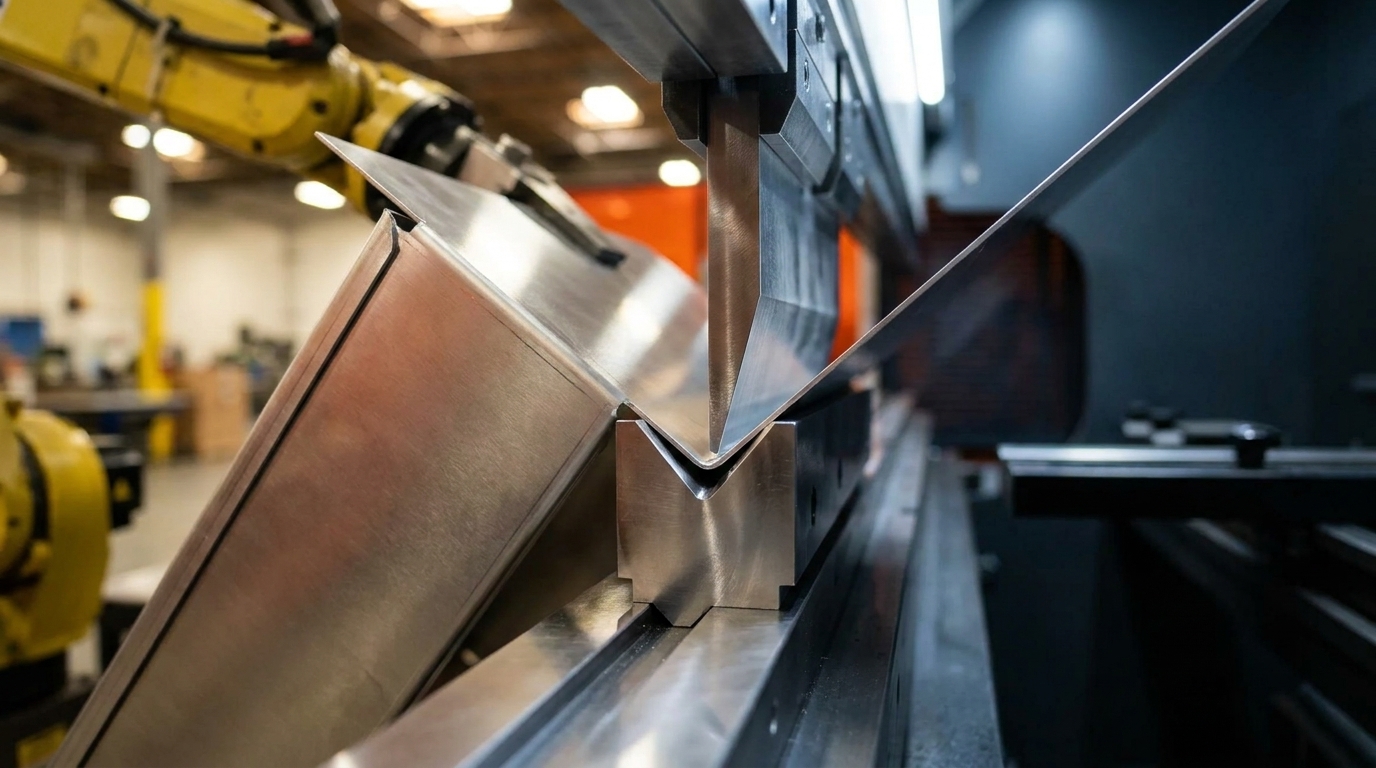
Minimum bend radius requirements vary by material and thickness to prevent cracking. The recommended minimum bend radius for sheet metal is 1 × material thickness, though it can be as low as 0.5 × material thickness across the grain for alloys like aluminum 5052-H32. Stainless steel needs larger radii because of work-hardening characteristics. A common guideline sets inside radius equal to material thickness.
Beyond the bend itself, proper spacing between features ensures these radii can be achieved without distortion. Critical spacing requirements include a recommended minimum inside flange length for air bending on a press brake of 3× the material thickness and bend spacing ≥2× material thickness from holes. Where bends intersect, notch width should be sized to prevent overlapping material during forming. These spacing rules interact with grain direction, which affects how tightly material can bend. Bending perpendicular to grain allows tighter radii compared to parallel bending, so grain-aware designs can sometimes relax spacing needs.
Fabcon’s precision press brake operations and material expertise prevent cracking while maintaining tight tolerances across aluminum, stainless steel and carbon steel enclosures.
Material and thickness choices that support manufacturability
Material selection shapes formability, durability and sustainability in sheet metal enclosures. Aluminum sheets are increasingly selected for technical enclosures and heat sinks in data centers because they are durable, easy to clean and corrosion resistant. Aluminum’s strength-to-weight ratio and infinite recyclability make it well suited for electric vehicle battery enclosures and medical device housings.
Carbon steel is widely used because of its strength, cost-effectiveness and reliability in structural applications. However, electric vehicle manufacturers often need to balance these strength benefits against weight constraints, requiring sheet metal with enhanced strength-to-weight ratios, electrical compatibility and specialized forming capabilities for battery housing. Carbon steel’s work-hardening behavior also ties back to the larger bend radii discussed earlier, often in the 1× to 1.5× thickness range depending on grade.
Sustainability trends favor recyclable alloys and advanced coatings. Demand continues to rise for pre-anodized or coated aluminum sheets for electrical enclosures and control panels in corrosive environments. Fabcon’s material expertise matches alloy selection to application requirements and supports sustainability goals through efficient processing and waste reduction.
Hole, feature and tolerance guidelines for clean forming
Proper hole sizing and placement prevent distortion during forming operations. The rule of thumb for perforating carbon steel and aluminum is that the minimum hole diameter should equal or exceed the material thickness. Edge distance guidelines include ≥1.5× material thickness from sheet edges and ≥2× material thickness from bend tangent lines.
Hole-to-hole tolerances support PEM fasteners or alignment. For tight tolerances, increase hole edge to bend distance beyond the 2× minimum to maintain dimensional accuracy. These tolerance requirements become easier to maintain when designs use standardized features.
Cutout standardization improves manufacturability by using common tooling. Features like keystone and D-sub cutouts benefit from standardized dimensions across product lines. Fabcon’s CNC punching and laser cutting capabilities support precise hole placement and consistent tolerances for reliable assembly fits.
Design for assembly strategies in sheet metal enclosures
Assembly-focused design reduces manufacturing complexity and improves product reliability. Access planning covers clearance for hardware installation, wire routing and maintenance operations. Modular design approaches support efficient assembly sequences and simplified field service.
Hemmed edges remove sharp edges and add structural stiffness. Slot-and-tab assemblies reduce welding time, improve dimensional consistency and shorten lead times compared to traditional fixturing. Self-clinching fasteners provide strong, clean hardware installation when located away from bend lines.
Finishing integration shapes assembly sequence and fit. Powder coating thickness must be considered in mating surfaces and threaded features. Fabcon’s integrated finishing and light electromechanical assembly capabilities bridge the gap between fabrication shops and large contract manufacturers and provide complete enclosure solutions under one roof.
Sheet metal DFM quick checklist for enclosure reviews
Essential DFM verification points for sheet metal enclosures:
- Verify minimum bend radius (1× thickness, or 0.5× across grain for soft aluminum)
- Confirm holes ≥2× material thickness from bend lines
- Check minimum inside flange length for air bending (3× thickness)
- Ensure hole diameter ≥ material thickness
- Validate edge distance ≥1.5× material thickness
- Standardize hole sizes and bend radii across assemblies
- Plan assembly access for hardware and wiring
- Account for grain direction on critical bends
- Add bend relief at intersecting bends
- Review tolerance requirements for functionality
Fabcon applies this checklist during design reviews to improve manufacturability before production begins. Contact Fabcon for a detailed DFM analysis and manufacturing quote.
Common DFM pitfalls and practical fixes
Frequent DFM errors include insufficient bend radii that cause cracks, poor hole placement that leads to distortion and missing bend relief at intersections. Incorrect bend calculations due to improper K-factor cause misaligned mounting holes and parts that cannot assemble. Placing holes too close to bend lines causes distortion, oval holes and misaligned fasteners after forming.
Tolerance specification errors can increase inspection requirements and costs. Overly tight tolerances can require more intensive inspection, which raises costs, queue time and labor. Beyond tolerance issues, material selection mismatches create a different category of problem and cause formability issues or inadequate strength for load-bearing applications.
Fabcon’s engineering team identifies and resolves these common pitfalls during the design phase and prevents costly rework and production delays. The integrated approach optimizes data center enclosures for thermal management while maintaining structural integrity and assembly efficiency.
Frequently asked questions about sheet metal DFM
What is a sheet metal DFM checklist and why is it important?
A sheet metal DFM checklist is a systematic verification tool that confirms designs can be manufactured efficiently without defects or rework. It covers critical aspects like bend radii, hole placement, material selection and assembly considerations. The checklist prevents common errors such as cracking from tight bends, hole distortion from improper placement and assembly issues from inadequate access. Using a comprehensive DFM checklist reduces prototype iterations, shortens development cycles and improves product quality while controlling manufacturing costs.
What are the minimum bend radius rules for different sheet metal materials?
Minimum bend radius varies by material type, thickness and temper condition. Aluminum 5052-H32 typically allows small multiples of material thickness. Harder 6061-T6 requires larger multiples that depend on grain direction. Stainless steel 304 and 316 need larger multiples because of work-hardening characteristics. Carbon steel generally permits thickness multiples for cold-rolled grades. Designers should avoid values below 1× material thickness without specific material testing. Grain direction significantly affects formability, and perpendicular bending allows tighter radii than parallel bending.
How do tolerance requirements affect sheet metal enclosure manufacturing?
Tolerance specifications directly affect manufacturing cost, inspection requirements and production speed. Typical overall tolerances support general dimensions. Hole-to-hole tolerances support critical alignments. Overly tight tolerances can require more intensive inspection, specialized tooling and increased setup time. Door and panel gaps target proper fit and gasket compression. Functional tolerances should apply only where assembly, sealing or performance requires precision, while noncritical dimensions can use standard shop tolerances.
How does Fabcon’s approach differ from typical job shops for sheet metal enclosures?
Fabcon provides vertically integrated manufacturing that combines design support, precision fabrication, finishing and light electromechanical assembly under one roof. Unlike basic job shops that handle only build-to-print fabrication, Fabcon offers early DFM collaboration, integrated powder coating, hardware insertion and wiring capabilities. This structure removes vendor handoffs, reduces supply chain complexity and improves quality control. The 220,000 square feet of manufacturing space and ISO 9001:2015/AS9100D certifications provide infrastructure and quality systems that small shops cannot match while maintaining the agility that large contract manufacturers lack.
What are the benefits of vertical integration for sheet metal enclosure projects?
Vertical integration removes coordination delays between multiple vendors, reduces quality finger-pointing and accelerates project timelines. Single-source accountability means one purchase order, one quality system and one point of contact for the entire project. Integrated finishing prevents coating compatibility issues and supports proper masking of threaded features. In-house assembly capabilities enable complete testing and validation before shipment. This approach particularly benefits complex enclosures that require precise fits, EMI shielding and thermal management where system-level integration is critical for performance.
Comprehensive sheet metal DFM guidelines prevent costly design errors and accelerate product development in demanding applications. Fabcon’s vertically integrated approach combines decades of fabrication expertise with modern manufacturing capabilities to deliver refined enclosure solutions. Partner with Fabcon for DFM-optimized sheet metal enclosures and request a free design review and quote today.