
Last updated: April 17, 2026
Key Takeaways
- Use a minimum bend radius of 1T for mild steel and 2T to 5T for high-strength aluminum to prevent cracking and distortion.
- Keep holes at least 2T from bends, and punch holes after forming when you need very tight spacing to protect accuracy.
- Choose 5052-H32 aluminum for highly formable prototypes and low-volume runs, or 6061-T6 when the design needs higher strength.
- Maintain uniform thickness, provide flange lengths of at least 4T, and use realistic tolerances such as ±0.015″ for bend-to-hole positioning.
- Partner with Fabcon for a free DFM audit that refines designs, cuts cost, and speeds time-to-market with vertically integrated manufacturing.
Core Sheet Metal DFM Rules You Can Check Before Quoting
Use this table to confirm your design meets basic sheet metal DFM rules before you request a quote. The Fabcon Tip column shows how our process capabilities handle edge cases when standard rules feel too restrictive.
| Rule | Specification | Reason | Fabcon Tip |
|---|---|---|---|
| Bend Radius | For steel sheet metal, bend radius R can be smaller than material thickness T, though it increases the risk of cracking, while high-strength alloys require larger radii | Prevents cracking | Our CNC forming runs especially well with 5052 aluminum |
| Holes from Bend | ≥2T | Avoids distortion | Punch after forming when spacing must be tight |
| Uniform Thickness | Maintain consistent thickness | Reduces distortion risk | Design parts that suit our laser nesting patterns |
| Minimum Hole Diameter | ≥ T | Prevents tool breakage | We stock standard punch sizes |
| Flange Length | Long enough for die opening | Provides secure support during bending | Minimum 4T for our tooling |
| Bend Angle Tolerance | ±1° standard, ±0.5° precision | Reflects manufacturing capability limits | CNC sensors help compensate springback |
Material Selection for Sheet Metal DFM
Material selection shapes manufacturability, cost, and long-term performance. 5052-H32 aluminum offers superior ductility and formability for prototype and low-volume production, while 6061-T6 provides higher strength but needs larger bend radii to prevent cracking. Steel remains a cost-effective choice for structural parts, and mild steel can use a minimum bend radius of 1T. Stainless steel 304 and 316 improve corrosion resistance but require close control of work hardening during forming.
The table below maps common steel gauges to actual thickness and typical use cases. Use it to choose the lightest gauge that still meets your structural needs, because thinner material lowers both material cost and forming effort.
| Material | Gauge | Thickness (mm) | Fabcon Recommendation |
|---|---|---|---|
| Steel | 14 | 1.897 | Heavy-duty structural parts |
| Steel | 16 | 1.519 | Standard enclosure bodies |
| Steel | 18 | 1.214 | Covers and internal brackets |
| Aluminum 5052 | Various | varies | EV enclosures and medical carts |
Fabcon’s in-house material specialists help you match alloys to real applications, from corrosion-resistant data center racks to biocompatible medical components.
Sheet Metal Bending DFM Rules
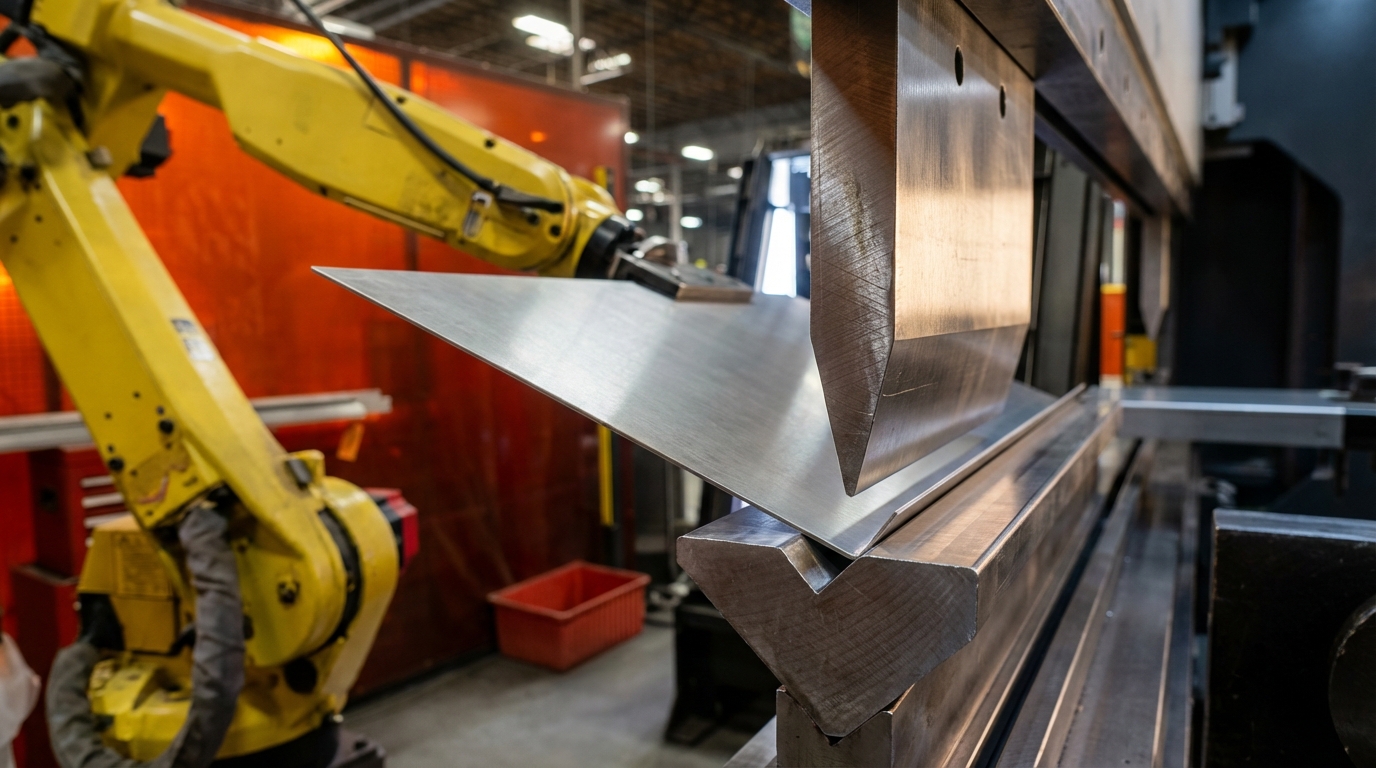
Correct bend design protects parts from cracking and keeps dimensions within tolerance. Minimum bend radius for mild steel sheet metal varies by thickness: 0.8T (0.5-1mm), 1T (1-3mm), 1-1.5T (3-6mm), 1.5-2T (6-12mm), while high-strength aluminum alloys like 2024-T3 require minimum bend radii of approximately 2.8T to 5T depending on sheet thickness for maximum strength in aerospace applications to avoid micro-cracks that cause fatigue failure. Bend relief cuts at corners further reduce the chance of tearing.
Uniform thickness throughout the part is critical, because thickness changes create unpredictable springback and dimensional variation. Even with consistent thickness, springback still occurs and needs compensation through overbending or CNC machines with sensors. Accurate springback control depends on K-factor calculations for flat pattern development that reflect material properties and bend radius, so the unfolded dimensions match the formed part.
Fabcon recently improved an EV charging station enclosure where the original design specified a 0.5T bend radius in 6061-T6 aluminum. Our engineering team recommended a 2T radius and updated the flat pattern, which removed cracking issues seen with the previous supplier and cut prototype iterations by 60%.
Holes, Slots, and Feature Placement Guidelines
Thoughtful feature placement around bends protects holes and slots from distortion during forming. Minimum distance from bend to holes is ≥2T to avoid deformation during bending. Slots also need enough distance from bends so edges do not warp during forming.
When tight spacing cannot be avoided, punch holes after forming to maintain accuracy, especially in deep-drawn parts where material flow can shift hole locations. Beyond bend-to-hole spacing, you also need adequate edge-to-hole distance to prevent edge bulging and enough hole-to-hole spacing to prevent material creep between features.
Fabcon’s integrated CNC punching and forming capabilities support flexible sequencing, so we can punch holes before or after forming based on your dimensional needs while still protecting manufacturability and precision. Discuss your feature placement challenges with our engineering team to determine the best sequence for your design.
Tolerances and Flat Pattern Best Practices
Realistic tolerances balance functional needs with cost and process capability. Standard bend-to-hole position tolerance is ±0.381 mm (±0.015 inches), and bend length tolerances typically achieve ±0.38 mm (±0.015 inches) per bend. Quality punching equipment holds tight hole diameter tolerances, while tighter overall tolerances may require secondary operations or higher-cost processes.
Flat pattern development must reflect material behavior, bend sequence, and tooling limits. Sharp or zero-radius internal bends should be avoided by ensuring sufficient flange length and space between features so the flat pattern stays stable during forming.
For data center rack hardware, Fabcon holds ±0.005-inch tolerances on critical mounting features through careful flat pattern calculation and CNC forming with real-time feedback. Our quality systems keep results consistent across production runs, which supports reliable rack-and-stack performance in hyperscale deployments.
Integrating DFM with Assembly, Finishing, and Scaling
Modern sheet metal DFM now covers how parts assemble, how they are finished, and how they scale in production. Fabcon’s vertically integrated model combines laser cutting, CNC forming, powder coating, and electromechanical assembly in one facility, which removes vendor handoffs that often create delays and quality issues.
Assembly-focused design considers hardware access, wire routing paths, and thermal management from the start. Parts intended for automated assembly need consistent orientation features and clearances that support robotic handling. Finishing choices such as powder coating, wet paint, or specialty coatings also affect early design decisions, including material selection and feature layout.
Sustainability now influences many DFM choices. Designs that use standard dimensions and locally available materials shorten lead times and support reshoring. Aluminum’s high recyclability supports sustainability goals without sacrificing performance.
A recent medical device program shows how this integrated approach works in practice. Fabcon collaborated with the customer to adjust bend locations for internal wiring harnesses and to define efficient hardware insertion sequences, which cut assembly time by 40% while still meeting strict medical device quality standards.
Sheet Metal DFM Checklist and Free Download
A practical sheet metal DFM checklist covers minimum bend radius by material and thickness, hole-to-bend spacing of at least 2T, uniform material thickness, adequate flange lengths, and proper bend relief design. It also includes realistic tolerance targets, assembly access, finishing compatibility, application-specific material selection, flat pattern verification, tooling constraints, and sustainability considerations.
Download Fabcon’s DFM checklist PDF for detailed guidelines, material tables, and real project examples from more than 45 years of precision fabrication. The checklist includes focused notes for data center, medical, EV, and energy applications.
Why Fabcon Is a Strong DFM Partner
Fabcon’s 220,000 square feet of vertically integrated U.S. manufacturing combines more than 45 years of experience with ISO 9001:2015 and AS9100D certifications. Our engineering team engages early in the design cycle and flags potential problems before they become expensive changes. Like IGT’s 40% cost reduction through DFM analysis, Fabcon customers often see meaningful savings from proactive design refinement.
Unlike job shops that focus only on basic fabrication or large contract manufacturers with rigid minimums, Fabcon offers advanced infrastructure with the agility to support evolving programs from prototype through mid-volume production. Experience the integrated manufacturing difference on your next project.
Frequently Asked Questions
What is the minimum bend radius for sheet metal?
Minimum bend radius depends on both material type and thickness. For mild steel, use the thickness-based guidelines discussed earlier, which range from about 0.8T for thin sheets to around 2T for thicker material. High-strength aluminum alloys like 2024-T3 require larger radii, typically 2.8T to 5T for aerospace-grade material. Stainless steel usually needs larger radii because of work hardening. Always review material data and consider fatigue requirements when you choose a bend radius.
How far should holes be placed from bends in sheet metal?
Hole placement rules scale with material thickness. As discussed in the feature placement section, keep at least 2T between holes and bends. If your design needs closer spacing, consider punching holes after forming to protect dimensional accuracy.
What tolerances are achievable in sheet metal fabrication?
Standard tolerances include ±1° for bend angles, or ±0.5° for precision work, and about ±0.015 inches for bend-to-hole positioning and per-bend length, as outlined in the tolerances section above. Quality tooling supports these length tolerances, and good punching equipment maintains tight hole diameters. Tighter tolerances are possible but may require extra operations and higher cost.
How does DFM reduce sheet metal fabrication costs?
DFM reduces cost by preventing design-related rework, improving material usage, and simplifying manufacturing steps. Correct bend radius choices avoid cracked parts and scrap, while proper hole placement reduces secondary operations. Material standardization lowers inventory and shortens lead times. Early DFM collaboration often delivers large savings compared with designs that need heavy modification during production.
What is the best aluminum alloy for sheet metal fabrication?
5052-H32 aluminum provides a strong balance of formability, strength, and availability for most sheet metal work. It handles tighter bends than 6061-T6 and is widely stocked in sheet form. For higher strength, 6061-T6 performs well with larger bend radii, while 7075 offers maximum strength with limited formability and higher cost. Match the alloy to your strength, formability, and corrosion resistance needs.
Applying sound sheet metal DFM principles from the beginning prevents costly redesigns and supports manufacturable parts that scale smoothly from prototype to production. Fabcon’s integrated model combines deep fabrication experience with modern quality systems to deliver precise parts that meet both specification and schedule. Request your free DFM review and quote today.