
Key Takeaways
- Keep material thickness uniform and use a minimum bend radius of at least 1× thickness to prevent cracking and simplify tooling.
- Place holes at least 2× thickness from bends and 1× thickness from edges to avoid tearing during forming.
- Design flanges at least 4× thickness and include bend reliefs of 0.5-1× thickness for reliable corner forming.
- Use standard ISO 2768 tolerances and common hole sizes to cut manufacturing costs by 20-30% without losing functionality.
- Partner with Fabcon for integrated DFM review to refine sheet metal designs and speed up time-to-market.
Core Sheet Metal DFM Rules for Reliable Parts
Seven practical rules guide effective sheet metal design for manufacturability and consistent production quality.
- Uniform thickness: Keep material thickness consistent across the part to simplify tooling and reduce cost.
- Minimum bend radius: Use a bend radius at least 1 × material thickness for most ductile metals.
- Proper hole spacing: Place holes at least 2 × thickness from edges and bends to prevent tearing.
- Adequate flange length: Design flanges at least 4 × thickness for consistent forming.
- Bend relief requirements: Add reliefs 0.5-1 × thickness to prevent cracking at corners.
- Hem edge design: Use hem geometry that supports strength, safety, and appearance.
- Standard hole sizes: Choose common drill sizes and punches to keep tooling costs low.
|
Material |
Thickness Range |
Min Bend Radius |
Notes |
|
Mild Steel |
1-6mm |
≥ 1 × T |
Standard ductility |
|
Aluminum |
1-6mm |
≥ 1.5 × T |
Higher radius prevents cracking |
|
Stainless Steel |
1-6mm |
≥ 1.5-2 × T |
Work hardening material |
Fabcon’s engineering team joins early in the design process to set these parameters correctly. This integrated approach removes the coordination headaches that come with separate vendors for fabrication, finishing, and assembly.
Preventing Cracking With Smart Bend Design
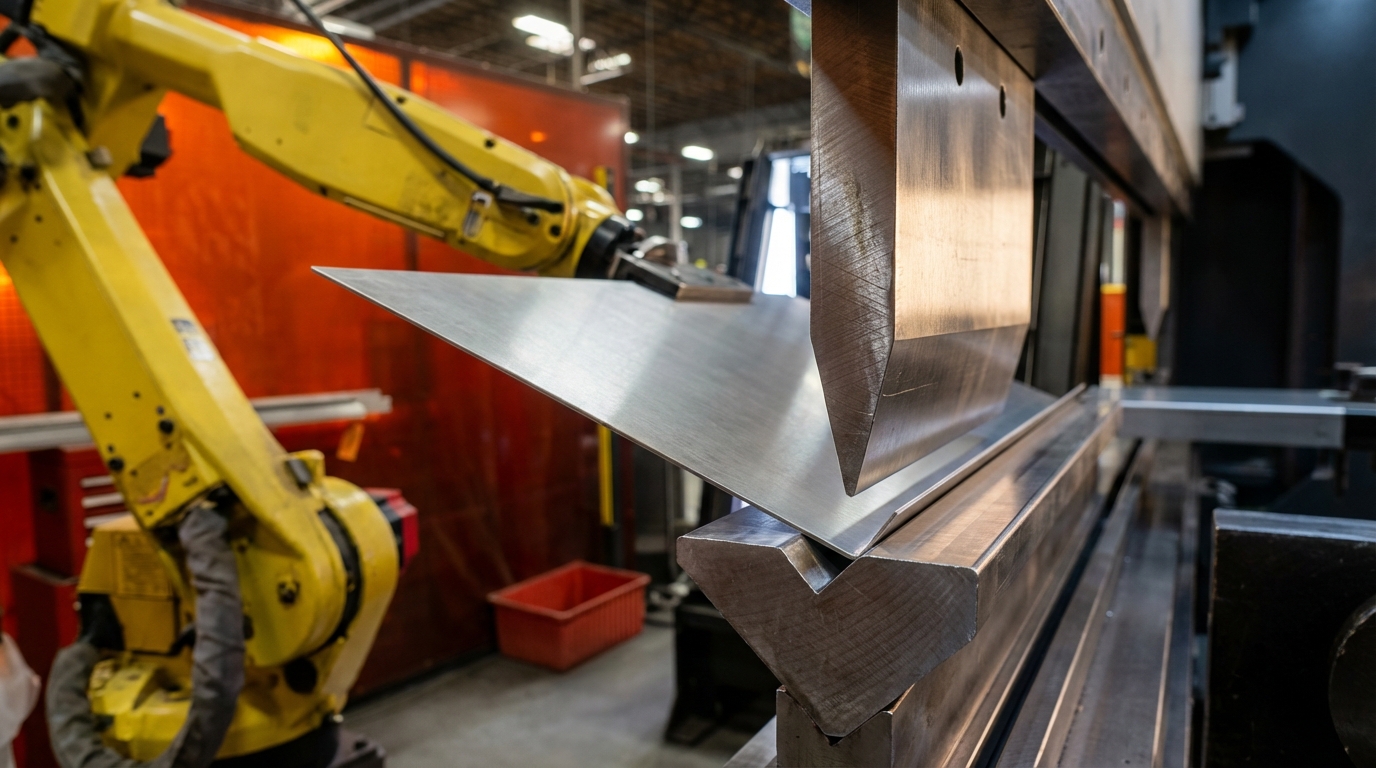
Set the minimum inside bend radius at least equal to material thickness to reduce cracking risk. Material grain direction strongly affects bend quality, so orient critical bends perpendicular to the grain whenever possible. Keep minimum flange lengths at 3-4 times material thickness to support proper forming without distortion.
Well-designed bend reliefs stop tearing at corners where bends intersect. Size reliefs at 0.5-1 times material thickness and extend them slightly beyond the bend radius. For parts with multiple bends, plan the bend sequence carefully to control spring-back and maintain dimensional accuracy.
|
Feature |
Standard Tolerance |
Thick Gauge |
Fabcon Achievable |
|
Bend Angles |
±1.0° |
±1.5° |
±0.5° |
|
Bend Location |
±0.25mm |
±0.5mm |
±0.13mm |
|
Flange Length |
±0.3mm |
±0.5mm |
±0.2mm |
Common issues include tight bends in thick material, ignoring grain direction, and using little or no bend relief. Fabcon’s press brake capabilities and routing strategies deliver consistent bend quality across both prototypes and production runs. Contact our engineering team for DFM analysis on bend-intensive designs.
Placing Holes, Slots, and Features Without Distortion
Keep holes at least 2 times thickness from bends and 1 times thickness from edges to avoid distortion during punching and forming. Slots and cutouts need more room, so place slots at least 3 times their width away from bends.
Five placement errors often cause scrap and rework.
- Holes too close to bend lines that create tears
- Edge distance too small, which leads to material pullout
- Overlapping punch operations that cause tool interference
- Non-standard hole sizes that drive up tooling costs
- Poor slot orientation that increases material waste
Design tabs and slots with assembly in mind and keep clearances suitable for hardware and wiring. Fabcon’s laser cutting and CNC punching capabilities support precise assemblies for data center hardware and EV infrastructure systems.
Using Tolerances and Standards to Cut Cost
ISO 2768-1 defines general tolerances, with medium class (m) at ±0.1mm for 0.5-3mm and ±0.2mm for 6-30mm features. Using these standard tolerances reduces manufacturing complexity and can lower costs by 20-30% compared to custom callouts.
|
Feature Type |
Standard Tolerance |
Precision Option |
Notes |
|
Hole Diameter |
±0.13mm |
±0.05mm |
Laser cut precision |
|
Bend Angles |
±1.0° |
±0.5° |
Press brake control |
|
Overall Length |
±0.25mm |
±0.13mm |
Depends on size |
Avoid tight tolerances on features that do not need precision, since they add cost and extend lead time. Fabcon’s combined machining and assembly capabilities keep chassis components aligned during final assembly and remove the field modifications that often appear with fragmented supply chains.
Designing Sheet Metal for Fast, Clean Assembly
Designing assembly features directly into sheet metal parts removes many secondary operations. Add tabs, slots, and mounting features during initial fabrication instead of later rework. Leave enough clearance for hardware installation, wiring paths, and service access.
Electromechanical needs work best when considered early in the design. Plan wire routing, connector locations, and airflow or cooling paths before locking the enclosure. Fabcon’s single-facility model, which combines fabrication, finishing, and light assembly, supports complex enclosures for EV charging and data center systems.
This integrated capability sets Fabcon apart from job shops that only cut and bend metal and from large contract manufacturers that struggle with fast design changes. Flexible production cells adapt to changing BOMs and volume shifts without the overhead of global CMs. Get a quote for integrated sheet metal builds that combine mechanical and electrical content.
DFM Pitfalls to Avoid and a Quick Checklist
Five frequent DFM mistakes appear across many sheet metal programs, and each has a straightforward fix.
- Ignoring grain direction: Keep critical bends perpendicular to the rolling direction.
- Over-tolerancing features: Reserve tight tolerances for features that truly need them.
- Insufficient bend relief: Add reliefs sized to prevent corner cracking.
- Poor hole placement: Respect minimum distances from edges and bends.
- Complex assembly sequences: Design parts for simple, logical assembly steps.
Sheet Metal DFM Checklist:
- Verify minimum bend radius for each material and thickness.
- Check hole spacing from edges and bends.
- Confirm flange lengths support forming.
- Add bend reliefs at all corner intersections.
- Standardize hole sizes and tolerances where possible.
- Plan assembly sequence and hardware access.
- Account for finishing and coating requirements.
- Review material grain orientation on critical bends.
Conclusion: Turning DFM Rules Into Faster Launches
Applying these sheet metal DFM rules reduces rework, scrap, and schedule risk. Early collaboration with experienced partners like Fabcon shapes designs for efficient production while protecting quality and function.
Fabcon’s 45+ years of precision fabrication experience, backed by ISO 9001:2015 and AS9100D certifications, supports reliable execution from prototype through full production. Contact Fabcon for a free DFM review and fast quoting, your U.S. partner for dependable sheet metal parts that support demanding infrastructure and technology programs. Get a quote today and see how thoughtful design choices cut cost and improve time-to-market.
Frequently Asked Questions
Minimum Bend Radius by Sheet Metal Material
The minimum bend radius depends on both material and thickness. For mild steel, use a bend radius equal to or greater than the material thickness (≥1×T). Aluminum needs a slightly larger radius of 1.5 times the thickness (≥1.5×T) because it tends to crack with tight bends. Stainless steel, which work hardens, typically requires 1.5-2 times the thickness (≥1.5-2×T) to avoid cracking. These values support reliable forming without material failure, and slightly larger radii often improve manufacturability and reduce tooling wear.
Guidelines for Hole Spacing From Bends and Edges
Proper hole spacing protects the material during punching and forming. Place holes at least 2 times the material thickness away from bend lines and 1 times the thickness from sheared edges. For a 2mm thick steel part, this means holes at a minimum of 4mm from bends and 2mm from edges. Countersinks need more room, so keep them at least 3 times the thickness from bends and 4 times the thickness from edges. These rules support clean hole formation and reduce the chance of pullout or distortion.
Choosing Sheet Metal Tolerances for Cost and Function
Standard tolerances based on ISO 2768 medium class usually give the best balance between cost and performance. For linear dimensions, use ±0.1mm for features 0.5-3mm, ±0.2mm for 6-30mm features, and ±0.3mm for 30-120mm dimensions. Bend angles typically hold ±1.0° with standard tooling, and hole diameters often achieve ±0.13mm with laser cutting or punching. Reserve tighter tolerances for features that directly affect function, since precision requirements raise manufacturing costs. Over-tolerancing non-critical features remains a common source of unnecessary expense.
Designing Bend Reliefs to Protect Corners
Well-sized bend reliefs protect corners where multiple bends intersect by reducing stress. Create reliefs 0.5-1 times the material thickness in width and extend them slightly beyond the point where bend radii intersect. Set the relief depth so it reaches 1-2 times the material thickness beyond the bend line intersection. Common relief shapes include rectangular notches, round holes, and teardrop profiles. Without these features, stress concentrations at corners can cause cracking during forming, especially in thicker stock or work-hardening alloys such as stainless steel.
Key Factors for Integrating Assembly Features
Successful assembly integration starts with planning mounting features, access, and clearances early in the design. Add tabs, slots, and mounting holes as part of the primary fabrication process instead of later secondary work. Leave 1.5-2 times the fastener diameter for wrench or driver access around hardware. Plan wire routing with smooth paths and suitable bend radii to protect cables. Consider thermal expansion, vibration, and service access when placing components. Design the assembly sequence so parts install in a logical order without interference between components or tools.