
Key Takeaways
- Precision sheet metal fabrication follows a 10-step process from CAD design and material selection through cutting, forming, welding, finishing and quality control to deliver high-quality assemblies.
- DFM best practices such as optimal bend radii, hole placement away from bends and standard material gauges prevent production issues and reduce costs.
- Material choices such as carbon steel, stainless steel and aluminum affect strength, corrosion resistance and manufacturability, and tolerances follow ISO 2768-m standards.
- Vertical integration removes multi-vendor handoffs, shortens lead times, improves quality consistency and supports agile scaling from prototypes to production.
- Fabcon’s ISO 9001:2015 and AS9100D certified facilities provide end-to-end solutions for aerospace, data centers and energy applications; get a quote today to streamline the next project.
How Fabcon’s 10-Step Sheet Metal Process Works
The precision sheet metal fabrication process follows a systematic 10-step approach that transforms raw materials into finished assemblies. Each stage builds on the previous one, so every handoff can affect lead time, cost and quality. Vertical integration reduces those risks by keeping the full sequence under one roof.
1. Design and CAD Development with DFM Integration
Engineers create detailed CAD models and apply Design for Manufacturability principles from the start. Early DFM collaboration identifies potential production issues and adjusts designs for cost-effective fabrication. Critical considerations include bend relief, hole spacing and material flow.
2. Material Selection and Sourcing
Material choice affects formability, strength and lead times. Selecting readily available options shortens lead times, and standard sheet metal gauges support consistent fabrication and repeatable quality.
3. Precision Cutting Operations
Laser cutting, CNC punching and shearing create accurate part geometries. Modern laser cutting and waterjet processes achieve tight tolerances. High-power fiber laser cutting machines enable faster cutting speeds, which supports shorter cycle times.
4. Forming and Bending
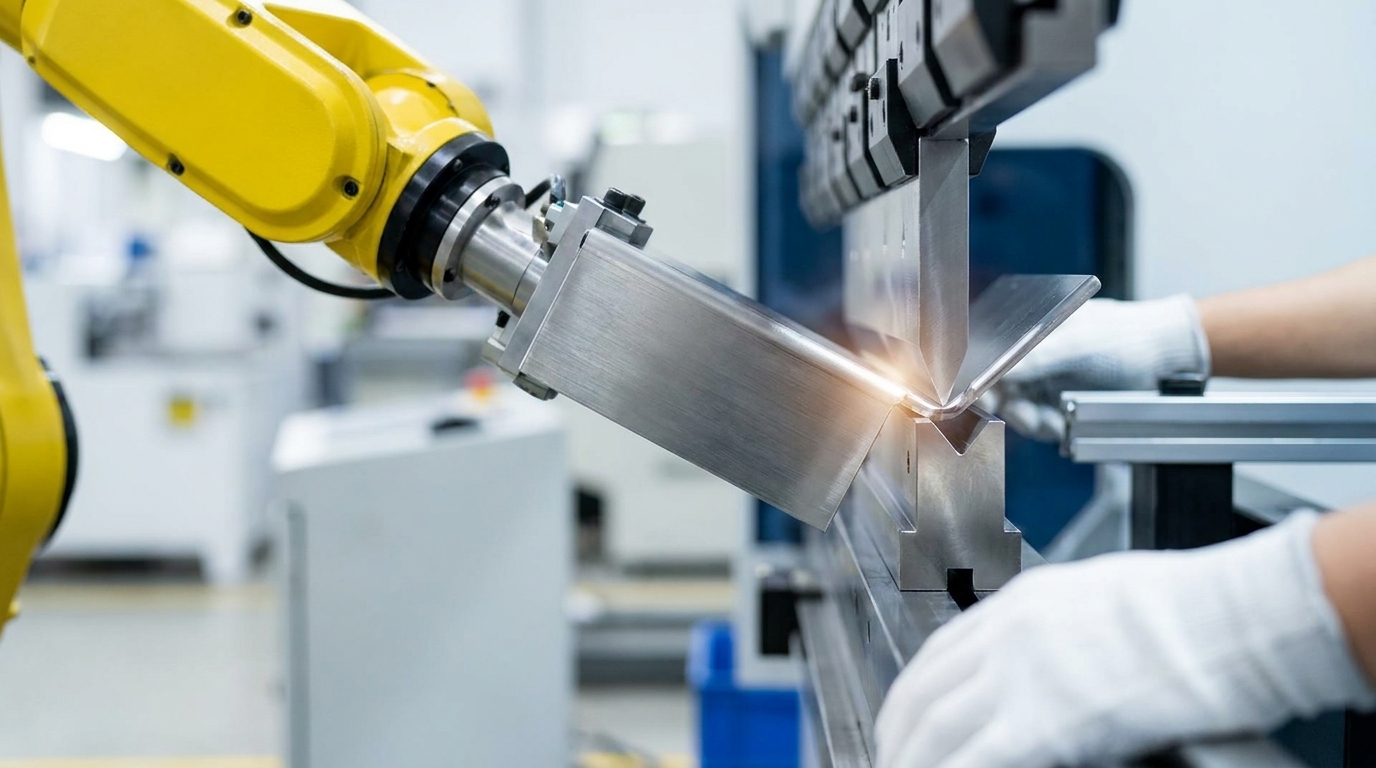
CNC press brakes shape flat patterns into three-dimensional parts. Springback compensation through overbending or adjusted tooling ensures precise final angles and consistent bend quality.
5. Joining and Welding
TIG, MIG and resistance welding join components into rigid assemblies. Proper fixturing controls distortion and protects dimensional accuracy. Interlocking tabs solve welding issues by holding parts in place and enhancing strength.
6. Secondary Machining and Hardware Integration
CNC machining adds threaded holes, counterbores and precision features that cutting and forming cannot provide alone. Hardware insertion installs fasteners, hinges and mounting components that complete mechanical assemblies and prepare parts for final build.
7. Surface Finishing
Powder coating, wet paint, anodizing and specialized coatings protect parts and meet appearance requirements. Powder coating adds thickness to surfaces, so designs must account for that added build on critical fits.
8. Electromechanical Assembly
Wiring, component integration and system-level assembly turn fabricated parts into functional products. This stage often involves coordination between multiple vendors in fragmented supply chains, which can slow programs when work is not integrated.
9. Quality Control and Testing
Dimensional inspection, functional testing and compliance verification confirm that parts meet specifications. In-process inspection technologies verify dimensional accuracy and part geometry and support consistent quality across batches.
10. Packaging and Fulfillment
Protective packaging and logistics coordination deliver finished products to end customers in usable condition. Integrated operations reduce shipping delays between fabrication and assembly stages and simplify scheduling.
Fabcon’s vertically integrated approach removes handoffs between these stages and reduces quality risks. Agile production cells adapt to changing volumes and evolving bills of material.
Material Choices and Tolerances that Drive Performance
Material selection impacts fabrication success because different applications require different balances of strength, weight and corrosion resistance. Carbon steel provides strong and cost-effective performance for structural components where weight has less impact. Stainless steel delivers corrosion resistance and durability for harsh or regulated environments. Aluminum offers lightweight and corrosion-resistant properties for applications where weight reduction matters.
Tolerance capabilities depend on process choice and material thickness. ISO 2768-m specifies general linear tolerances that guide many sheet metal designs. Turret punching and CNC punching achieve tight tolerances on holes and profiles when designs respect process limits.
Design for Manufacturability principles connect material selection and tolerance specification. Designing with standard sheet metal gauges improves manufacturability and supports consistent bending and cutting. Fabcon’s engineering team collaborates early to align material choices and tolerances with performance targets and practical production limits.
DFM Best Practices that Prevent Rework
Effective Design for Manufacturability prevents costly rework and production delays through structured design review. DFM connects material and tolerance decisions with bending, cutting and assembly methods so parts run smoothly from prototype through production.
Bend Design Guidelines
Maintain inside bend radii equal to or greater than material thickness to reduce cracking during forming. Keep bend radii consistent across parts to simplify tooling setups and shorten changeovers. Position holes away from bend lines to prevent distortion, since material stretches around the bend and can pull holes out of round.
Hole and Feature Placement
Maintain minimum hole diameter equal to material thickness. This guideline supports clean cutting, reduces thermal distortion and helps punching and laser processes hold size across the run.
Tolerance Management
Manage tolerances on features impacting fit and function instead of tightening every dimension. Monitor tolerance stack-ups throughout design and fabrication so accumulated variation stays within assembly limits and aligns with the ISO 2768-m framework.
Assembly Integration
Design parts for efficient assembly with clear hardware access and adequate clearances. Include necessary hardware and gaps for all connecting parts so final builds fit correctly and technicians can work without rework or modification.
Fabcon’s engineering team identifies these opportunities before production begins. DFM support reduces rework cycles and helps designs scale smoothly from prototype to production. Get a quote to apply these practices to upcoming projects.
Solving Supply Chain and Scaling Challenges with Integration
Fragmented supply chains create challenges for precision sheet metal fabrication programs. Managing separate vendors for cutting, forming, welding, finishing and assembly introduces coordination delays, quality variation and added cost. Traditional multi-vendor approaches require long procurement timelines and complex scheduling.
Vertical integration addresses these challenges by consolidating processes under one roof. Vertically integrated manufacturing shortens procurement timelines and simplifies communication. Domestic manufacturing enables manufacturing to order, reduced inventories and improved quality control, which supports responsive programs.
Scaling challenges appear when production volumes shift or product configurations change. Traditional job shops often lack infrastructure for volume scaling, while large contract manufacturers may require high minimums and rigid processes. Fabcon’s agile production cells provide flexibility to move from prototype quantities to mid-volume production without disruptive vendor changes.
Quality consistency improves when operations stay integrated. Pneumatic assembly tools deliver uniform force across production batches, which supports repeatable builds. Single-source accountability also simplifies problem solving when quality issues appear.
Where Fabcon’s Capabilities Deliver the Most Value
Precision sheet metal fabrication supports critical applications across infrastructure-intensive industries. Data center operators depend on modular enclosures with precise cooling integration and cable management systems. Aerospace manufacturers require components that meet AS9100D standards with full traceability and tight tolerances. Energy storage systems need weatherproof enclosures with integrated electromechanical assembly.
Fabcon’s ITAR-compliant facilities and AS9100D certification support defense and aerospace applications that demand strict quality control and documentation. ISO 9001:2015 certification maintains consistent processes across all industry segments. The combination of precision fabrication, integrated finishing and assembly streamlines complex programs that might otherwise require several vendors.
Recent projects highlight the advantages of this integrated model. Complex enclosures that require fabrication, powder coating, hardware insertion and wiring harness integration move faster through a single-source workflow than through traditional multi-vendor approaches. Get a quote to discuss how these capabilities align with specific industry requirements.
Frequently Asked Questions
What is precision sheet metal fabrication?
Precision sheet metal fabrication transforms flat metal sheets into complex three-dimensional parts and assemblies through cutting, forming, welding and finishing processes. The precision designation reflects tight tolerances, consistent quality and advanced manufacturing techniques that meet demanding specifications for aerospace, data center, energy and other critical applications. Modern precision fabrication combines CAD design, CNC automation and quality control systems to deliver repeatable results across production volumes.
How does DFM improve the precision sheet metal fabrication process?
Design for Manufacturability shapes part designs for efficient production before manufacturing begins. DFM collaboration between designers and fabricators identifies issues such as excessive springback, difficult weld access or tolerance stack-up problems early in the design phase. This proactive approach reduces rework cycles, limits material waste and supports smooth scaling from prototype to production. Effective DFM also considers tooling needs, setup efficiency and inspection access.
What are the benefits of vertical integration in sheet metal fabrication?
Vertical integration consolidates multiple manufacturing processes under one roof and removes handoffs between separate vendors for cutting, forming, welding, finishing and assembly. This structure can reduce lead times by weeks compared with fragmented supply chains and improve quality consistency through single-source accountability. Integrated operations also simplify project management through one purchase order and point of contact and support faster responses to design changes or urgent requirements.
How does Fabcon differ from typical job shops?
Traditional job shops often focus on basic sheet metal cutting and forming, while Fabcon provides comprehensive manufacturing solutions that include engineering support, precision machining, advanced finishing and electromechanical assembly. Integrated facilities totaling 220,000 square feet support complex projects that require multiple processes without external vendors. ISO 9001:2015 and AS9100D certifications also support quality standards that exceed typical job shop capabilities, particularly for aerospace, defense and other regulated industries.
What role do certifications like AS9100D play in precision fabrication?
AS9100D certification demonstrates adherence to aerospace industry quality standards that exceed general manufacturing requirements. This certification requires enhanced process controls, risk mitigation procedures, complete traceability and counterfeit parts prevention measures. For organizations in aerospace, defense and other critical industries, AS9100D certification provides confidence that suppliers can meet stringent quality and safety expectations and maintain detailed documentation for regulatory compliance and audits.
Why choose U.S. partners amid current reshoring trends?
Reshoring manufacturing to the United States reduces supply chain risks, improves communication and enables faster response times compared with overseas suppliers. Domestic partners provide stronger intellectual property protection, remove long shipping delays and currency fluctuations and support easier quality control and compliance oversight. U.S. manufacturers also adapt more quickly to design changes and urgent requirements while supporting domestic job creation and economic stability goals that many companies prioritize in sourcing strategies.
Conclusion
Successful precision sheet metal fabrication depends on clear control of each stage from design through delivery and on DFM practices that prevent delays and quality issues. The framework in this guide supports evaluation of manufacturing partners and refinement of designs for efficient production. Get a quote from Fabcon to explore how a vertically integrated approach and engineering expertise can streamline precision sheet metal fabrication requirements.