
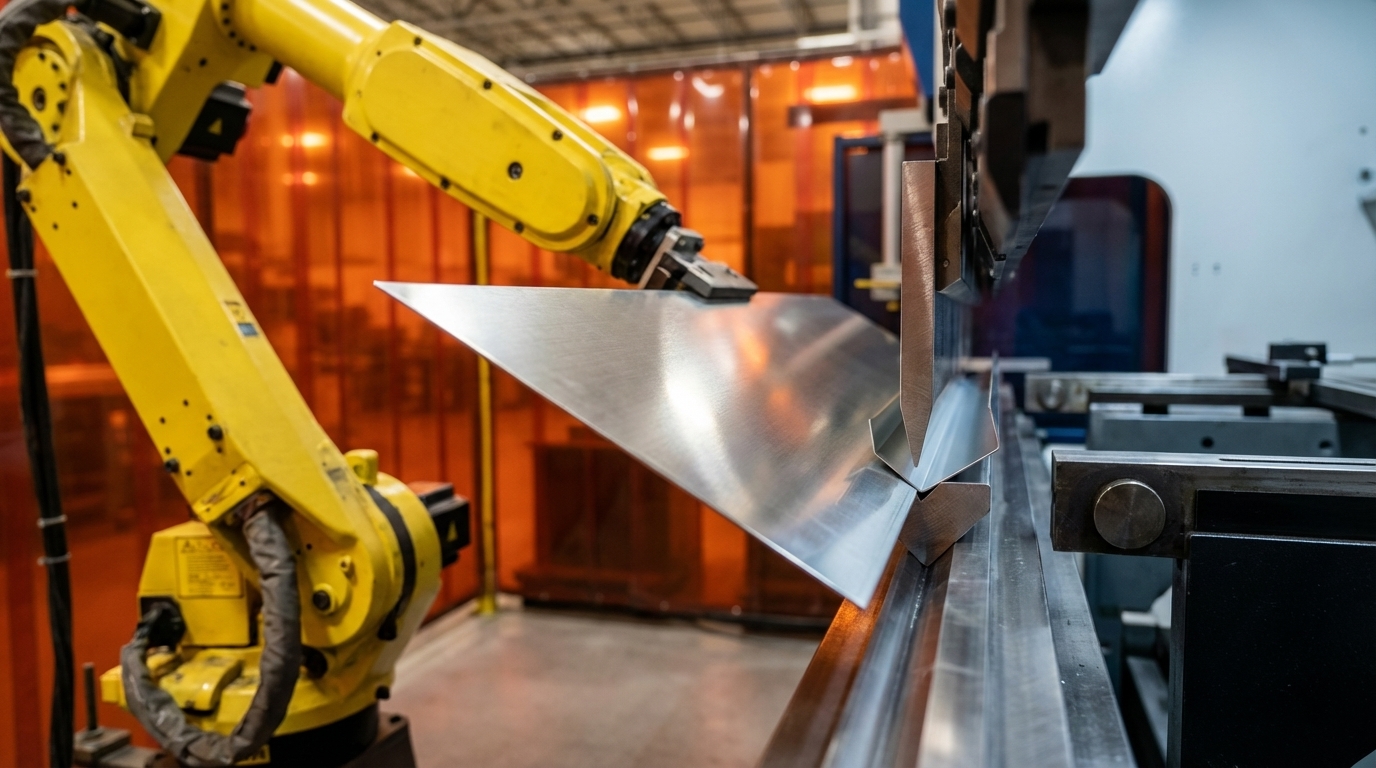
R ≥ 1T steel/0.5T aluminum, hole-edge ≥1.5T, stack-up ±0.005″ same-surface. Use these core formulas to create reliable prototypes that move smoothly from concept to full production.
Key Takeaways for 2026 Sheet Metal DFM
- Minimum bend radius of 1T for steel and 0.5T for aluminum prevents cracking and excessive springback.
- Hole-to-edge distance ≥1.5T and hole-to-hole ≥2T avoids deformation during cutting and punching.
- Same-surface tolerances reach ±0.005″ while across bends allow ±0.030″ to control stack-up.
- 2026 fiber-laser cutting delivers ±0.05mm precision, and AI-driven control can reduce scrap by about 30%.
- Working with Fabcon provides vertically integrated precision fabrication that supports every stage from prototype to production.
Guideline 1: Set Minimum Bend Radius by Material
R ≥ 1T for steel, R ≥ 0.5T for aluminum. Insufficient bend radius causes cracking, excessive springback, and tool wear. Inside radius should at least match material thickness to prevent cracking. The table below compares typical minimum bend radii by material so you can choose conservative values for each design, with stainless steel requiring the largest radius because of work hardening.
|
Material |
Min Radius |
Thickness (T) |
Notes |
|
Cold Rolled Steel |
1.0T |
0.5-3.0mm |
Standard tooling |
|
Aluminum 5052 |
0.5T |
1.0-2.5mm |
Higher springback |
|
Stainless 304 |
1.5T |
1.0-2.0mm |
Work hardening |
In data center rack enclosures, Fabcon tunes bend radii by material to hold about ±0.1mm dimensional accuracy on critical features.
Guideline 2: Protect Holes with Proper Edge Distances
Hole-to-edge ≥ 1.5T, hole-to-hole ≥ 2T. Tight spacing causes deformation during punching or laser cutting. Placing holes at least two times material thickness from bend locations helps prevent oval distortion. The table below compares standard and precision tolerances for common feature relationships so you can match spacing and process choice to the accuracy your design needs.
|
Feature |
Standard Tolerance |
Precision Tolerance |
Process |
|
Hole-to-edge |
±0.005″ |
±0.002″ |
Laser/Punch |
|
Hole-to-hole |
±0.005″ |
±0.002″ |
Same surface |
|
Hole-to-bend |
±0.010″ |
±0.005″ |
Formed edge |
Precise hole patterns in Fabcon’s EV charging enclosures support airflow and cable routing while preserving panel strength.
Guideline 3: Control Tolerances and Stack-Up
±0.005″ same-surface, ±0.030″ across bends. Same-surface features can hold about ±0.005″ with punch press or laser equipment. Bend-to-bend tolerance often reaches ±0.02″ with about ±0.03″ maximum cumulative. The table summarizes how feature type affects achievable tolerance and stack-up risk.
|
Feature Type |
Standard Tol |
Precision Tol |
Stack-Up Impact |
|
Same surface |
±0.005″ |
±0.002″ |
Minimal |
|
Across 1 bend |
±0.010″ |
±0.005″ |
Material stretch |
|
Across 2+ bends |
±0.030″ |
±0.015″ |
Cumulative error |
Fabcon uses structured stack-up analysis and fixture-based assembly on medical device enclosures to keep critical dimensions within tolerance while avoiding over-specification.
Guideline 4: Align Bends with Material Grain Direction
Bend perpendicular to grain direction. Orient bends across the grain, not parallel, to reduce snapping risk. This orientation matters because the rolling direction that forms the grain also affects formability and surface finish, so bending parallel to the grain concentrates stress along existing weaknesses.
Fabcon’s ISO 9001:2015 and AS9100D certified processes control grain orientation for aerospace and medical parts that demand high reliability. Request a quote for your aerospace or medical project.
Guideline 5: Use Bend Relief and Springback Compensation
Relief cuts at flange intersections prevent tearing. Small rectangular or circular bend reliefs stop tearing when bending along flat edges. Springback varies by material, so aluminum often needs 1–2° of overbend to reach the final angle.
|
Material |
Springback |
Compensation |
Relief Size |
|
Mild Steel |
0.5-1° |
Standard |
1.5T × 1.5T |
|
Aluminum |
1-2° |
Higher |
2T × 2T |
|
Stainless |
2-3° |
Maximum |
2T × 3T |
Guideline 6: Keep Embossing Depth Within Limits
Emboss depth ≤ 0.5T maximum. Excessive depth thins the material and can cause cracking. Laser-assisted embossing with digital pattern control supports very fine detail on complex shapes while staying within safe forming limits.
|
Thickness |
Max Depth |
Min Radius |
Applications |
|
1.0mm |
0.5mm |
0.5mm |
Labels, logos |
|
2.0mm |
1.0mm |
1.0mm |
Stiffening |
|
3.0mm |
1.5mm |
1.5mm |
Structural |
Guideline 7: Design Stiffening Ribs for Flatness
Rib height 3–4T, spacing set by panel span. Small ribs, folded edges, or shallow embosses increase stiffness and reduce oil-canning on wide panels. Well-placed ribs cut vibration and help panels stay flat over time.
|
Panel Span |
Rib Height |
Spacing |
Thickness |
|
200mm |
6mm |
50mm |
2.0mm |
|
400mm |
9mm |
80mm |
2.5mm |
|
600mm |
12mm |
100mm |
3.0mm |
Guideline 8: Integrate Welding into DFM Early
Use intermittent welds and plan robotic access paths. Robotic welding can cut labor costs by 40–60% compared to manual welding. Within a robotic approach, intermittent welds often reduce costs by another 30–50% when the structure allows, because the robot spends less time on each joint.
Fabcon’s vertically integrated welding operations control distortion and quality across complex assemblies. Our ISO/AS9100D certified team applies welding-focused DFM, so you can discuss your welding requirements with our engineering team.
Guideline 9: Plan Hardware Insertion and Assembly
Use PEM fasteners to absorb tolerance variation. PEM floating fasteners provide about 0.030 inches of radial float, which works with the ±0.030″ cross-bend tolerance discussed earlier to manage stack-ups in welded enclosures. Standardizing PEM inserts gives durable threads and common screw sizes across your product line.
|
Insert Type |
Material |
Float |
Applications |
|
PEM Standoff |
Steel/SS |
0.030″ |
PCB mounting |
|
Floating Nut |
Steel |
0.030″ |
Panel joints |
|
Press Nut |
Steel |
Fixed |
High strength |
Guideline 10: Design with Finishing in Mind
Use ≥0.030″ thickness for tumbling. Stainless parts need at least 0.030 inches thickness for tumbling so they do not deform. Finishing often represents 15–30% of total fabrication cost, so planning finishes early protects both appearance and budget.
|
Process |
Min Thickness |
Lead Time |
Cost Impact |
|
Powder Coat |
0.020″ |
3-5 days |
15-20% |
|
Wet Paint |
0.025″ |
5-7 days |
20-25% |
|
Anodizing |
0.030″ |
7-10 days |
25-30% |
Guideline 11: Build for High-Mix, Scalable Production
Use standard gauges and agile manufacturing cells. Standard sheet gauges can cut material costs by 15–25% and improve lead time predictability. Automated laser cutting systems support quick setups and flexible production when BOMs change frequently.
Fabcon’s agile production cells handle high-mix, low-volume work without the constraints common in large contract manufacturers, so programs move from prototype to production on a single platform.
Guideline 12: Use 2026 AI and Laser Tolerance Advances
Target ±0.05mm fiber-laser tolerances with AI predictive control. Modern fiber lasers deliver faster cutting, cleaner edges, and tighter tolerances. AI-based predictive systems improve process precision and lower defect rates, especially when combined with digital twins.
|
Technology |
2025 Capability |
2026 Advance |
Impact |
|
Fiber Laser |
±0.1mm |
±0.05mm |
50% improvement |
|
AI Process Control |
Manual setup |
Predictive |
30% less scrap |
|
Digital Twins |
Limited |
Real-time |
Faster iteration |
Common DFM Questions for Precision Sheet Metal
Latest 2026 Laser Cutting Tolerances
Modern fiber-laser systems reach about ±0.05mm on thin to medium-thickness metals, which improves on 2025 capability by roughly 50%. This precision supports data center racks, EV enclosures, and medical housings without many secondary machining steps.
Practical Ways to Improve DFM for Enclosures
Focus on tolerance stack-up control with same-surface features at about ±0.005″. Reduce critical dimensions that cross bends, use floating hardware to absorb assembly variation, and design weld joints for robotic access. Correct grain orientation and bend relief help prevent cracking during forming.
Current Embossing Design Guidelines
Limit emboss depth to 0.5T, keep at least 0.5T radius, and space features so the sheet does not thin excessively. Laser-assisted embossing with digital control supports very fine detail while maintaining structural strength.
How Fabcon Shortens Lead Times
Fabcon’s 220,000 sq ft vertically integrated facilities combine fabrication, finishing, and assembly in one location, which removes vendor handoffs. Agile production cells adjust to changing volumes and SKUs, so programs scale from prototype to production without the rigidity of large CMs.
Tolerance Improvements from Early DFM
Early DFM collaboration often delivers 20–40% cost reduction and raises first-pass yield from about 85% to more than 98%. Rationalizing tolerances so standard values cover roughly 80% of dimensions can lower fabrication costs by 15–30% without affecting function.
Download Fabcon’s comprehensive DFM checklist and tolerance tables, and request your project consultation for precision sheet metal fabrication.
Conclusion: Turn DFM Guidelines into Production Results
These 12 guidelines create a practical framework for precision sheet metal fabrication in 2026:
- Minimum bend radius control protects material and tooling.
- Correct hole-to-edge spacing prevents deformation during cutting and punching.
- Thoughtful tolerance stack-up planning cuts rework by 30–50%.
- Advanced laser and AI capabilities support ±0.05mm precision.
- Integrated finishing and assembly keep production flow efficient.
Fabcon’s 220,000 sq ft vertically integrated facilities, ISO 9001:2015 and AS9100D certifications, and 45+ years of fabrication experience bring these principles into daily production. Work stays under one roof, which avoids fragmented job shops and the rigidity of large contract manufacturers. Proven programs with companies such as Traffix Systems and Jabil show consistent quality for data centers, EV infrastructure, and medical devices.
Partner with Fabcon for precision DFM that reduces cost, shortens time-to-market, and scales reliably.
Start your project today and experience the benefits of true vertical integration.