
Last updated: April 17, 2026
Key Takeaways
- Sheet metal DFM addresses bend radii, gauge uniformity, and hole spacing, which differ from plastic molding guidelines.
- Follow 10 proven steps from requirements assessment to production scaling for cost reductions up to 40% and faster lead times.
- Prioritize uniform material gauge, minimum 1x thickness bend radii, and embossed ribs for structural efficiency.
- Collaborate early with fabricators and use FEA simulation to prevent costly redesigns and ensure manufacturability.
- Partner with Fabcon for free DFM review and vertically integrated sheet metal enclosure production.
DFM Sheet Metal Enclosures: Who This Guide Helps and Why It Matters
This guide serves Directors of Engineering and Senior Mechanical Engineers who work in CAD and already understand basic DFM concepts. Sheet metal DFM differs from plastic molding because it focuses on bend radius, typically 1 to 2 times material thickness, uniform gauge selection, and tolerance stack-up across formed features.
The 2026 manufacturing landscape emphasizes US reshoring and supply chain resilience. Companies now seek agile partners that can move from prototype to production without the rigidity of large contract manufacturers or the limits of basic job shops. Fabcon’s 220,000 square foot vertically integrated facility with ISO 9001:2015 and AS9100D certifications addresses this gap through comprehensive sheet metal fabrication, finishing, and assembly capabilities. The following 10-step framework uses these integrated capabilities to guide your enclosure design from initial requirements through production scaling.
10-Step Guide: How to Implement DFM Enclosures
Step 1: Assess Requirements and Constraints Upfront
Start by defining functional requirements such as IP rating, thermal management, electromagnetic shielding, and structural loads. These technical specifications then guide your production planning, including volumes, target costs, and timeline constraints that match your functional needs. Alongside these parameters, document regulatory requirements such as UL listings or medical device standards, because compliance often drives material choices and manufacturing processes. Together, this clear foundation prevents costly redesigns during fabrication planning and keeps projects on schedule.
Step 2: Select Materials and Maintain Gauge Uniformity
Choose a uniform gauge thickness that supports consistent forming characteristics across the enclosure. 16-gauge steel (1.519mm) provides the standard rigidity-to-cost balance for enclosure bodies, while 18-gauge (1.214mm) suits covers and internal brackets. Aluminum 5052 offers excellent formability, while 6061 provides higher strength but needs larger bend radii. Avoid gauge variations exceeding 20% within assemblies to reduce warping, simplify fixturing, and control tolerance stack-up.
Step 3: Balance Wall Thickness and Material Distribution
Keep wall thickness consistent throughout the design to support predictable forming and stable tolerances. Embossed ribs can increase stiffness by 200 to 400% while enabling 10 to 25% thickness reduction, which allows thinner base materials without sacrificing structural performance. Design embossed strengthening ribs with a typical depth around 3 to 4 times material thickness for reliable forming and repeatable strength.
Partner with Fabcon for DFM-optimized enclosures. Start your enclosure optimization review
Step 4: Design Practical Bends and Radii
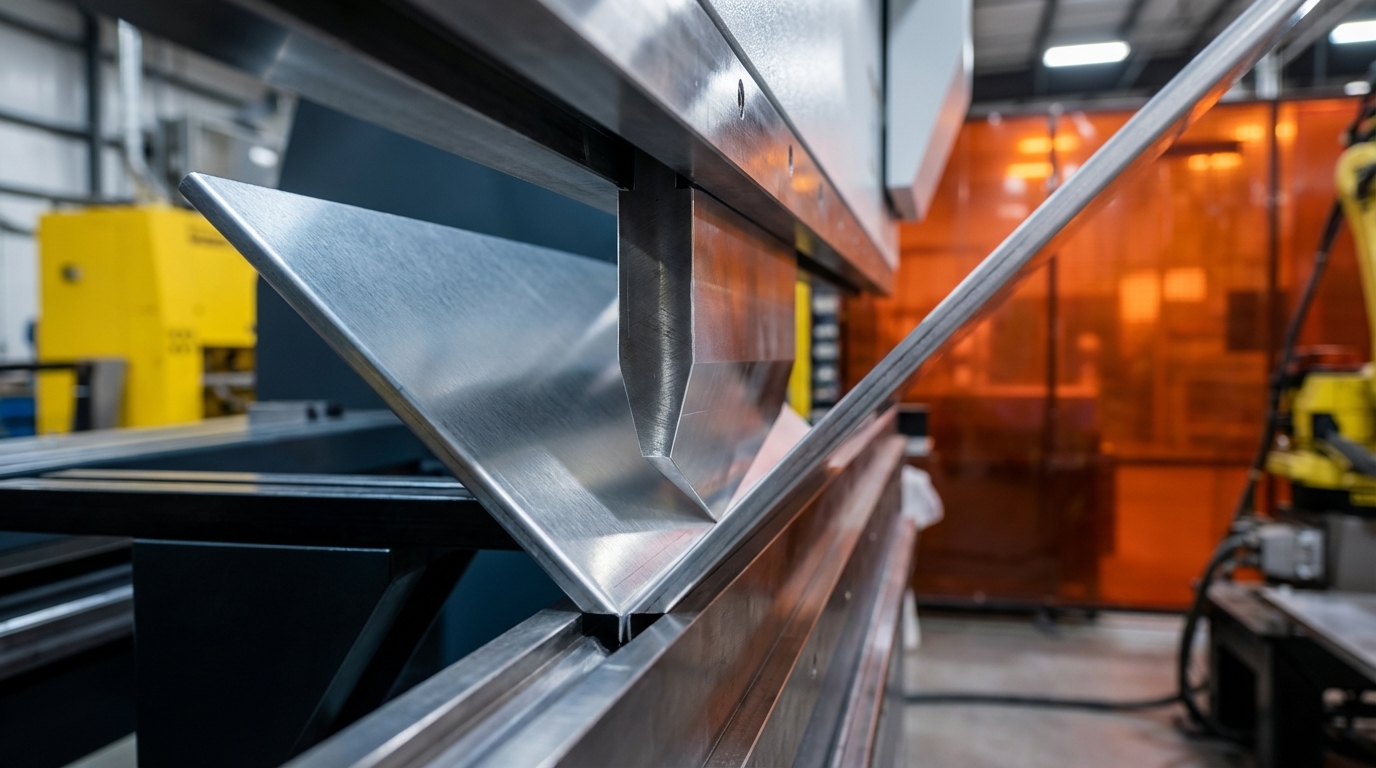
Specify bend radii of at least material thickness to prevent cracking and reduce press-brake wear. Use standard tooling radii to avoid extra setup costs and delays. As discussed in Step 2, this minimum radius guideline applies regardless of your chosen gauge and supports consistent forming. Account for springback in high-strength materials through bend allowance calculations and shop feedback.
Step 5: Use Drafts and Fillets to Reduce Stress
Apply appropriate drafts on deep-drawn features to ease part ejection and lower forming forces. Add minimum fillets at internal corners to spread stress and reduce the chance of crack initiation. These features become critical in high-volume production where consistent part release, stable dimensions, and long tool life matter to overall cost.
Step 6: Minimize Undercuts and Standardize Fasteners
Remove undercuts that require secondary operations or complex tooling whenever possible. Replace unnecessary fasteners with integrated geometry where loads and serviceability allow, since fasteners increase part count, installation time, and risk of human error. When fasteners are necessary, limit them to 4 to 6 per panel and use standard PEM nuts or studs to support consistent installation and simplified inventory.
Step 7: Integrate Machining and Assembly Operations
Design your enclosure so sheet metal forming, CNC machining, and assembly operations work as a single integrated flow. In-house capabilities remove vendor handoffs, shorten lead times, and reduce communication risk. One EV infrastructure project achieved a 50% vendor reduction by consolidating fabrication, machining, and assembly under one roof, which improved quality control and delivery predictability.
Fabcon’s vertical integration supports complex programs from one source. Explore integrated fabrication solutions
Step 8: Use Simulation and Prototyping Early
Apply FEA analysis to validate stress distribution and forming feasibility before you commit to tooling. Digital twin tools can reduce physical trial runs and shorten new product introduction cycles by over 40%. Quick-turn prototyping then confirms design assumptions, reveals real-world manufacturing issues, and refines tolerances before full production.
Step 9: Collaborate Early with Your Fabrication Partner
Early DFM reviews typically achieve 15 to 40% cost reduction through design optimization, with the higher end of this range coming from comprehensive implementation of all 10 steps in this guide. Engage fabrication engineering during the design phase to refine tooling requirements, material utilization, and assembly sequences. This collaboration reduces redesign cycles, improves manufacturability, and speeds the move from prototype to production.
Step 10: Iterate from Pilot Runs to Production Scale
Set up agile production cells that can adjust to changing volumes and SKU mixes without major retooling. Statistical process control maintains quality consistency in large-volume fabrication. Build traceability systems that support high first-pass yield and continuous improvement, so each production run becomes more stable and predictable.
Essential DFM Rules for Sheet Metal Enclosures
These seven core rules give your team a quick checklist for designing sheet metal enclosures that form reliably and assemble cleanly across volumes.
- Uniform gauge: Consistent thickness selection
- Bend radius: Minimum 1x material thickness, preferably 1.5 to 2x
- Draft angles: Appropriate for deep-drawn features
- Hole spacing: Minimum 2x material thickness from edges and bends
- Minimum hole diameter: Equal to material thickness
- Bend relief: Sufficient clearance from bend line
- Fillet radius: Minimum at internal corners
DFM Practices: Checklists, Tools, and Real-World Use
Effective DFM relies on systematic checks for gauge selection, bend calculations, and tolerance analysis. Downloadable checklists should cover material thickness verification, bend radius calculations, and hole-to-edge spacing validation for every enclosure. For data center applications, laser cutting often delivers better edge quality than punching for precision enclosures that require tight tolerances and clean cosmetic surfaces.
Fabcon’s integrated approach combines fabrication, finishing, and assembly operations to remove vendor fragmentation. This vertical integration reduces coordination complexity, improves communication, and maintains quality control throughout the manufacturing process.
DFM Mechanical Design: Common Issues and Fixes
Many teams struggle with overly tight tolerances that raise scrap rates and asymmetric features that cause warping during forming. Proper DFM implementation achieves over 70% reduction in rework due to distortion and springback. Tolerance stack-up analysis prevents assembly interference, while symmetric design features reduce forming stresses and keep dimensions stable across batches.
Measuring DFM Success and Key FAQs
Track key metrics such as high first-pass yield, lead times under six weeks, and rework rates below 5%. These benchmarks signal effective DFM implementation and strong manufacturing process control.
What bend radius should I specify for 16-gauge steel?
For 16-gauge steel, specify a minimum internal bend radius equal to the material thickness, with extra margin when possible for production reliability. This guideline prevents cracking and supports consistent forming characteristics across production volumes.
How long does a DFM review typically take?
Comprehensive DFM reviews usually require one to two weeks, depending on design complexity. This window covers material selection validation, tolerance analysis, and manufacturing process refinement. Early engagement during the design phase delivers the largest cost savings and design improvements.
Can DFM principles scale from prototype to production?
Proper DFM implementation supports smooth scaling from prototype to mid-volume production. Fabcon’s agile production cells adjust to changing volumes while holding quality standards and lead time consistency.
How does DFM apply to medical device enclosures?
Medical device enclosures introduce added requirements such as biocompatibility, cleaning protocols, and regulatory compliance. DFM focuses on eliminating crevices, specifying appropriate surface finishes, and maintaining traceability throughout manufacturing to support audits and field performance.
What should I look for in a DFM partner?
Evaluate certifications such as ISO 9001:2015 and AS9100D, along with vertical integration capabilities, depth of engineering support, and prototype-to-production experience. The right partner also demonstrates statistical process control and quality systems that align with your industry requirements.
Conclusion: Scale Sheet Metal Enclosures with Proven DFM
These 10 steps create a practical roadmap for successful sheet metal enclosure DFM. From material selection through production scaling, each step builds toward cost-effective, high-quality manufacturing that supports your product roadmap. Fabcon’s 45-plus years of precision fabrication experience, combined with vertically integrated capabilities, enable seamless prototype-to-production transitions for data center, EV infrastructure, and medical device applications.
Get your DFM enclosure quote from Fabcon today. Request your quote