
Last updated: April 17, 2026
Key Takeaways
- Custom sheet metal laser cutting achieves ±0.005″ precision tolerances and handles complex geometries without dedicated tooling.
- Advanced fiber lasers with AI controls and nesting software reduce scrap by 20-30% and can double production efficiency.
- DFM guidelines protect cut quality: holes at least equal to material thickness, 2× thickness to bends, and accurate kerf compensation.
- Integrated services combine cutting, forming, welding, and assembly to remove vendor handoffs and speed time-to-market.
- Partner with Fabcon for vertically integrated laser cutting, DFM review, and scalable production from prototype through mid-volume.
How Custom Sheet Metal Laser Cutting Works
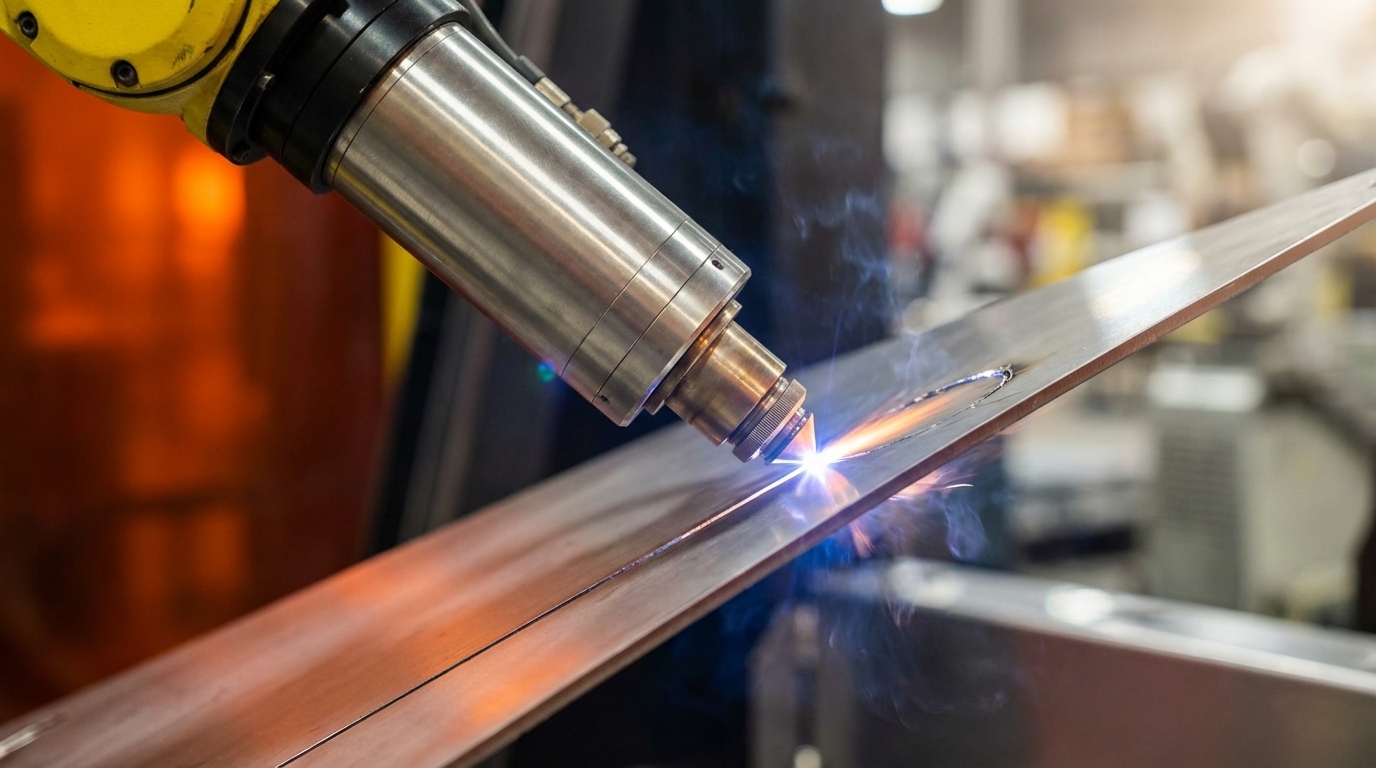
Custom sheet metal laser cutting uses focused fiber laser beams to melt, vaporize, and cut through metal sheets with high precision. Modern 12kW+ fiber laser systems double output per shift compared to traditional CO2 lasers. AI-driven closed-loop control systems enable automatic focusing and adaptive parameter tuning, which keeps quality consistent across production runs.
Laser cutting achieves ±0.005″ standard dimensional tolerances without tooling requirements, unlike plasma or waterjet cutting. The process supports complex geometries, tight internal corners, and intricate patterns that traditional methods struggle to produce.
| Material | Maximum Thickness | Typical Tolerance |
|---|---|---|
| Stainless Steel 304 | 40 mm (1.57 inches) | ±0.005″ |
| Aluminum 6061-T6 | Varies by laser power | ±0.127mm |
| Carbon Steel A36 | up to 30 mm with 4000W-6000W lasers | varies by thickness: +/- 0.005” for 1/4” and under, +/- 0.008” for 1/2”, +/- 0.017” for 1” |
Professional-grade custom sheet metal laser cutting supports mid-volume production that hobbyist services cannot handle. This capability delivers the precision and scalability needed for data center enclosures, EV chassis components, and medical device assemblies.
Five Stages of the Custom Laser Cutting Workflow
The custom sheet metal laser cutting workflow follows five stages that protect precision and efficiency from quote to shipment.
- Design Upload and DFM Review: Engineers upload CAD files for design-for-manufacturability analysis. The review flags issues such as minimum hole diameters less than material thickness that could cause cutting problems.
- Material Selection and Nesting: Advanced software arranges parts on sheet material to minimize waste and reduce cost through efficient material utilization.
- Precision Laser Cutting: AI-sensor equipped fiber laser heads execute cuts while monitoring temperature, air pressure, and melt pool conditions in real time to maintain consistent quality.
- Deburring and Secondary Operations: Parts move through edge finishing and any required forming operations so they meet final dimensional and cosmetic specifications.
- Quality Assurance and Integration: Dimensional inspection confirms tolerances before parts move into integrated fabrication or assembly operations.
Vertically integrated facilities combine laser cutting with CNC machining, forming, welding, and assembly in one location. This structure removes coordination delays and quality inconsistencies that often appear in fragmented supply chains. Upload your designs for comprehensive DFM review and coordinated production planning.
DFM Design Rules That Protect Cut Quality
Effective design-for-manufacturability prevents costly rework and production delays by addressing feature sizing, material behavior, and part geometry.
First, size features for clean cutting and accurate fit.
- Minimum Feature Sizes: Hole diameters should equal or exceed material thickness to ensure clean cutting without distortion.
- Kerf Compensation: Account for kerf and taper when designing mating parts or assemblies so final dimensions align after cutting.
Next, plan for how material stretches and moves during forming.
- Bend Allowances: Use K-factors between 0.38-0.41 for aluminum and 0.42-0.47 for mild steel when calculating flat pattern dimensions so bends form accurately.
Finally, design geometry that supports reliable forming and secondary operations.
- Edge-to-Feature Spacing: Maintain minimum distances of 2× material thickness from hole edges to bend lines to prevent deformation during forming.
- Flange Design: Minimum flange length on sheet metal parts must be at least 4 times the material thickness, with 3× thickness as the recommended minimum for air bending on a press brake so tooling can engage properly.
| Design Element | Good Practice | Poor Practice |
|---|---|---|
| Hole-to-Bend Distance | ≥2× thickness | <1× thickness (causes distortion) |
| Minimum Hole Size | ≥1× thickness | <0.5× thickness (poor cut quality) |
| Bend Relief Width | ≥0.381mm for laser-cut sheet metal parts | No relief (corner cracking) |
Early DFM collaboration surfaces these issues before production begins, which reduces scrap and shortens project timelines. Start your DFM collaboration to tune designs for manufacturing efficiency.
Integrated Fabrication Services That Go Beyond Cutting
Integrated services reduce supply chain fragmentation that increases lead times and quality risk. These partners combine laser cutting with CNC machining, forming, welding, powder coating, and assembly in a single facility.
This structure eliminates vendor handoffs that can add weeks to project timelines and often trigger quality disputes between suppliers. 82% of US manufacturers are reshoring production, which increases demand for domestic suppliers with broad capabilities.
Vertically integrated facilities offer ISO 9001:2015 and AS9100D certifications that support traceability and compliance for regulated industries. The combination of more than 220,000 square feet of manufacturing space with agile production cells supports prototype-to-production scaling without the high minimums common at large contract manufacturers.
Explore integrated fabrication and assembly services that streamline your supply chain and reduce time-to-market.
Industry-Specific Uses for Custom Laser-Cut Sheet Metal
Custom sheet metal laser cutting supports critical applications across technology-driven industries that require precision and repeatability.
Data Center Infrastructure: Precision-cut server rack components, cable management systems, and cooling enclosures rely on tight tolerances for proper fit and thermal performance. Integrated assembly capabilities enable complete rack systems with pre-installed hardware and wiring.
Electric Vehicle Components: Battery tray assemblies, charging station enclosures, and structural chassis components benefit from laser cutting’s ability to handle complex geometries while maintaining dimensional accuracy across production volumes.
Medical Device Manufacturing: Equipment carts, diagnostic enclosures, and surgical instrument components require FDA-compliant manufacturing with full traceability and biocompatible finishing options.
| Industry | Key Components | Primary Benefit |
|---|---|---|
| Data Centers | Server racks, cable trays | Reliable on-time delivery |
| Electric Vehicles | Battery trays, chassis | Reduced lead times |
| Medical Devices | Equipment carts, enclosures | Full traceability compliance |
Choosing Between Job Shops, Integrated Partners, and Large CMs
The manufacturing landscape offers three primary options, each with distinct advantages and limitations. The following table compares how each option handles engineering support, service breadth, and volume flexibility so you can align partner type with your production needs.
| Capability | Job Shops | Integrated Partners | Large CMs |
|---|---|---|---|
| Engineering Support | Limited | Comprehensive DFM | Extensive but rigid |
| Service Scope | Single operations | End-to-end fabrication | Full manufacturing |
| Minimum Volumes | Low | Agile mid-volume | High minimums |
Integrated partners occupy the critical middle ground, providing the single-vendor simplicity discussed earlier without the rigidity and high minimums of large contract manufacturers. They also offer broader capabilities and engineering support than typical job shops.
Pricing, Quotes, and How to Get Started
Custom sheet metal laser cutting costs depend on material selection, part complexity, and production volume. Key pricing drivers include:
- Material type and thickness
- Cut length and geometry complexity
- Required tolerances and finishing steps
- Volume and delivery requirements
Integrated manufacturers provide fast quoting with low minimum order quantities that support both prototype development and production scaling. Advanced nesting software improves material utilization, which lowers cost while maintaining quality standards.
Upload your designs for an instant quote and see how integrated custom sheet metal laser cutting can simplify your supply chain.
Frequently Asked Questions
What tolerances can I expect from custom sheet metal laser cutting?
Modern fiber laser systems achieve standard tolerances of ±0.005″ for most applications. High-precision work can reach ±0.002″ for critical features such as holes and slots. Actual tolerances depend on material thickness, part geometry, and specific project requirements.
What are typical lead times for custom sheet metal laser cutting?
Prototype parts can be produced in as few as 1-5 business days. Laser cut parts typically have a standard lead time of 1-2 business days for simple orders, depending on volume and complexity. Integrated facilities often reduce lead times compared to fragmented supply chains by removing vendor handoffs and coordination delays.
Which materials are supported for custom sheet metal laser cutting?
Common materials include stainless steel (304, 316), aluminum alloys (5052, 6061, 7075), carbon steel (A36, 1008), and specialty alloys such as titanium. Thickness capabilities typically range from 0.020″ to 1.000″ depending on material type and laser power.
How does the design-for-manufacturability process work?
DFM review starts with CAD file analysis to identify potential manufacturing issues such as minimum feature violations, bend radius problems, or tolerance stack-up concerns. Engineers then provide feedback and recommendations before production, which reduces rework and improves cost efficiency.
Can you scale from prototype to production volumes?
Agile production cells support scaling from single prototypes to mid-volume production runs without the high minimums common at large contract manufacturers. Flexible manufacturing systems adapt to changing volumes and product configurations throughout the product lifecycle.
Why choose US-based manufacturing over overseas options?
Domestic manufacturing improves supply chain reliability, speeds communication, and supports compliance with US quality standards. The reshoring trend mentioned earlier translates into practical benefits such as reduced shipping costs, shorter lead times, and stronger intellectual property protection.
How do integrated services compare to online quoting platforms?
Online platforms work well for hobbyist projects and simple cutting needs. Integrated manufacturers provide comprehensive engineering support, DFM collaboration, and end-to-end fabrication capabilities. This approach reduces vendor management complexity and helps maintain consistent quality across all manufacturing operations.
Conclusion
Custom sheet metal laser cutting addresses supply chain fragmentation and DFM challenges that delay product launches and increase costs. Integrated manufacturing partners deliver precision cutting with comprehensive fabrication services, removing vendor handoffs while preserving the agility required for technology-driven industries. Get a quote for custom sheet metal laser cutting and experience the advantages of vertically integrated manufacturing.