
Last updated: April 17, 2026
Key Takeaways
- Follow DFM rules like 4T hole-to-bend distance, 1T minimum bend radius, and 4T flange length to prevent distortion and keep production consistent.
- Use bend designs with K-factors between 0.3 and 0.5, relief cuts, and ±1° angle tolerances to improve flat pattern accuracy and springback control.
- Apply standard tolerances (±0.005” for key features, ±0.5–1° for bends) and adjust for material-specific springback to maintain precision at any scale.
- Sequence workflows in a cut-form-join-finish order and use nesting, fixtures, and batching to cut cycle times by 15–30% and support scaling.
- Partner with Fabcon for vertically integrated DFM reviews and end-to-end manufacturing that reduces lead times by 30–40%, and get a quote today.
The 10 Best Practices Playbook
1. Apply Core DFM Geometry Rules on Every Part
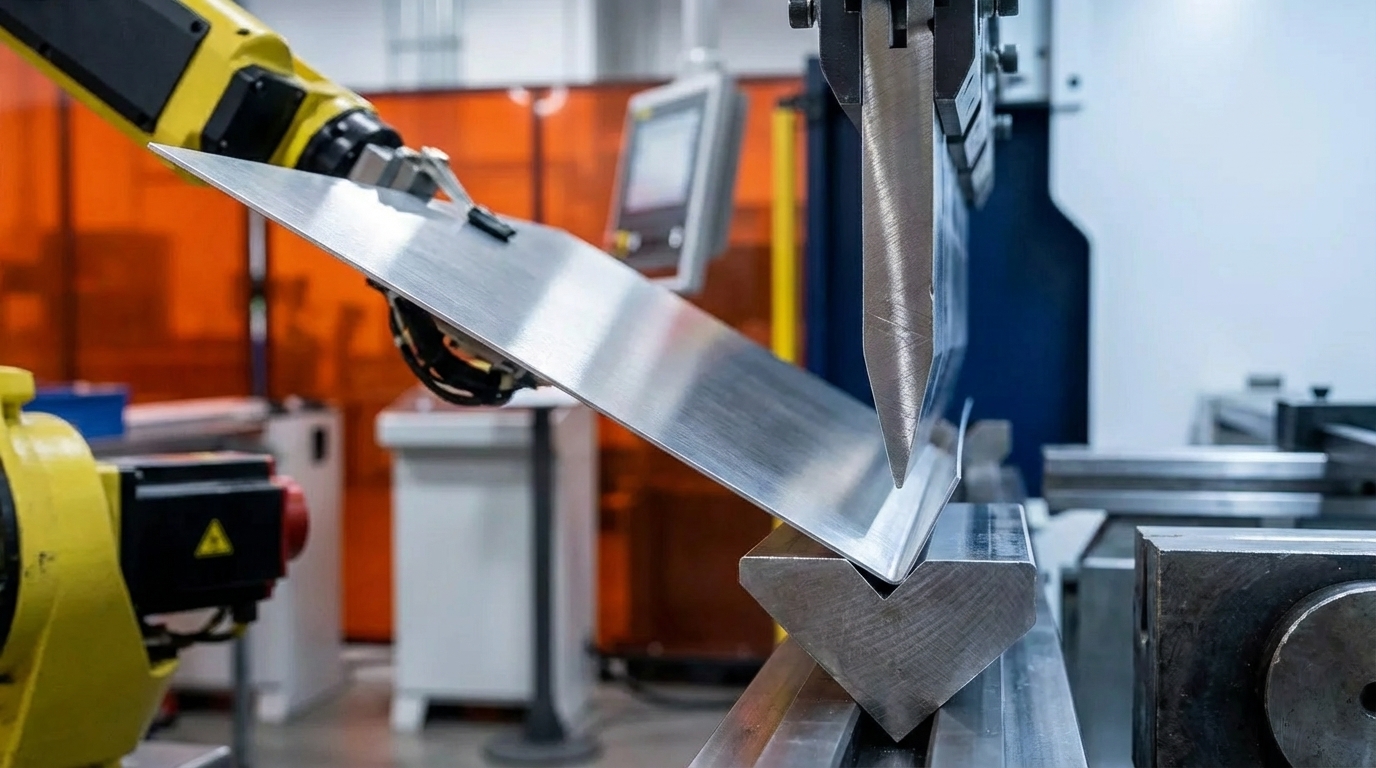
Efficient sheet metal production starts with clear Design for Manufacturability geometry rules that protect form quality and repeatability. The 4T rule requires holes to be positioned at least 4 times the material thickness away from bend lines to prevent distortion during forming operations. Xometry recommends a minimum bend radius of 1t for all sheet metal parts, and minimum flange length of 4T (material thickness) helps maintain consistent springback behavior across production runs.
The table below summarizes these core DFM geometry rules and shows how Fabcon’s production standards often exceed the minimums to support tighter tolerances.
| DFM Rule | Minimum Distance | Fabcon Production Tip |
|---|---|---|
| Hole to bend line | 4T minimum | Use 5T for tight tolerance holes |
| Bend radius | 1T minimum | Standardize on 0.030″ for most gauges |
| Flange length | 4T minimum | 4T preferred for press brake clearance |
2. Use Practical Bend Design Guidelines for Reliable Forming
Strong bend design prevents cracking, distortion, and rework during forming. K-factors between 0.3 and 0.5 support accurate flat pattern development and predictable springback, and typical bend angle tolerances of ±1° are achievable with proper compensation. Relief cuts should extend past the bend line so material can flow without tearing, especially near corners and tight features.
3. Set Tolerance Strategies That Match Material Behavior
Beyond the geometric rules covered earlier, recommended default sheet metal tolerances are ±0.005” for sheared edge to hole and two holes on one surface, but each material’s properties affect achievable precision. Bend angle tolerances typically range from ±0.5° to ±1° for common gauges, and consistent results require springback compensation tuned to the alloy and thickness.
The following comparison highlights how tolerance expectations and springback behavior vary across three common sheet metal materials.
| Material | Linear Tolerance | Bend Angle | Springback Compensation |
|---|---|---|---|
| Mild Steel | Varies by feature | Varies | Requires overbend |
| Aluminum 5052 | Varies by feature | Varies | Requires overbend |
| Stainless 304 | Varies by feature | Varies | Requires overbend |
4. Choose Materials That Support Scaling and Lead Time
Material selection affects bend behavior, tooling needs, and how quickly a program can scale. Aluminum 5052 can typically achieve a 1T bend radius, while 6061-T6 often requires 2T to 3T, which changes tooling choices and cycle times. Standard gauges and widely available alloys shorten procurement, reduce risk of stockouts, and support faster transitions from prototype to production.
5. Sequence Production Workflows for Cut-Form-Join-Finish Efficiency
Well-planned sequencing reduces handling, shortens cycle times, and keeps work moving smoothly across fabrication stages. The cut-form-join-finish workflow needs tight coordination to avoid bottlenecks, especially in mid-volume runs where setup efficiency and repeatable methods matter most.
The table below shows how production priorities shift from prototype to mid-volume runs and how Fabcon captures efficiency gains at each stage.
| Production Stage | Prototype Focus | Mid-Volume Focus | Fabcon Efficiency Gain |
|---|---|---|---|
| Cutting | Speed/flexibility | Nesting optimization | 15% material savings |
| Forming | Tooling validation | Setup standardization | 25% cycle time reduction |
| Joining | Fit verification | Fixture optimization | 20% labor savings |
| Finishing | Appearance validation | Batch processing | 30% throughput increase |
6. Lock In a Clean Prototype-to-Production Handoff
Strong prototype-to-production handoffs rely on consistent processes, clear documentation, and stable DFM decisions. DFM checklists validated during prototyping prevent late-stage design changes that disrupt scaling and add cost. Fabcon’s integrated approach removes vendor handoffs that typically add 2–3 weeks to production timelines and supports faster market entry for time-sensitive programs.
7. Improve Welding and Forming Through Fixtures and Standards
Efficient welding and forming depend on certified procedures and robust fixturing that hold parts repeatably. AWS D1.1 structural welding standards provide a baseline for joint quality and inspection, while dedicated fixtures protect dimensional accuracy during high-mix production. Thoughtful weld sequencing limits distortion so assemblies fit correctly without extra rework or shimming.
8. Integrate Finishing and Assembly Under One Roof
Integrated finishing and assembly remove external dependencies that slow programs and complicate logistics. In-house powder coating, wet paint, and assembly capabilities keep work inside a single system and support the earlier mentioned 30–40% lead time reduction from vertical integration. Hardware insertion, wiring integration, and final assembly in one facility simplify scheduling, improve traceability, and keep quality consistent from raw material through shipment.
9. Build QA and Inspection Systems for Production Scale
Scalable QA systems keep quality stable as volumes grow and product mixes change. AS9100D quality systems support consistent inspection protocols from prototype through production and align teams around documented standards. First article inspection validates dimensional accuracy and process capability and sets control parameters for ongoing runs. AI-driven quality monitoring then spots trends early, cuts scrap, and improves yield before issues spread across batches.
10. Use Agile Manufacturing Cells for Mid-Volume Programs
Agile manufacturing cells give mid-volume programs flexibility that traditional high-volume lines cannot match. Reshoring trends in 2026 are increasing demand for responsive domestic manufacturing that can support EV infrastructure, data centers, and other fast-moving sectors. Fabcon’s cellular approach enables quick responses to program changes while maintaining stable quality and repeatable processes.
Fabcon as Your Production Engineering Partner
Fabcon has operated as a vertically integrated US manufacturing leader since 1977, bridging the gap between limited job shops and rigid contract manufacturers. Our 220,000 square feet of ISO 9001:2015 and AS9100D certified facilities provide end-to-end capabilities from DFM collaboration through final assembly. This integration reduces supply chain complexity, shortens lead times, and improves quality consistency compared to multi-vendor setups. Get a quote for a comprehensive DFM review that uses our production engineering experience to support your next build.
Frequently Asked Questions
What is sheet metal DFM and why does it matter for production engineering?
Sheet metal Design for Manufacturability (DFM) aligns part geometry with efficient production processes. It covers bend radii, hole placement, material selection, and tolerance specifications that prevent manufacturing problems before they reach the floor. Strong DFM reduces scrap, lowers tooling costs, and supports smoother prototype-to-production transitions. The 4T rule, bend relief requirements, and material-specific behavior form the core of effective DFM practices.
What are the most common sheet metal bending pitfalls in production?
Common bending pitfalls include insufficient bend relief that causes cracking, holes placed too close to bend lines that create distortion, and inconsistent bend radii that drive springback variation. Inadequate flange length can also prevent proper tooling engagement and lead to unstable forming. Material grain direction affects bendability, with across-grain bending usually allowing tighter radii than with-grain orientation. Strong fixture design and certified welding procedures help avoid these issues as volumes increase.
How do lead times differ between prototype and mid-volume sheet metal production?
Prototype lead times often range from 2 to 5 days for simple parts that use standard materials and common processes. Mid-volume production needs extra setup time for nesting optimization, fixture preparation, and quality system documentation, which can extend timelines. Vertically integrated manufacturers can cut these extended timelines by about 30–40% through internal coordination and removal of vendor handoffs.
What are the benefits of vertical integration in sheet metal fabrication?
Vertical integration removes vendor handoffs, shortens lead times, and improves quality consistency across all stages. Single-source accountability reduces finger-pointing between suppliers and keeps responsibility clear. Integrated quality systems maintain traceability from raw material through finishing, while cost predictability improves as markup chains shrink. Engineering changes also move faster because teams do not need to coordinate across multiple external vendors.
How does Fabcon differ from traditional job shops for production engineering?
Fabcon goes beyond traditional build-to-print job shop work by providing full production engineering support, including DFM collaboration, integrated finishing, and light assembly capabilities. The certifications and scale mentioned earlier enable complex program management that small shops cannot support, while maintaining the responsiveness that large contract manufacturers often lack. Customers gain a single partner that can support development, ramp, and ongoing production within one coordinated operation.
Conclusion
These 10 production engineering best practices create a practical framework for improving sheet metal fabrication from design through delivery. Success depends on disciplined geometry rules, thoughtful material selection, smart process sequencing, and robust quality systems that scale with demand. Fabcon’s vertically integrated model removes the burden of managing multiple vendors and provides the engineering depth needed for reliable scaling. Get a quote today and put our production engineering expertise to work on your next program.