
Last updated: April 17, 2026
Key Takeaways
- Micro laser cutting achieves ultra-tight tolerances (±0.0005 in.) for medical components like stents, with small heat-affected zones that preserve material properties in nitinol and titanium.
- Key applications include cardiovascular stents, surgical instruments, and orthopedic implants, enabling complex geometries that traditional machining cannot produce.
- Fabcon’s vertically integrated approach reduces costs by 20-30%, removes vendor handoffs, and maintains AS9100D/ISO 9001 compliance for FDA-aligned manufacturing.
- U.S.-based services provide ITAR compliance, shorter supply chains, IP protection, and faster lead times (3-5 days for prototypes) compared with offshore options.
- Partner with Fabcon for end-to-end precision micro laser cutting, from design review through assembly, to simplify your medical device production.
How Micro Laser Cutting Supports Advanced Medical Devices
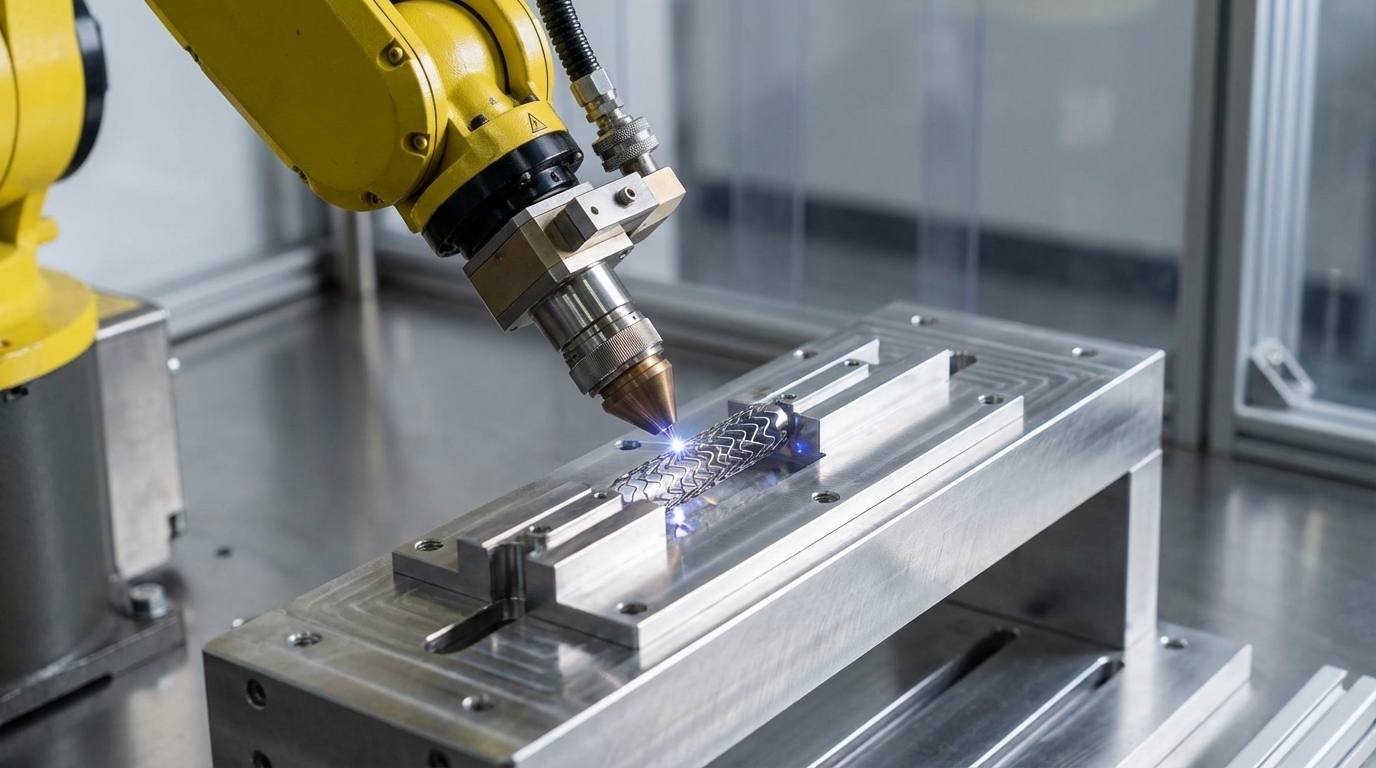
Micro laser cutting delivers precise, repeatable results for medical device manufacturing, including demanding Nitinol components. The process produces burr-free edges that support biocompatibility and clean interfaces for downstream processing. Small heat-affected zones help maintain critical material properties, such as shape memory in nitinol stents, while still allowing efficient throughput on production lines.
Key Applications for Medical Micro Laser Cutting
Cardiovascular stents represent one of the most demanding applications, requiring precise support structures with very tight cutting accuracy. This same precision enables surgical instruments to incorporate micro-features such as small holes, narrow slots, and complex geometries that conventional machining cannot achieve. Beyond intricate patterns, the process also supports implantable devices through hermetic sealing and biocompatible surface preparation.
The following table compares how common medical-grade materials perform under micro laser cutting, highlighting achievable precision and typical use cases for each material.
| Material | Achievable Tolerance | Heat-Affected Zone | Primary Applications |
|---|---|---|---|
| Nitinol | High precision | Small | Stents, guidewires |
| Ti-6Al-4V | High precision | Small | Orthopedic implants |
| 316L Stainless Steel | High precision | Small | Surgical instruments |
How the Precision Medical Laser Cutting Process Works
The micro laser cutting workflow starts with a focused design review and design-for-manufacturability analysis that aligns part geometry with laser processing capabilities. Engineering teams select advanced fiber lasers or ultrashort-pulse systems based on material properties and required tolerances. Ultraviolet picosecond lasers support ultra-fine feature creation while limiting thermal impact on sensitive alloys.
Process control relies on real-time monitoring of cutting parameters, assist gas flow, and beam positioning to maintain consistent quality from part to part. Post-cutting inspection uses coordinate measuring machines and optical systems to confirm dimensional accuracy and surface finish. Fabcon’s ISO 9001:2015 and AS9100D certifications provide frameworks aligned with FDA requirements for medical device manufacturing, supporting full traceability and complete compliance documentation.
Validation, Quality Standards, and Tolerances
Medical device components require validation of special processes when results cannot be fully verified through later inspection steps. Validation typically includes Installation Qualification (IQ), Operational Qualification (OQ), and Performance Qualification (PQ) protocols that document consistent process capability. These protocols demonstrate that the cutting process produces stable quality over time and across production lots.
Micro Laser Cutting Services Cost: What to Expect
Micro laser cutting service costs for medical components depend on part complexity, material selection, and production volume. Tolerance requirements often represent the primary cost driver, because tighter limits demand more process control and inspection. Material choice also affects pricing, since alloys such as nitinol and titanium require specialized handling, fixturing, and process development.
The table below summarizes common cost factors and explains how Fabcon’s model influences each one, so you can better estimate project budgets.
| Cost Factor | Impact Level | Typical Range | Fabcon Advantage |
|---|---|---|---|
| Tolerance | High | Varies | Integrated QC reduces rework |
| Nitinol Material | High | Varies | Specialized expertise |
| Low Volume | Medium | Varies | Agile production cells |
| Compliance Documentation | Medium | Varies | Built-in AS9100D processes |
Fabcon’s vertically integrated approach delivers the cost savings mentioned earlier by removing vendor handoffs and consolidating quality management. Single-source accountability reduces coordination overhead and supports consistent quality across fabrication, finishing, and assembly operations.
U.S.-Based Micro Laser Cutting Services and Reshoring Benefits
The reshoring trend accelerated after 2025, with North American medical device production driving higher demand for domestic micromachining capabilities. U.S.-based manufacturing supports ITAR compliance for defense-related medical technologies, shortens supply chains, and strengthens intellectual property protection. Proximity to major medical device clusters also enables faster prototyping cycles and closer collaboration between engineering teams.
Fabcon operates 220,000 square feet of manufacturing space across two Southern California facilities in Santa Ana and Valencia, giving regional access to precision micro laser cutting services. This location serves major medical device manufacturers throughout the West Coast and supports competitive lead times with responsive customer service. Local manufacturing also removes international shipping delays and customs complications that can disrupt critical product launches.
Ready to remove those delays from your supply chain and speed up new product introductions? Request a quote and see how Fabcon’s Southern California facilities can accelerate your next medical device launch.
Why Fabcon Excels in Medical Micro Laser Cutting
Fabcon combines more than 45 years of precision manufacturing experience with vertically integrated capabilities that include laser cutting, CNC machining, finishing, and electromechanical assembly. This structure directly addresses the common problem of fragmented supply chains that slow medical device programs and increase risk. Engineering leaders gain a single accountable partner for complex assemblies, and procurement teams consolidate vendors while still meeting quality and compliance targets.
Agile production cells allow Fabcon to adapt to changing volumes and evolving Bills of Materials without the rigidity often found at large contract manufacturers. A recent stent frame project achieved 40% faster lead times than a traditional multi-vendor model by using integrated design-for-manufacturability collaboration and streamlined production workflows. Fabcon’s AS9100D and ISO 9001:2015 certifications provide a robust quality framework that supports demanding medical device applications.
The following certifications highlight Fabcon’s readiness for regulated and defense-related medical work and show how its quality systems align with industry expectations.
| Certification | Fabcon Status | Medical Device Relevance |
|---|---|---|
| AS9100D | Certified | Advanced quality management |
| ISO 9001:2015 | Certified | Quality system foundation |
| ITAR Registration | Registered | Defense medical applications |
Fabcon vs. Traditional Laser Cutting Shops
Fabcon’s integrated manufacturing model stands apart from traditional laser cutting job shops that focus only on cutting services without assembly or finishing. While competitors such as LaserStar and CDT primarily deliver cut parts, Fabcon provides complete assemblies that are ready for final integration. This higher level of integration removes vendor handoffs that often introduce quality variation and schedule risk.
| Capability | Fabcon | Traditional Laser Shops | Advantage |
|---|---|---|---|
| Integration Level | Full end-to-end | Cutting only | Fabcon |
| Facility Scale | 220K sq ft | Varies | Fabcon |
| Compliance Depth | AS9100D + ITAR | Basic ISO | Fabcon |
| Engineering Support | Full DFM | Limited | Fabcon |
Reducing Risk with a Qualified Micro Laser Cutting Partner
Effective risk reduction for medical device laser cutting starts with thorough supplier evaluation and clear process expectations. Teams should verify certifications, review process validation documentation, and conduct facility tours to assess cleanroom capabilities and quality systems. Over-reliance on a single supplier can create exposure, which Fabcon addresses through redundant equipment and cross-trained personnel that support continuity.
Process validation requirements also call for complete documentation of Installation Qualification, Operational Qualification, and Performance Qualification protocols. These records help demonstrate that the laser cutting process remains stable, repeatable, and compliant across the full product lifecycle.
Micro Laser Cutting for Medical Devices FAQ
What tolerances can be achieved with micro laser cutting for medical devices?
Modern micro laser cutting systems achieve very tight tolerances for materials such as nitinol and stainless steel. Fabcon’s advanced fiber laser systems consistently reach these precision levels while keeping heat-affected zones small, which helps preserve material properties in critical medical components.
How do micro laser cutting service costs compare to traditional machining?
Initial cutting costs can exceed conventional machining, but micro laser cutting often removes secondary operations such as deburring and significantly reduces scrap. Total project costs frequently decrease by 20-30% when teams factor in shorter lead times, higher yields, and reduced effort coordinating multiple vendors.
What lead times should I expect for micro laser cutting medical components?
Prototype lead times for micro laser cutting medical components typically range from 3-5 business days, depending on part complexity and material availability. Production quantities for most applications ship within several weeks. Fabcon’s integrated model shortens these timelines compared with multi-vendor solutions by eliminating inter-vendor delays.
How does micro laser cutting support FDA and ISO compliance?
Micro laser cutting processes require validation through IQ, OQ, and PQ protocols that document consistent quality and traceability. Teams monitor and record process parameters to meet FDA 21 CFR Part 820 requirements, while material certifications and biocompatibility testing support alignment with ISO 13485 standards.
What advantages do U.S.-based micro laser cutting services offer?
Domestic manufacturing supports ITAR compliance for defense-related medical applications, shortens supply chains, and improves IP protection. U.S. facilities also simplify on-site audits and encourage closer engineering collaboration for complex medical device projects.
Streamline Your Medical Device Manufacturing with Fabcon
Medical device teams face the combined challenges of ultra-tight tolerances, controlled thermal input, strict regulatory requirements, and often fragmented supply chains. Fabcon’s 45+ years of precision manufacturing experience, supported by vertically integrated capabilities and AS9100D certification, provides a single, coordinated solution for these demands.
Request a free design-for-manufacturability review and see how Fabcon’s micro laser cutting expertise can accelerate product development while simplifying your supply chain. Start your project with Fabcon, a vertically integrated U.S. partner for precision medical device components.