
Key Takeaways for Laser-Cut Chassis Projects
- Laser cutting delivers tight tolerances, interlocking joints and low distortion for chassis fabrication, outperforming traditional cutting methods.
- Common chassis materials include carbon steel, stainless steel and aluminum alloys, each matched to specific strength, corrosion and weight targets.
- Effective designs use interlocking joints, kerf compensation and 3D tube cutting to speed assembly and improve structural consistency.
- Challenges such as heat distortion and poor edge quality are controlled through fiber lasers, tuned parameters and integrated quality checks.
- Fabcon’s vertical integration from laser cutting through assembly shortens lead times and lowers total cost; request a chassis project review from Fabcon.
Laser Cutting’s Role in Modern Chassis Fabrication
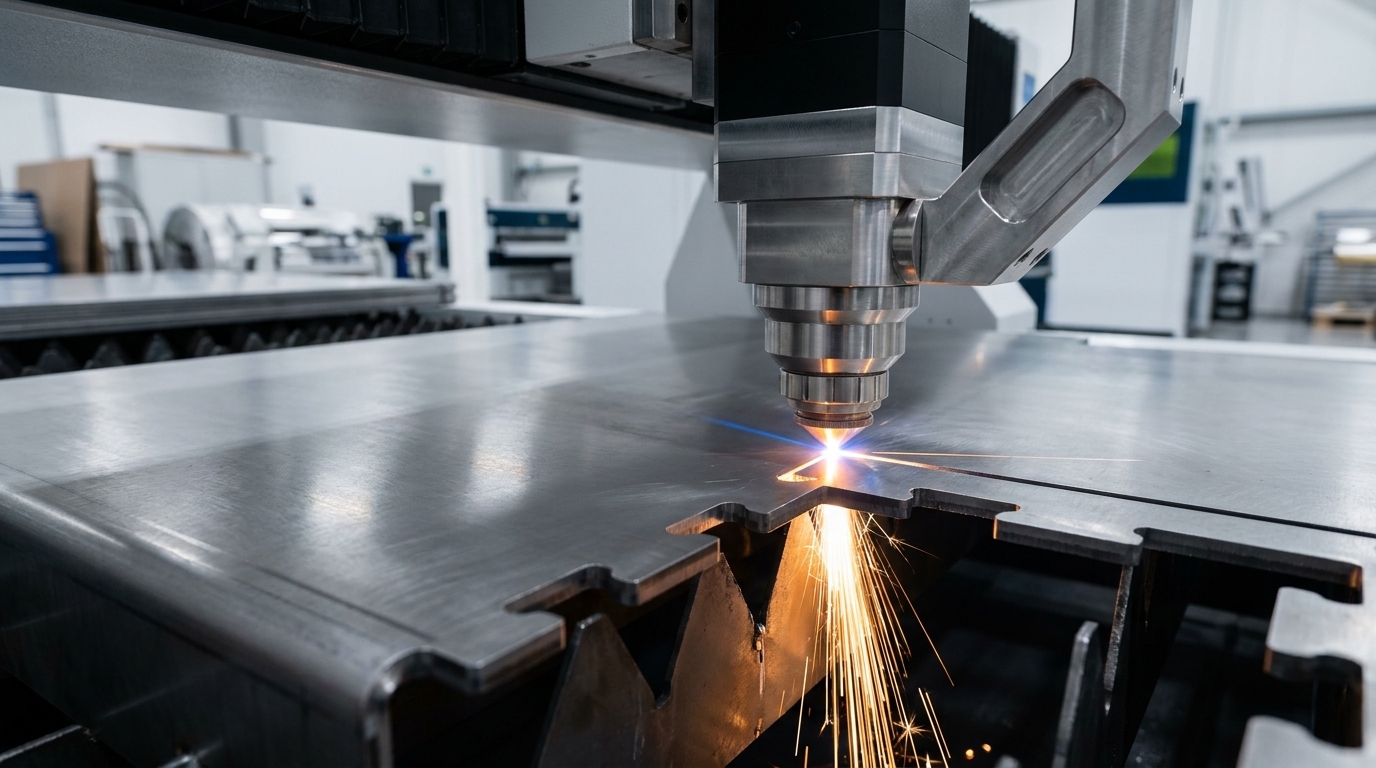
Laser cutting for chassis fabrication uses CNC fiber lasers to cut sheet metal and tubes into frames, brackets and structural elements. The process delivers high speed and accuracy for interlocking joint geometries while limiting thermal distortion compared with mechanical or thermal cutting. These capabilities support complex shapes and tight tolerances required in transportation, infrastructure and industrial equipment chassis.
Core Advantages of Laser Cutting for Chassis Builders
Laser cutting provides several clear advantages for chassis fabrication.
- Precision tolerances: Supports high assembly precision.
- Interlocking joint efficiency: Creates accurate joints that reduce welding requirements and shorten assembly time.
- Repeatability and scalability: Delivers high repeatability for identical results in mass production.
- Versatile geometries: Handles complex 2D profiles and 3D tube cutting for a wide range of chassis layouts.
- Clean edge quality: Produces clean edges requiring minimal post-processing.
Fabcon’s in-house integration combines laser cutting with forming, welding and assembly capabilities. This structure removes vendor handoffs and shortens total project timelines. Schedule a chassis fabrication consultation with Fabcon to align cutting, forming and assembly in one workflow.
Best Materials for Laser-Cut Chassis Structures
Material selection shapes chassis strength, weight, corrosion resistance and laser cutting efficiency.
- Carbon and mild steel: Easiest materials for fiber lasers to cut due to excellent absorption of laser wavelength, and they provide strong, cost-effective structures for many chassis designs.
- Stainless steel: Highly compatible with fiber laser systems, yielding smooth, bright cutting edges with minimal burring, which supports corrosion-resistant chassis used in harsh environments.
- Aluminum alloys: Lightweight metals with strong corrosion resistance that suit weight-sensitive platforms, while requiring higher power fiber lasers due to high reflectivity and thermal conductivity.
- High-strength alloys: Advanced materials that support demanding transportation and energy applications where durability and fatigue resistance take priority.
Fabcon’s team works across this full range of chassis-grade metals and aligns each project with materials that match performance, cost and manufacturability targets.
Designing Laser-Cut Chassis: Interlocking Joints and 3D Tubes
Effective chassis design uses laser precision to create structures that assemble quickly and repeatably. Interlocking designs enable glue-free construction of complex 3D assemblies by forming joints that hold components together mechanically. To achieve accurate fit, dimensions account for kerf width, which is the material removed by the laser beam. Fiber laser cutting transforms raw profiles into these Lego-like prefabricated components ready for welding and assembly. This approach supports Design for Manufacture and Assembly by reducing alignment work and assembly labor.
Beyond flat sheet components, 3D tube laser cutting extends these benefits to structural members with precise hole patterns and slots. Designers adjust tab and slot dimensions for precise fit between tubular and flat elements so assemblies lock together consistently. Design-for-manufacturability work then focuses on material nesting to limit scrap and on joint accessibility so welders and assemblers can reach every connection point.
These design principles deliver the strongest results when applied early in development. Fabcon’s early design collaboration refines chassis layouts before production, which reduces rework and improves manufacturability. Contact Fabcon for a comprehensive design review that aligns laser cutting with downstream assembly.
Common Laser Cutting Pitfalls in Chassis Work and How Fabcon Addresses Them
Several recurring challenges affect laser cutting quality and efficiency in chassis fabrication. Heat-affected zones and material distortion represent primary concerns, particularly with thicker materials or complex geometries where the laser dwells longer and transfers more heat into surrounding metal. This thermal challenge connects directly to edge quality, where variations can appear when cutting parameters or assist gas selection fail to clear molten material cleanly. Even with tuned parameters, thickness limits can restrict design options for heavy-duty chassis that push the laser’s power capacity.
Welding preparation requirements can also add steps after cutting, especially when edges need grinding or beveling before joining. Burn marks on laser-cut edges result from insufficient power, slow speed or lack of air assist, so parameter adjustments remove these defects and reduce cleanup.
Fiber laser technology addresses many of these issues through superior beam quality that concentrates energy precisely and limits heat spread. Proper fixturing stabilizes parts to reduce distortion during cutting. Optimized cutting parameters for each material type improve edge quality and minimize burn marks. Fabcon’s integrated quality assurance and agile manufacturing cells support these controls through end-to-end process monitoring and rapid feedback.
Thickness Limits and Cost Drivers in Chassis Laser Cutting
Laser cutting thickness capacity depends on laser power and material type. Higher power fiber lasers enable greater thickness processing while still meeting edge quality standards. Cost then reflects design complexity, material grade and thickness, production volume and any secondary operations such as forming or finishing.
Machine time required to cut the design is the primary cost driver, not material area, because intricate geometries require slower cutting speeds. Order quantity influences total cost through economies of scale, with per-part costs decreasing significantly for high-volume orders.
Return on investment grows through vendor consolidation, simpler inventory and shorter lead times. Fabcon’s one-purchase-order model replaces multi-vendor coordination with a single schedule and predictable cost structure.
Why Fabcon Fits Complex Chassis Laser Cutting Programs
Traditional job shops often provide build-to-print cutting without design-for-manufacturability support or assembly services, which leaves customers managing fragmented supply chains. Large contract manufacturers frequently require high minimum volumes and lengthy onboarding that limit agility for evolving programs.
These constraints create a gap for manufacturers that need advanced capabilities with flexible engagement. Fabcon occupies this middle ground with vertical integration that spans laser cutting through final assembly. The Southern California facilities combine precision laser cutting with CNC machining, forming, welding, finishing and electromechanical assembly under ISO 9001:2015 and AS9100D certified quality systems.
Agile production cells support smooth scaling from prototype through mid-volume production without the rigid structures common at large contract manufacturers. Early design collaboration improves chassis manufacturability, which reduces rework and shortens time-to-market. Case studies include traffic safety chassis where design-for-manufacturability work simplified assembly and improved structural performance.
Fabcon delivers low total cost of ownership through integrated manufacturing. Single-source accountability replaces the coordination overhead of managing multiple suppliers. Contact Fabcon to model cost, schedule and quality gains for upcoming chassis programs.
Frequently Asked Questions
What are tab-and-slot designs in chassis laser cutting?
Tab-and-slot designs create interlocking joints where protruding tabs fit precisely into corresponding slots, enabling assembly without welding or fasteners. These designs use laser cutting precision to form tight connections that maintain structural integrity while simplifying assembly and reducing manufacturing steps.
How does laser cutting improve chassis fabrication compared with traditional methods?
Laser cutting delivers higher precision, faster processing, lower material waste and stronger support for complex geometries than mechanical cutting methods. The process produces clean edges with small heat-affected zones, supports intricate interlocking joints and allows rapid design changes without new tooling, which suits modern chassis programs.
What considerations affect material selection for laser-cut chassis?
Material selection reflects strength targets, corrosion exposure, weight limits and laser compatibility. Carbon steel offers strong structures and efficient cutting, stainless steel supports corrosion resistance and aluminum reduces weight. Thickness, thermal behavior and post-processing needs also influence final choices.
What factors influence costs for laser-cut chassis components?
Key cost drivers include cutting time set by design complexity, material type and thickness, production volume and secondary operations. Intricate geometries with tight tolerances slow cutting speeds and raise cost. Higher volumes usually reduce per-part cost through better material utilization and setup efficiency.
How does laser cutting differ from traditional cutting methods for chassis?
Laser cutting uses noncontact processing that avoids tool wear and mechanical stress on materials. It delivers superior edge quality, tighter tolerances, faster processing for complex shapes and the ability to cut detailed internal features. Traditional methods such as plasma or mechanical cutting cannot match this precision for interlocking joint designs.
What are the benefits of integrated fabrication for chassis manufacturing?
Integrated fabrication combines laser cutting with forming, welding and assembly in one organization, which reduces lead times and simplifies coordination. This structure supports consistent quality control, lowers transportation cost and improves design outcomes through early collaboration between cutting and assembly teams.
How does vertical integration reduce lead times for chassis projects?
Vertical integration removes delays between separate vendors by controlling the full path from laser cutting through final assembly. Internal coordination replaces external scheduling, which reduces queue time and shipping delays. Real-time communication between departments supports quick problem resolution and design updates.
What certifications are important for chassis fabrication in regulated industries?
Key certifications include ISO 9001:2015 for quality management systems and AS9100D for aerospace work. These standards support consistent quality, full traceability and compliance with industry regulations. Additional certifications may apply for sectors such as medical devices or defense, depending on end-use requirements.
Laser cutting for chassis fabrication provides a strong solution for precision metal structures that require tight tolerances and complex geometries. Fabcon’s vertically integrated approach combines design-for-manufacturability support with end-to-end fabrication that consolidates what often requires several vendors. Start a chassis project discussion with Fabcon to align laser cutting and fabrication with program goals.