
Key Takeaways
- CNC milling excels for low-volume prototypes with tolerances up to ±0.005mm, ideal for precise PCB mounting and complex heatsinks.
- Sheet metal fabrication delivers lower per-unit costs ($20-80) above 50 units and provides EMI shielding performance greater than 90 dB.
- Select CNC for 1-10 units that need tight tolerances, and use sheet metal for cost-effective mid-to-high production volumes.
- Hybrid programs combine CNC precision with sheet metal efficiency, which reduces vendor complexity and shortens lead times.
- Fabcon’s vertically integrated, ISO-certified facilities support electronics enclosures from prototype through production—contact Fabcon for a free DFM review.
How to Evaluate CNC vs Sheet Metal for Electronics Enclosures
Electronics enclosures must meet several performance requirements that differ between CNC milling and sheet metal fabrication. Precision tolerances create the clearest separation, with CNC milling achieving ±0.025 mm (±0.001″) for aluminum alloys compared to typical sheet metal tolerances of ±0.5 mm. Cost per unit, scalability across production volumes, thermal performance, EMI shielding, IP rating potential, and lead time from prototype to production all influence the right choice. Advanced CNC setups can reach ±0.0002 inches depending on material and geometry. This capability sets the precision benchmark for electronics that demand exact PCB mounting and connector interfaces.
CNC Milling for Electronics Enclosures
CNC milling uses subtractive manufacturing on solid metal billets, cutting away material to form precise three-dimensional enclosure geometries. This process performs best in low-volume prototype work where tight tolerances, complex internal features, and custom heatsink designs matter most. CNC machining for enclosures achieves tight tolerances up to ±0.01 mm, ideal for precise holes, threads, and interfaces in electronics applications. CNC milling supports intricate cooling fins, threaded mounting points, and curved surfaces that match specific PCB layouts and connector locations.
CNC milling also maintains uniform material properties throughout the enclosure, which removes weak connection points that could affect sealing or structural performance in harsh environments. The tradeoff comes from higher material waste, often 40-80 percent, and long machine time per part. These factors drive higher per-unit costs across most production volumes.
Sheet Metal Fabrication for Electronics Enclosures
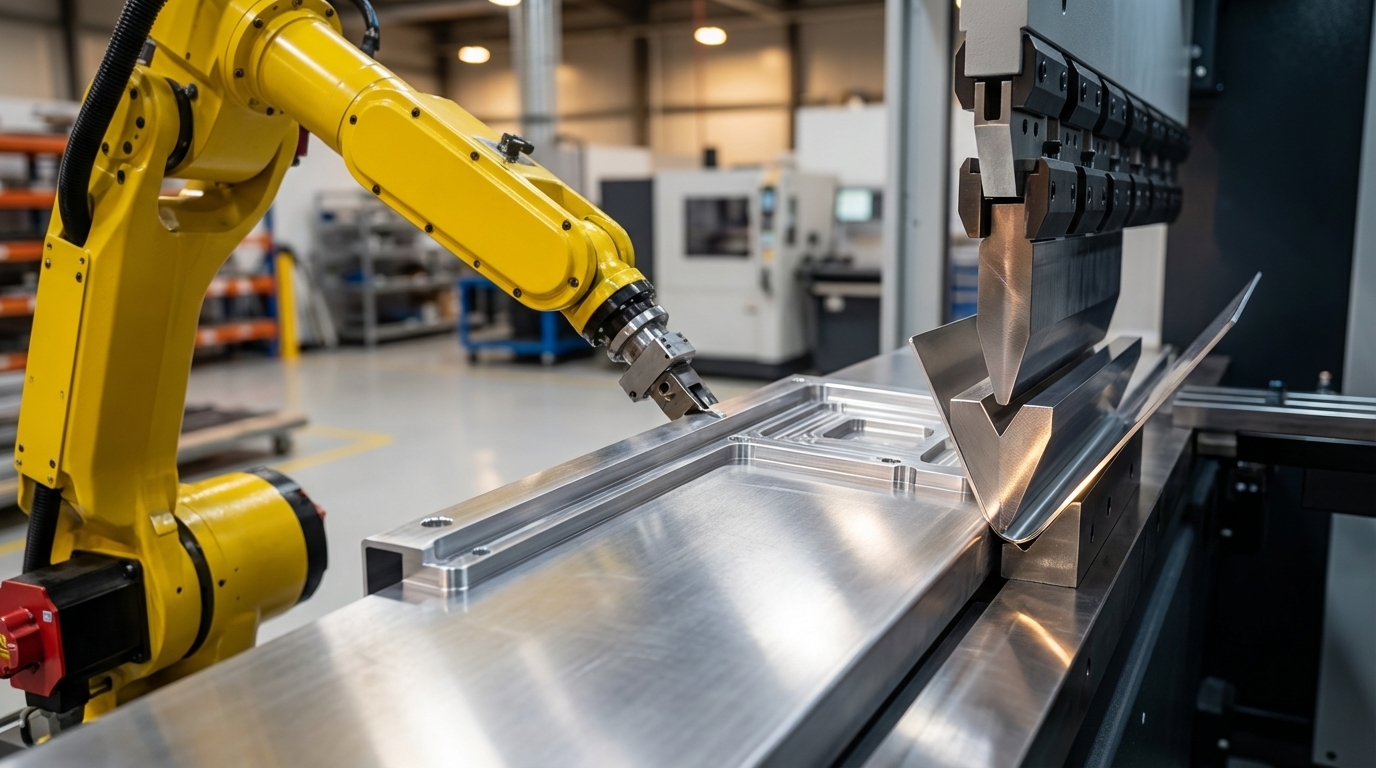
Sheet metal fabrication uses laser cutting, CNC punching, forming, and welding to build enclosures from flat metal sheets. This approach delivers cost-effective production for medium to high volumes and performs especially well in EMI shielding and large panel designs. Sheet metal fabrication typically offers lower per-unit costs at volumes above 50-100 units because modest tooling costs amortize quickly. The process supports integrated grounding features, conductive paths, and continuous seams that improve EMI shielding performance.
Sheet metal enclosures use thin materials from 0.040″ to 0.125″ thick, which keeps portable equipment lightweight. Engineers maintain structural integrity through strategic bend locations and reinforcement ribs that stiffen the enclosure without adding unnecessary mass.
Side-by-Side Cost and Performance Comparison
Use CNC for low-volume prototypes that need precision and heatsinks. Use sheet metal when mid-volume production requires cost control and EMI. Turn to Fabcon for integrated sheet metal fabrication and CNC machining support.
|
Criteria |
CNC Milling |
Sheet Metal Fabrication |
|
Tolerances |
±0.005mm (prototypes) |
±0.5mm (scale) |
|
Cost/Unit (1-100) |
$50-200 |
$40-100 |
|
Thermal/EMI |
Custom fins (>138W/mK) |
Seamless shielding (>90dB) |
|
Lead Time (Proto) |
2-4 weeks |
1-3 weeks |
Cost comparisons show that sheet metal fabrication almost always costs less per part at volumes above 50 units. This data answers the common question “Is sheet metal cheaper than CNC for enclosures?” with a clear yes for mid-volume production. CNC milling stays competitive mainly in prototype quantities from 1 to 10 units, where setup costs are spread across fewer parts.
The tolerance gap strongly affects applications that require precise PCB mounting. CNC capability at ±0.005mm keeps component alignment accurate, while sheet metal’s ±0.5mm standard tolerance suits designs with more dimensional flexibility.
Electronics Use Cases, Thermal Needs, and EMI Shielding
Thermal management plays a central role in electronics enclosure design, and aluminum (5052-H32) provides 138 W/m·K thermal conductivity in both CNC and sheet metal builds. CNC milling supports detailed cooling fin patterns and internal channels that increase surface area for convective cooling. These features help move heat away from sensitive components.
Sheet metal stands out in EMI shielding performance. Proper construction can achieve more than 90 dB EMI shielding at 1 GHz through continuous seams and integrated grounding features. IP rating potential depends on sealing design, and CNC’s uniform material structure removes weld-related weak points that might reduce moisture protection.
Common use cases include low-volume data center prototypes that rely on CNC for precise mounting and connector alignment. Mid-volume telecommunications enclosures often use sheet metal for strong EMI performance and cost control. EV charging infrastructure benefits from Fabcon’s integrated precision sheet metal fabrication, CNC machining support, and electromechanical assembly under one roof.
DFM, Hybrid Programs, and Fabcon’s Recommendation
Design-for-manufacturability works best when engineering teams and manufacturing partners collaborate early. This collaboration reduces tolerance stack-ups, material waste, and production complexity. Fabcon’s vertically integrated model uses in-house CNC machining for precision components that support fabricated assemblies, along with precision sheet metal fabrication for enclosures. This structure removes vendor handoffs that often cause delays and quality variation.
Vertical integration also keeps prototype and production work inside the same facility, which maintains dimensional consistency and shortens lead times. ISO 9001:2015 and AS9100D certifications provide traceability across every manufacturing step, and U.S.-based production improves supply chain agility for tight launch schedules. This approach supports volume growth from prototype through production without the constraints that large contract manufacturers often impose. Get a quote to see how Fabcon’s integrated capabilities can support your electronics enclosure program.
Final Recommendation for CNC vs Sheet Metal
The CNC milling versus sheet metal fabrication decision for electronics enclosures comes down to precision needs, production volume, and cost targets across the product lifecycle. Hybrid strategies that use both methods often deliver the strongest results for modern electronics, especially when a vertically integrated partner like Fabcon manages the full program. With more than 45 years of experience and comprehensive U.S.-based manufacturing, Fabcon provides engineering collaboration, quality certifications, and production flexibility for demanding electronics enclosure programs.
Get your custom electronics enclosure quote from Fabcon today and move your next product toward launch.
FAQs
Is sheet metal cheaper than CNC for electronics enclosures?
Yes, sheet metal fabrication becomes more cost-effective than CNC milling at volumes above 50-100 units. Sheet metal costs typically range from $20-80 per unit for mid-volume production, while CNC milling costs $50-200 per unit regardless of quantity because of machine time and material waste. For prototype quantities from 1 to 10 units, CNC can remain competitive, but sheet metal almost always delivers lower per-unit costs at production volumes.
What tolerances can CNC milling achieve for enclosures?
CNC milling can achieve tolerances of ±0.005mm (±0.0002″) for aluminum enclosures, with standard tolerances of ±0.1mm (±0.004″) for most applications. These tight tolerances suit precise PCB mounting, connector interfaces, and threaded holes where exact dimensional accuracy supports proper assembly and long-term function.
Which method works best for low-volume electronics production?
CNC milling works best for low-volume electronics enclosures from 1 to 100 units that require tight tolerances, complex geometries, or custom thermal management features. Fabcon supports low-volume production with both precision sheet metal fabrication and in-house CNC machining. These capabilities allow a smooth transition to higher volumes while maintaining design consistency and controlling costs.
What are the benefits of a hybrid manufacturing approach?
A hybrid approach combines CNC precision for critical components with sheet metal cost advantages for larger panels. This mix reduces overall program costs while protecting quality and performance. Managing both processes through a single vendor also removes coordination delays, quality disputes, and supply chain complexity that often appear when multiple suppliers share responsibility.
What are typical lead times for Fabcon enclosure projects?
Fabcon supports fast quoting and short lead times by integrating fabrication, machining, finishing, and assembly within one organization. This structure removes external vendor dependencies that usually extend project timelines. Actual lead times depend on project complexity, volume, and specific technical requirements.