
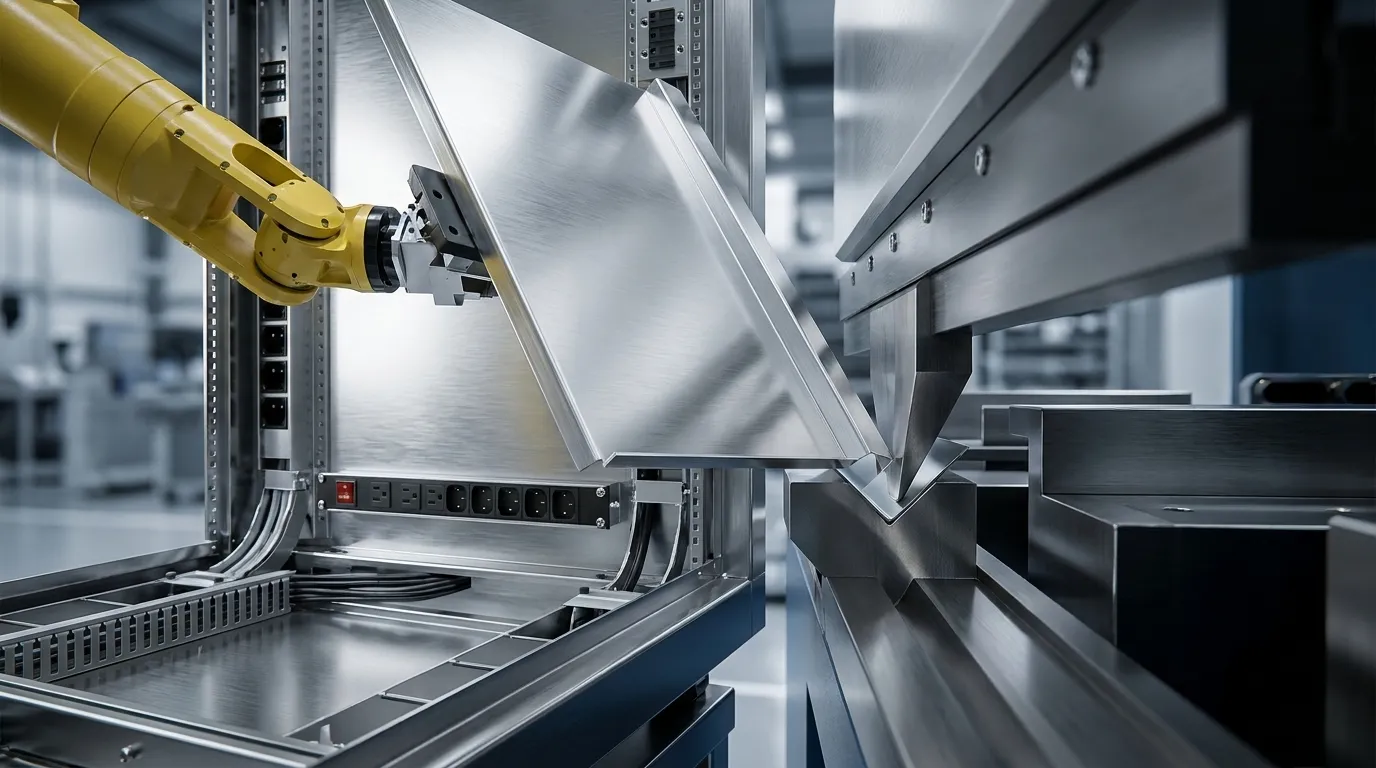
Key Takeaways for Custom Electromechanical Rack Programs
- Electromechanical assembly combines precision sheet metal, thermal management, PDUs, cable routing and security hardware into code-compliant server rack enclosures.
- Successful programs rely on partners with strong technical capabilities, integrated operations, proven quality systems, scalable capacity and dependable domestic supply chains under a single PO.
- Early DFM collaboration on airflow, PDU mounting, cable routing and structural load ratings reduces tolerance issues, rework and compliance failures during production.
- Vertically integrated fabrication, finishing and assembly in one manufacturing campus reduce handoffs, speed prototype-to-production transitions and support consistent quality for mid-volume programs.
- Start a conversation about vertically integrated U.S. manufacturing and DFM support for the next custom server rack enclosure program.
Evaluation Framework for Electromechanical Rack Integration Partners
A structured evaluation across five dimensions separates capable partners from transactional vendors and supports long-term program stability.
Technical capabilities form the foundation. The partner must demonstrate precision sheet metal fabrication, in-house finishing and light electromechanical assembly. Shops that stop at cut-and-form cannot support wiring, PDU mounting or thermal integration.
Integration scope builds on those capabilities. Evaluate whether fabrication, coating and assembly occur within a single, coordinated operation. Multi-vendor handoffs introduce tolerance mismatches, scheduling gaps and quality disputes.
Quality and compliance provide process discipline. ISO 9001:2015 and AS9100D certifications signal documented process control and full traceability. UL and CSA compliance support data-center and telecom deployments.
Scalability and flexibility keep programs on track as demand changes. The partner must support prototype quantities and scale to mid-volume production without rigid minimums or long onboarding cycles.
Supply-chain reliability ties the framework together. Single-PO accountability, domestic manufacturing and integrated logistics reduce lead-time variability and limit cross-vendor coordination risk.
Discuss rack enclosure requirements with Fabcon’s engineering team.
Thermal Management and Airflow in Custom Server Rack Enclosures
Thermal performance often sets the limit for high-density data-center hardware, so enclosure airflow strategy must be defined early in the design process. Perforated door patterns, fan mounting positions, baffles and blanking panels all influence airflow uniformity across installed equipment.
Power supply designs that pass bench testing can fail in deployment when enclosure airflow in a server rack differs from open-bench conditions, which causes components to run hotter than predicted and can trigger operational failures. Thermal and EMI decisions function as architecture choices made at the block-diagram stage, not layout afterthoughts.
Preventing these thermal failures requires early DFM collaboration. DFM reviews for electromechanical assemblies evaluate enclosure fit, fastening methods, tolerance accumulation and material compatibility to support consistent production. Early engineering collaboration between the design team and the fabricator confirms that perforation patterns, baffle geometry and fan-mounting provisions run at volume before tooling is committed.
Power Distribution and PDU Mounting in Rack Cabinet Assembly
Zero-U channels and vertical PDU placement preserve usable rack unit space while maintaining front-to-rear airflow paths. Mounting hardware must support the weight and connector density of high-amperage PDUs without creating tolerance stack-up that misaligns outlet positions relative to installed equipment.
Complex connectors and high-mass components require focused DFM attention because they can challenge solder wetting and thermal profiles during assembly of power distribution components. The same DFM discipline used for thermal planning also strengthens PDU mounting design. Review of PDU mounting provisions highlights interference risks, fastener accessibility and bracket geometry early, which reduces rework during integration.
These mounting provisions must also address thermal performance. Thermal relief features and material selection in DFM promote even heat distribution and reduce solder-joint stress for components that handle power dissipation in rack enclosures. When fabrication and assembly share the same facility, bracket tolerances and PDU mounting geometry are validated against actual sheet metal before production quantities are released.
Cable Routing and EMI Control in Server Rack Enclosures
Overhead access points, lacing bars, brush strips and horizontal cable managers define the routing architecture of a custom enclosure. Each element must be positioned to separate power and data paths, maintain bend-radius minimums and preserve airflow lanes.
Cables overlooked during architecture planning can become broadband radiators that cause radiated-emissions failures in EMC testing. Shielding provisions, grounding lugs and bonding straps must be specified in the build-to-print package and verified during assembly, not added as field corrections.
Cable bend radius, connector alignment and overall layout coordination require early planning during DFM to prevent assembly issues and long-term reliability problems in rack enclosure cable routing. When the metal fabrication team and the wiring team operate in the same facility, routing provisions are cut, formed and validated against actual cable assemblies before production begins.
Structural Load Ratings and Standards for Custom Racks
Custom server rack enclosures must meet structural requirements that support dense equipment loads across the full service life of the installation. Frame gauge, weld integrity and gusset placement determine whether an enclosure meets static load specifications under real-world conditions.
Precision metal components including server racks, rack chassis and frames function as key structural elements in hyperscale and data-center infrastructure. NEMA ratings govern enclosure protection levels for dust and moisture ingress, and the selected rating must appear in the sheet metal design, gasket specification and finishing process.
DFM highlights mechanical stress points from tolerance stack-up, material selection and environmental loading such as vibration or shock that could cause field failures in custom server rack enclosures. Material selection and weld procedure must be validated against the load and environmental requirements before production quantities are committed.
Environmental Protection and Security in Rack Integration
Enclosures deployed in edge, telecom or outdoor-adjacent environments require NEMA-rated sealing, corrosion-resistant finishes and multi-point locking hardware. Removable side panels and rear doors must maintain seal integrity across repeated access cycles.
FM Data Sheet 5-32 requires server enclosures and racks in data processing equipment rooms to use noncombustible materials, and prohibits PVC materials for power cable raceways, routing assemblies, junction boxes and hot or cold aisle containment systems. UL and CSA compliance requirements must be addressed in the design package and verified through the fabricator’s quality system before shipment.
Fabcon’s certified quality systems provide full traceability across fabrication, finishing and assembly, which supports compliance documentation for UL and CSA requirements on every build.
Fabcon’s Build-to-Print Workflow for Rack Enclosures
Fabcon’s in-house workflow begins with drawing review and DFM collaboration. Engineering and quoting teams evaluate tolerances, material specifications and assembly sequences before manufacturing routers and work instructions move to the floor.
Fabrication follows, using laser cutting, CNC punching, forming and certified welding to produce sheet metal components to print. In-house finishing, including powder coat, wet paint and mil-spec coatings, is applied before components move to the assembly cell, which removes outbound shipping between process steps.
Light electromechanical assembly then integrates PDUs, thermal hardware, cable routing provisions and security hardware against the build-to-print package. A typical AI server-rack assembly program moves through DFM review and process planning, first-article builds and production ramp in a structured sequence. That timeline compresses when fabrication and assembly share the same facility and quality system.
Explore a build-to-print rack enclosure program with Fabcon’s engineering team.
One-Partner Supply Chain vs Fragmented Vendors
Low-complexity job shops handle basic sheet metal but lack the engineering depth for DFM and cannot manage wiring, finishing or electromechanical integration. Each additional vendor adds a handoff, a purchase order and a potential quality gap.
Large global contract manufacturers offer scale but impose high minimum volumes, long onboarding cycles and rigid production structures that do not support evolving BOMs and high-mix programs common in data-center and telecom work. Early involvement from a manufacturing partner improves design-to-manufacture alignment. Without early collaboration, product alterations during production can drift from the original design.
Fabcon occupies the critical middle ground. Operating from 220,000 square feet of vertically integrated manufacturing space across two U.S. facilities, Fabcon delivers fabrication, finishing and light electromechanical assembly within a single integrated workflow and PO, with end-to-end accountability for mid-volume, high-mix programs.
Early Engineering Collaboration for Faster Ramp and Less Rework
Common manufacturability issues flagged by DFM include components that block test probes or access, blind vias that trap flux and tight tolerances that increase cost or interfere with assembly of thermal management and power systems. Catching these issues before fabrication eliminates rework cycles that compress launch timelines.
Fabcon’s agile production cells adapt to changing volumes, mixed SKUs and evolving BOMs without the overhead rigidity of large contract manufacturers. Monthly volumes for AI server rack programs can scale from initial production quantities to higher output within months of first-article approval. That ramp requires a partner with flexible cell structures and a quality system that scales with the program.
The certifications mentioned earlier govern every stage of Fabcon’s build process and provide the traceability and process documentation that infrastructure and telecom customers require for compliance and risk management.
Key Questions for Evaluating Rack Integration Partners
Use this checklist when evaluating fabrication and assembly partners for custom electromechanical rack programs. Each question ties back to the evaluation dimensions outlined earlier, so no critical capability gap remains unexamined.
- Does the partner offer DFM review before quoting, and does the engineering team engage directly with the customer’s design team?
- Are fabrication, finishing and electromechanical assembly performed in-house, or are any steps subcontracted?
- What quality certifications does the partner hold, and do they cover the full build scope including assembly and finishing?
- Can the partner support prototype quantities and scale to mid-volume production without changing the program structure or imposing new minimums?
- Is the manufacturing facility domestic, and does the partner maintain single-PO accountability across the full build?
- How does the partner handle design changes or BOM revisions mid-program?
Conclusion and Next Steps for Custom Rack Programs
Custom electromechanical assembly server rack enclosures require a partner who manages precision sheet metal fabrication, finishing and system-level integration without fragmenting the supply chain. The handoff problems described earlier increase timelines and program risk.
Fabcon’s vertically integrated U.S. model, supported by the certifications noted earlier, agile production cells and in-house DFM collaboration, delivers custom rack enclosures from prototype through mid-volume production with one accountable manufacturing partner. As North America EMS box-build demand approaches tens of billions by 2031, programs anchored to a domestic, vertically integrated partner with strong engineering depth gain a structural advantage.
Partner with Fabcon’s vertically integrated team for the next rack enclosure program.
Frequently Asked Questions
What is electromechanical assembly for server rack enclosures?
Electromechanical assembly for server rack enclosures is the process of integrating mechanical and electrical components, including thermal management hardware, power distribution units, cable routing systems and security hardware, into a precision sheet metal cabinet. The result is a functional, code-compliant rack-level system ready for installation in a data-center or telecom environment. This process extends beyond basic sheet metal fabrication and requires coordination between metal, finishing and wiring disciplines, ideally within a single integrated operation to maintain design intent and quality consistency.
Why does vertically integrated fabrication matter for custom rack enclosure programs?
When fabrication, finishing and assembly are split across multiple vendors, each handoff introduces scheduling risk, tolerance mismatches and quality accountability gaps. A vertically integrated partner controls every step of the build internally, so DFM feedback arrives quickly, finishing specifications apply to the actual fabricated parts and assembly is validated against the same quality system that governed the metal work. For mid-volume, high-mix programs where BOMs evolve and timelines stay compressed, this integration reduces rework and accelerates prototype-to-production transitions.
What certifications should a server rack enclosure fabricator hold?
ISO 9001:2015 certification establishes a documented quality management system with traceability across the full build. AS9100D certification adds aerospace-grade process controls and risk management requirements that many data-center and infrastructure customers now reference for documentation. UL and CSA compliance apply to enclosures deployed in commercial data-center and telecom environments. Partners who hold these certifications across fabrication, finishing and assembly, rather than only for one process step, provide more complete compliance coverage for complex electromechanical programs.
How does DFM collaboration reduce cost and rework in custom enclosure programs?
Design-for-manufacturability review identifies issues in the design package before fabrication begins, including tolerance stack-up problems, fastener accessibility constraints, material incompatibilities and assembly sequence conflicts. Catching these issues at the drawing stage removes the cost and schedule impact of mid-production rework or tooling changes. When the DFM team works in the same facility as the fabrication and assembly floor, feedback loops shorten and recommendations reflect the actual production environment rather than theoretical manufacturing guidelines.
What distinguishes Fabcon from basic job shops and large contract manufacturers for rack enclosure programs?
Basic job shops handle sheet metal fabrication but lack the engineering depth for DFM and cannot perform finishing or electromechanical assembly, which forces customers to manage multiple vendors for a single finished product. Large contract manufacturers offer scale but typically require high minimum volumes, long onboarding processes and rigid production structures that do not support evolving BOMs or high-mix programs. Fabcon operates between these extremes as a 220,000-square-foot vertically integrated U.S. operation with in-house engineering, fabrication, finishing and light electromechanical assembly, certified quality systems and agile production cells that support mid-volume programs from prototype through production without the constraints of either extreme.