
Last updated: August 30, 2026
Key Takeaways for Climate-Controlled Enclosure Sourcing
- Climate-controlled network enclosures combine NEMA or IP-rated cabinets with integrated HVAC to protect active electronics in outdoor deployments.
- U.S. domestic fabrication is increasingly favored in 2026 due to market growth, supply-chain stability and federal incentives that accelerate reshoring.
- Buyers can evaluate fabricators on seven criteria including ratings certification, HVAC integration, quality systems and lead-time reliability.
- Vertically integrated U.S. partners reduce risk by controlling fabrication, finishing and assembly under one roof, which removes multi-vendor handoffs.
- For mission-critical programs, request a DFM review with Fabcon to assess integration requirements before production begins.
Seven Evaluation Criteria for Climate-Controlled Enclosure Manufacturers
Buyers shortlisting fabricators for mission-critical outdoor enclosures can apply the following criteria before issuing an RFQ.
- NEMA or IP rating scope: Confirm the manufacturer can certify the specific rating required, such as NEMA 4, 4X or IP66/IP67. Verify that custom modifications such as HVAC cutouts and cable glands do not void that certification.
- HVAC integration capability: Assess whether the fabricator performs thermal load analysis and sizes cooling units to actual heat dissipation. Confirm that the team integrates compressor AC, heat exchangers or filtered fan systems in-house rather than outsourcing that step.
- Integration scope: Determine whether the partner handles fabrication, finishing and light electromechanical assembly under one roof. That scope includes wiring, component mounting and functional testing.
- Quality and compliance systems: Require ISO 9001:2015 certification at minimum, full material traceability and documented compliance with UL 508A and NEMA 250 standards.
- Scalability and flexibility: Evaluate whether production cells can handle evolving bills of materials, mixed SKUs and volume changes without the high minimums or rigid onboarding of large contract manufacturers.
- U.S. lead-time reliability: Domestic custom enclosure lead times are shorter than imported equivalents, and import logistics remain unpredictable. Domestic sourcing creates a meaningful schedule advantage for mission-critical programs.
- Total program cost versus risk: Factor in rework, vendor coordination overhead, freight exposure and certification delays, not unit price alone, when comparing fabricators.
IP66 Outdoor Cabinets with AC: Engineering and Supply-Chain Realities
Integrating active cooling into an IP66-rated cabinet is an engineering problem, not a procurement task. Adding an air conditioner to an outdoor cabinet requires engineering consideration of airflow, equipment clearance, condensate handling, structural support, sealing, maintenance access and electrical power for the cooling unit. That scope extends far beyond a side-panel cutout.
Sealing integrity is the central challenge because IP ratings address dust and water ingress but do not cover condensation-induced internal moisture, UV aging or atmospheric corrosion. These gaps mean that maintaining the rated seal depends on precise fabrication and consistent gasketing. A fabricator that controls CNC laser cutting or punching of HVAC cutouts in-house maintains factory tolerances and preserves gasket continuity, which often breaks down when multiple vendors share the build.
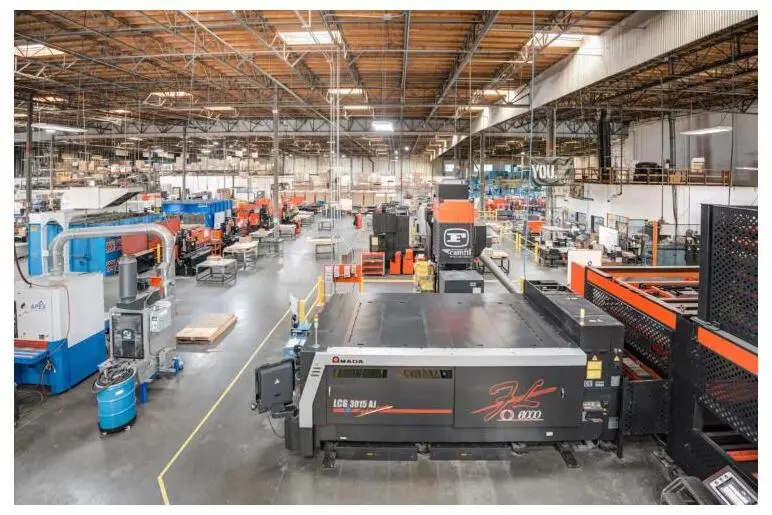
Supply-chain fragmentation compounds this risk. When fabrication, finishing and HVAC integration are split across vendors, each handoff introduces dimensional variation, schedule dependency and quality ambiguity. A single U.S. partner that owns the entire sequence, including sheet metal, powder coat, HVAC mounting and wiring, removes those gaps and provides one accountable point of contact for certification documentation and field support.
Request a DFM review with Fabcon to assess integration requirements before production begins.
NEMA 4 vs. 4X in Telecom: Matching Ratings to Corrosive Environments
NEMA 4 and NEMA 4X both provide watertight and dust-tight protection, but 4X adds corrosion resistance. That distinction matters in coastal, chemical-adjacent or high-humidity telecom deployments. For coastal or chemical facilities exposed to salt-laden air or process vapors, NEMA 4X stainless steel enclosures with IP66-equivalent protection represent the practical minimum for mission-critical outdoor panels.
Material selection drives this outcome. Buyers can specify exact material grades and sheet thickness, along with material certificates where required, because corrosion resistance in coastal or high-humidity environments depends on these details rather than surface appearance alone. The choice between carbon steel with powder coat, 304 stainless or 316/316L stainless depends on the corrosivity classification of the deployment site.
Finishing consistency often exposes weak points in multi-vendor supply chains. When a fabricator sends enclosures to an outside coating shop, dimensional control over gasket surfaces and door frames becomes shared, and quality disputes follow. A vertically integrated U.S. fabricator with in-house powder coat, wet paint and mil-spec finishing capabilities applies surface treatment in the same controlled environment as fabrication. That structure maintains sealing geometry and cosmetic standards across every unit in a production run.
Custom 5G Small Cell Enclosures When Standard Sizes Do Not Fit
5G deployments impose thermal and spatial constraints that off-the-shelf enclosures rarely satisfy. A single 5G radio generates significant waste heat, and three radios plus power system and battery backup in one cabinet can create a thermal load that exceeds equipment limits within minutes without adequate cooling. Cooling method selection must account for real heat load, ambient temperature, solar gain, enclosure sealing, contamination risk and maintenance access rather than nominal airflow alone.
Small cell sites add a strict space constraint. Pole-mounted or street-level deployments require enclosures sized to specific mounting envelopes, with HVAC, power distribution and cable management integrated before installation. Standard catalog sizes often force field modifications that compromise sealing and void ratings.
Undersized cooling, common when carriers later add radio bands, frequently leads to capacity shortfalls and summer shutdowns. A U.S. fabricator with agile production cells can handle mid-program BOM changes, revised thermal loads and updated mounting requirements without the long onboarding cycles or high minimums that large contract manufacturers impose. That responsiveness functions as a program-level risk control, not a convenience.
Custom vs. Off-the-Shelf Climate-Controlled Enclosures
Off-the-shelf enclosures with integrated AC work well when thermal loads, mounting dimensions and environmental ratings align with a catalog configuration. This approach also fits when volume remains low enough that unit cost dominates the decision. For most mission-critical infrastructure programs, those conditions do not align.
Custom fabrication becomes the right path when any of several conditions apply. The deployment environment may require a specific NEMA or IP rating combined with a nonstandard form factor. The thermal load may require a cooling system sized to actual heat dissipation rather than a catalog default. The program may involve evolving BOMs across multiple SKUs, or Buy America provisions, cybersecurity compliance requirements or supply-chain traceability mandates may apply. Section 45X domestic manufacturing credits and Buy America clauses are already influencing enclosure procurement decisions across infrastructure programs.
The practical alternative to both rigid global contract manufacturers and basic job shops is a mid-sized U.S. vertically integrated fabricator. Buyers are favoring domestic fabricators to reduce lead times and supply-chain exposure. A single partner that handles fabrication, finishing and assembly under one roof delivers the accountability and traceability that mission-critical programs require.
Request a DFM review to determine whether a custom or modified-standard enclosure fits the program.
Why Vertiv or Rittal Are Not Always the Right Fit
Vertiv and Rittal produce well-engineered enclosure platforms with broad distribution. For buyers with standard configurations, high volumes and stable BOMs, those platforms provide a reasonable starting point. Limitations appear when programs deviate from catalog norms.
Large global manufacturers are structured for high-volume, standardized production. Custom modifications, nonstandard dimensions, application-specific HVAC integration and mid-volume programs with evolving requirements fall outside that core model. Onboarding timelines run long, minimum order quantities remain high and engineering change cycles often move slowly relative to infrastructure deployment schedules.
A mid-sized U.S. vertically integrated fabricator occupies a different position. This model provides engineering depth, including DFM collaboration, in-house thermal analysis and integrated finishing and assembly, while maintaining the responsiveness and flexibility that infrastructure programs require when specifications change. This supply-chain structure, with full traceability from raw material to shipped unit under one purchase order, is not what large global CMs are designed to offer at mid-volume scale.
Risks of Used or Refurbished Climate-Controlled Enclosures
Used or refurbished climate-controlled enclosures present certification and traceability risks that are difficult to quantify at the time of purchase. NEMA and IP ratings apply to the enclosure as manufactured and tested, not as modified, aged or repaired in the field. Gasket degradation, weld repairs, HVAC unit replacements and undocumented cutouts can all compromise the original rating without visible indication.
Buyers can request certification information, test reports, file numbers and supporting records rather than accepting broad claims, and that standard is impossible to meet with refurbished units that lack original documentation. For mission-critical outdoor deployments such as 5G infrastructure, energy storage, EV charging and grid-adjacent equipment, the liability exposure from an unverifiable rating outweighs any unit-cost savings.
Frequently Asked Questions
NEMA 4 vs. NEMA 4X for Outdoor Telecom
NEMA 4 provides watertight and dust-tight protection suitable for many outdoor environments. NEMA 4X adds corrosion resistance, which makes it the appropriate choice for coastal sites, chemical-adjacent installations or any deployment where salt-laden air or process vapors are present. Most outdoor telecom programs specify NEMA 4X as the minimum, particularly for sites near coastlines or in high-humidity regions. The material, whether carbon steel with coating, 304 stainless or 316 stainless, determines the actual corrosion performance within the 4X designation.
Impact of Integrated HVAC on NEMA or IP Ratings
Any penetration of the enclosure wall for an AC unit, heat exchanger or filtered fan must be engineered and sealed to maintain the original rating. A cutout that is improperly sized, gasketed or reinforced can reduce the enclosure from IP66 to a lower rating. Fabricators that perform HVAC integration in-house, using CNC-cut openings and rated glands, maintain dimensional control over the seal geometry. Buyers can request documentation confirming that the integrated configuration, not just the bare enclosure, meets the specified NEMA or IP rating.
Volume Ranges for Custom U.S. Fabricators vs. Large CMs
Large global contract manufacturers are optimized for high-volume, stable-BOM programs where setup costs spread across large production runs. Mid-sized U.S. vertically integrated fabricators suit programs that range from prototype through mid-volume production, involve evolving specifications or require engineering collaboration during development. The right partner operates production cells that can handle volume changes and BOM revisions without a full re-onboarding cycle.
Effect of Vertically Integrated Assembly on Total Cost
When fabrication, finishing and electromechanical assembly are consolidated under one roof, buyers remove the coordination overhead, freight costs and schedule risk of managing multiple vendors for a single finished unit. Rework from dimensional mismatches between a fabricator and a separate coating shop, or between a coated enclosure and a third-party assembly house, adds cost that does not appear in unit-price comparisons. Total cost of ownership accounts for those downstream costs, and a single accountable partner reduces them structurally.
How to Evaluate a Fabricator’s DFM Collaboration
DFM capability appears through process, not claims. Buyers can ask whether the fabricator’s engineering and quoting teams review drawings together before production begins, whether the team provides 2D and 3D models with revision control and whether it identifies manufacturing conflicts such as cutouts too close to bends, gasket interruptions or component clearance issues before tooling is committed. A fabricator that surfaces those issues early reduces rework and compresses the prototype-to-production timeline. Requesting a sample DFM review on an existing drawing offers a practical way to assess that capability before committing to a program.
Certifications for Climate-Controlled Enclosure Manufacturers
ISO 9001:2015 serves as the baseline quality management certification for any fabricator supplying mission-critical enclosures. AS9100D indicates a higher-order quality system originally developed for aerospace, with stricter traceability and process control requirements. UL 508A and compliance with NEMA 250 are effectively mandatory for U.S. commercial and industrial enclosures. For programs with defense, aerospace or government supply-chain requirements, ITAR registration also matters. Buyers can request certification file numbers and verify current status rather than accepting copies of expired certificates.
Next Step: Engage Fabcon for a DFM Review
Fabcon is a vertically integrated U.S. precision sheet metal fabrication and assembly partner operating from facilities in Southern California. Fabcon handles in-house design, fabrication, finishing and light electromechanical assembly for custom NEMA and IP-rated enclosures serving telecom, data center, energy storage and EV infrastructure programs. ISO 9001:2015 and AS9100D certifications, along with ITAR registration, support programs from prototype through production under one roof and one purchase order.
Request a DFM review with Fabcon’s engineering team to begin the evaluation process.