
Key Takeaways for Aerospace Sheet Metal Programs
- Aerospace sheet metal fabrication transforms raw materials into precision components that meet strict tolerances, certified material requirements and rigorous quality controls for aircraft, spacecraft and defense systems.
- Supply chain pressures and a backlog of more than 17,000 aircraft orders make reliable fabrication partners essential to prevent costly program delays.
- Common materials include aluminum alloys for lightweight structures, titanium for high-stress applications, Inconel for extreme temperatures and stainless steel for corrosion resistance.
- Core processes such as laser cutting, waterjet cutting, press brake forming and TIG welding support dimensional accuracy, repeatability and compliance with aerospace specifications.
- Fabcon provides AS9100D-certified aerospace sheet metal fabrication with vertically integrated capabilities, and discuss aerospace component requirements with our team.
Why Aerospace Sheet Metal Fabrication Drives Program Performance
Aerospace sheet metal fabrication covers cutting, forming, bending, welding and finishing processes that create structural components for aircraft, spacecraft and related systems. These components must withstand extreme pressure, altitude changes and thermal stress while maintaining dimensional accuracy and structural integrity throughout service life.
The aerospace industry faces significant supply chain challenges. IATA and Oliver Wyman estimate that aerospace supply chain bottlenecks will cost the airline industry more than USD 11 billion in 2025, driven by excess fuel costs, maintenance expenses and inventory holding costs. Delivery shortfalls now total at least 5,300 aircraft, while the order backlog has surpassed 17,000 aircraft, which equals nearly 12 years of current production capacity.
These supply chain pressures make reliable fabrication partners more valuable than ever. Components that fail quality standards or arrive late can trigger program delays worth millions of dollars. Aerospace sheet metal fabrication therefore depends on suppliers with established capacity, proven processes and certifications that support high-reliability programs.
Material Choices That Shape Aerospace Sheet Metal Performance
Material selection drives performance, weight and cost outcomes in aerospace sheet metal components. Each material family occupies a specific role based on structural demands, operating temperatures and budget constraints.
Aluminum alloys provide a high strength-to-weight ratio that makes them the default choice for many airframe structures. These alloys suit fuselage skins, frames, bulkheads, stringers, wings and control surfaces because machinability and weldability support efficient fabrication. Aluminum alloys lose strength at elevated temperatures, which limits their use in hot sections and shifts those applications to titanium or superalloys.
Titanium alloys deliver exceptional strength-to-weight performance where aluminum reaches its limits. Titanium supports aerospace sheet metal components including fasteners, hydraulic tubing, landing gear, high-stress airframe parts, jet engine compressor blades and disks and spacecraft structures. The material forms a self-healing oxide layer that provides strong corrosion resistance, although titanium costs more than aluminum and requires specialized forming techniques.
Inconel nickel superalloys provide high-temperature strength and creep resistance for extreme environments. Inconel typically appears in aerospace sheet metal applications such as exhaust systems, heat shields, jet engine turbine blades, discs and shafts, rocket engine manifolds, thrust chambers and high-temperature spacecraft fasteners.
Stainless steel grades provide corrosion resistance and moderate strength for structural and hardware applications. Specialty alloys such as Hastelloy and Maraging steel address specific high-performance requirements where corrosion resistance, toughness or fatigue life justify higher material and processing costs. Current aerospace supply chain conditions favor precision fabrication partners that already maintain capacity, tooling and trained workforces rather than firms that require major ramp-up time.
Process Sequences in Aerospace Sheet Metal Fabrication
Precision fabrication processes ensure that aerospace components meet dimensional requirements and performance specifications. Typical sequences move from material separation to forming, joining and finishing, with each step selected to match material properties and design requirements.
Laser cutting serves as the industry standard for clean, precise and rapid sheet metal fabrication, producing fine-tolerance cuts and intricate profiles in materials such as carbon steel, stainless steel and aluminum with minimal heat-affected zones. This process supports complex geometries while maintaining edge quality and dimensional accuracy.
Waterjet cutting produces smooth, burr-free edges and is valued in aerospace applications where heat input must be minimized to preserve material mechanical properties and achieve tight tolerances or complex geometries. The cold-cutting process eliminates heat-affected zones that could alter strength or fatigue performance.
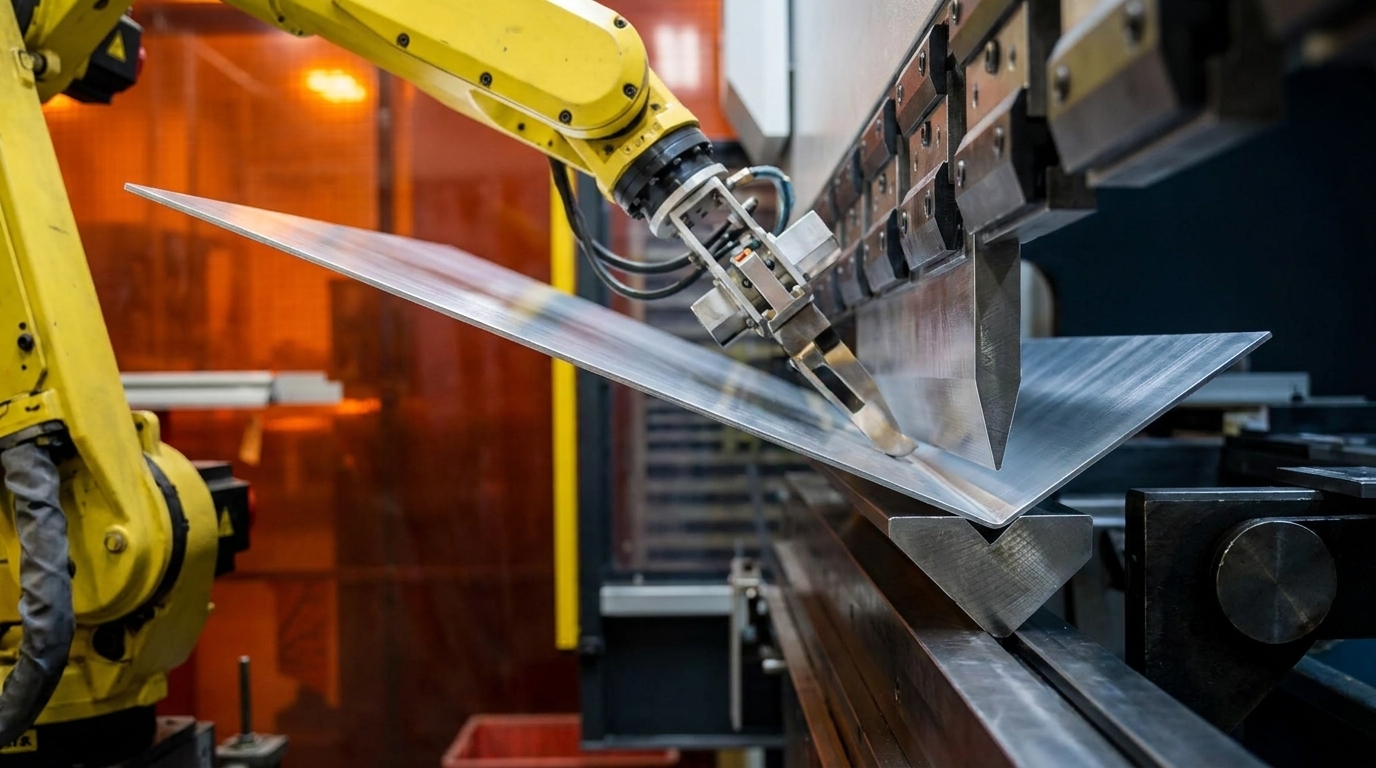
Once blanks are cut, forming operations shape flat material into functional components. Press brake folding creates precise bends and angles in sheet metal components such as brackets, panels and enclosures while minimizing springback and cracking, supporting repeatable results for both prototype and production aerospace parts. Advanced press brakes with CNC controls maintain consistent bend angles and dimensional accuracy across production runs.
TIG welding uses a non-consumable tungsten electrode to produce clean, precise welds with strong visual appearance and supports critical aerospace components made from stainless steel or titanium that require high structural integrity. Qualified welders and documented procedures ensure joint strength meets aerospace specifications.
CNC punching, hydroforming and other specialized forming processes expand the range of geometries achievable in aerospace sheet metal components. Surface finishing processes such as anodizing, chromate conversion coating and powder coating provide corrosion protection and meet appearance requirements.
Quality Standards and Certifications That Govern Aerospace Fabrication
Aerospace quality standards create the framework for reliable component manufacturing and supplier qualification. These certifications show that a fabricator can meet aerospace industry requirements consistently.
AS9100D is an aerospace-focused quality management standard that demonstrates rigorous process control and compliance with customer specifications in aviation component manufacturing. This certification builds on ISO 9001 requirements with additional aerospace-specific controls for configuration management, risk management and product safety.
AS9100 functions as a specialized quality management system standard for the aerospace industry and imposes more stringent requirements than ISO 9001. The standard addresses traceability, configuration control and continuous airworthiness, which makes it a key certification for suppliers that support high-reliability aerospace programs.
ITAR registration enables fabricators to work with defense-related technical data and components, which demonstrates compliance with export control regulations. While AS9100D and ISO 9001 govern quality management systems, ITAR focuses on access to sensitive technical data and controlled products. Aerospace suppliers typically hold AS9100D certification, ISO 9001:2015 certification, Nadcap accreditation for welding and US ITAR registration, which combines quality management, special process validation and export-control compliance for aerospace fabrication.
Nadcap approval is usually required for penetrant testing and magnetic particle testing to meet the quality demands of major aerospace OEMs. This accreditation validates special processes that cannot be fully verified through final inspection alone.
Aerospace quality control in sheet metal fabrication relies on material verification through supplier certification review, mechanical and chemical testing and full traceability. Traceability extends from raw material certification through final component delivery and supports durability, strength and resistance to environmental factors such as corrosion.
Applications and Challenges Across Aerospace Sectors
Aerospace sheet metal components support commercial aviation, defense systems and space programs. Each sector applies similar fabrication fundamentals while imposing distinct requirements for materials, processes and documentation.
Structural components such as fuselage frames, wing ribs, control surface skins and landing gear brackets require high strength-to-weight ratios and fatigue resistance. Engine components including heat shields, exhaust ducts and mounting brackets must withstand extreme temperatures and vibration. Interior components such as seat frames, galley structures and overhead bin assemblies balance weight reduction with passenger safety and regulatory requirements.
The aerospace supply chain remains fragile because many critical parts depend on a limited number of suppliers, which makes even small disruptions difficult to resolve amid economic uncertainty, changing tariff regimes and tight labor markets. A shortage of skilled labor, especially in engine and component manufacturing, continues to constrain production ramp-up plans for aircraft manufacturers. These conditions contribute to the USD 11 billion impact noted earlier.
Tier 3 and Tier 4 aerospace suppliers face working capital pressures, compressed profit margins and the need to fund raw materials and labor before customer payment. These financial pressures affect supplier capacity and reliability, which reinforces the partner selection criteria discussed later in this article.
The commercial aerospace industry faces an estimated backlog of roughly 17,000 aircraft orders, which at 2025 production rates would take manufacturers approximately 11–14 years to fulfill even without new orders. This backlog creates sustained demand for qualified fabrication partners and highlights the importance of production capacity and scalability.
Design-for-Manufacturability Practices for Aerospace Sheet Metal
Early collaboration between design and manufacturing teams reduces development time, manufacturing costs and quality issues. Effective DFM practices align component designs with fabrication capabilities and production requirements.
Sheet metal prototyping validates dimensional accuracy, form, fit and function before full production, which helps aerospace manufacturers identify refinements early and avoid costly design changes, material waste and production delays. Prototype validation confirms that designs translate effectively to production processes.
CAD software enables detailed digital modeling, simulation and manufacturability analysis in aerospace sheet metal projects, which supports accurate translation of designs into CNC programming for cutting, bending and machining operations. Digital design tools allow engineers to evaluate manufacturability before committing to tooling and production setup.
Material selection affects both performance and manufacturability. Design teams consider forming limits, welding requirements and finishing processes when specifying materials and tolerances. Bend radii, hole spacing and feature accessibility influence production efficiency and quality outcomes.
Tolerance specification balances functional requirements with manufacturing capabilities. Tighter tolerances than the application requires increase costs and lead times without improving function, while insufficient tolerances can compromise fit and performance. This trade-off makes early fabricator involvement valuable because experienced partners provide guidance on achievable tolerances for specific materials and processes.
Fabcon’s engineering team collaborates with customers during the design phase to improve manufacturability and reduce production costs. Our DFM expertise helps identify potential issues before production begins and supports smooth transfer from design to fabrication. Discuss design optimization for aerospace components with our engineering team.
Supplier Evaluation Checklist for Aerospace Sheet Metal Programs
Selecting qualified fabrication partners requires evaluation of capabilities, certifications and operational characteristics that support program success. A structured approach helps identify suppliers that can meet aerospace requirements consistently.
Certification requirements form the foundation of supplier qualification. AS9100D certification demonstrates aerospace quality management capabilities, while ITAR registration enables work on defense-related programs. Nadcap accreditation validates special processes including welding, heat treatment and non-destructive testing. ISO 9001:2015 provides the underlying quality management framework that supports continuous improvement.
Manufacturing capabilities must align with component requirements and volume expectations. Evaluation should cover equipment capabilities, capacity utilization and scalability to support program growth. Vertical integration reduces supply chain complexity and improves delivery reliability by limiting external dependencies for critical processes.
Quality systems need to provide full traceability from raw materials through final delivery. Certified aerospace suppliers are expected to inspect and certify incoming materials, in-process production and finished products under structured QA systems aligned with AS9100D and customer specifications. Inspection capabilities such as CMM measurement and non-destructive testing support quality verification.
Engineering support capabilities enable effective DFM collaboration and design optimization. Suppliers with in-house engineering resources can provide input during design development and respond quickly to engineering changes. Prototyping capabilities support design validation and production readiness.
Financial stability and operational maturity influence long-term partnership viability. Seventy-three percent of aerospace and defense manufacturers report struggling to find the skilled talent they need, and talent inefficiency can cost a median aerospace and defense manufacturer up to $330 million annually in lost productivity. Established suppliers with experienced workforces and stable operations provide greater reliability than those still building core capabilities.
Geographic location affects logistics costs, lead times and supply chain risk. Domestic suppliers support ITAR-controlled programs and reduce exposure to international trade disruptions. Proximity to customer facilities can improve communication and reduce transportation costs.
Frequently Asked Questions
What materials are most commonly specified for aerospace sheet metal components?
Aluminum alloys dominate aerospace sheet metal applications because they combine strength-to-weight performance, corrosion resistance and cost-effectiveness. The 2xxx series offers high strength for structural applications, while the 7xxx series provides higher strength for heavily loaded components. Aluminum-lithium alloys reduce weight further for next-generation aircraft. Titanium alloys support high-stress applications such as landing gear and engine components where strength and corrosion resistance justify higher costs. Inconel and other superalloys handle extreme temperature environments in propulsion systems. Stainless steel provides corrosion resistance for specific applications, while specialty alloys address unique performance requirements.
How do AS9100D and ITAR certifications affect supplier selection?
AS9100D certification shows that a supplier has implemented aerospace-specific quality management systems beyond standard ISO 9001 requirements. This certification indicates capability to handle configuration management, risk assessment and product safety requirements that aerospace programs demand. ITAR registration enables suppliers to access defense-related technical data and manufacture components for military and space applications. Together, these credentials qualify suppliers for demanding aerospace programs and provide customers confidence in quality and compliance capabilities.
What fabrication processes support repeatability in aerospace applications?
CNC-controlled processes provide the precision and repeatability that aerospace applications require. Laser cutting delivers consistent edge quality and dimensional accuracy across production runs. CNC press brakes maintain repeatable bend angles and limit springback variation. Automated welding systems maintain consistent weld quality and penetration, while CMM inspection verifies dimensional accuracy and provides statistical process control data.
Qualified welding procedures and certified welders ensure joint quality meets specifications. Environmental controls maintain consistent temperature and humidity during critical processes. Documented work instructions and structured operator training support process consistency across shifts and facilities.
How are current aerospace supply chain pressures impacting precision fabrication partners?
Supply chain bottlenecks create both challenges and opportunities for precision fabrication partners. Material availability issues affect lead times and costs, particularly for specialty alloys and high-strength materials. Skilled labor shortages increase competition for experienced fabricators and welders, which drives labor costs and extends training periods.
The large aircraft backlog provides sustained demand for qualified suppliers. OEMs invest in supplier relationships through long-term agreements and capacity support to secure reliable supply. Suppliers with established capacity, skilled workforces and appropriate certifications benefit from increased demand, while the industry trend toward supply chain consolidation favors partners that can handle multiple processes and provide integrated solutions.
What are the advantages of working with a vertically integrated aerospace fabrication partner?
Vertical integration reduces handoffs between multiple suppliers, which shortens lead times and lowers quality risk. Single-source accountability simplifies program management and reduces coordination overhead. Integrated quality systems provide traceability across all manufacturing processes and support consistent documentation.
Combined engineering resources enable comprehensive DFM support and design optimization. Consolidated scheduling improves delivery reliability and responsiveness to program changes. Integrated finishing and assembly capabilities deliver complete components ready for installation, while reduced logistics and markup layers can lower total program cost.
Conclusion: Selecting a Fabrication Partner for Mission-Critical Components
Aerospace sheet metal fabrication demands precision, compliance and reliability that qualified suppliers deliver through disciplined processes and certified systems. The current supply chain environment makes partner selection critical because delays and quality issues can cascade through complex aerospace programs.
Successful aerospace programs rely on fabrication partners with AS9100D certification, ITAR registration and proven capabilities in precision manufacturing. Vertical integration reduces supply chain complexity while supporting the quality standards that aerospace applications require. Early DFM collaboration improves manufacturability and shortens development timelines.
Fabcon combines aerospace certifications, vertically integrated capabilities and experienced engineering support to deliver reliable aerospace components. Our established capacity, skilled workforce and quality systems position us to support aerospace programs from prototype through production. Evaluate our aerospace fabrication capabilities for mission-critical components.