
Key Takeaways
-
Precision sheet metal battery enclosures support the expanding U.S. energy storage market, which installed 51 GWh of capacity in 2025.
-
Traditional procurement models create delays and quality disputes when companies manage separate vendors for fabrication, finishing and assembly.
-
Material selection among aluminum, steel and composites shapes thermal performance, structural strength and long-term reliability.
-
Early design for manufacturability collaboration cuts rework, controls costs and smooths prototype-to-production transitions.
-
Fabcon provides vertically integrated U.S. manufacturing for end-to-end battery enclosure fabrication, finishing and assembly under one roof, get a quote today.
Market Pressures on Battery Enclosure Sourcing
Engineering and supply chain teams face complex challenges when sourcing custom battery enclosures for energy storage and EV infrastructure programs. Traditional procurement models require coordination across multiple vendors for fabrication, finishing and assembly, which often introduces delays and quality disputes between suppliers.
The North America battery energy storage system market is projected to grow from $23.95 billion in 2026 to $50.02 billion by 2031. Many fabrication suppliers lack integrated capabilities that match this growth. Small job shops focus on basic sheet metal work, while large contract manufacturers impose high minimums and rigid onboarding that conflict with agile development cycles.
Wood Mackenzie forecasts that the United States will add 500 GWh of storage capacity between 2026 and 2031, a 250 percent increase over the prior six-year period. This expansion increases demand for domestic fabrication partners that scale from prototype to mid-volume production while maintaining consistent quality and delivery performance.
Request a quote for integrated fabrication that reduces vendor handoffs and accelerates project timelines.
Material Choices and Enclosure Rating Requirements
Material selection for battery enclosures shapes thermal management, structural integrity and long-term reliability. Aluminum enclosures excel in thermal management because high thermal conductivity allows heat to dissipate quickly, while low density supports closer spacing in high-density installations.
Steel enclosures provide high melting point and yield strength, which supports structural containment, fire performance and impact resistance in outdoor utility-scale BESS projects. Steel also offers strong mechanical protection for installations exposed to seismic loads or potential thermal runaway events.
Metal battery enclosures deliver mechanical protection, effective heat dissipation and EMI shielding, so they appear frequently in EVs, industrial equipment and energy storage systems. These thermal advantages become critical in high-power lithium battery systems, where heat dissipation limits overheating and reduces thermal runaway risk.
Beyond metals, composite enclosures offer specialized benefits in corrosive or high-voltage environments. Fiberglass-reinforced polymers provide electrical isolation, low thermal conductivity and resistance to electrolyte leakage, which supports use in demanding installations despite higher upfront material costs.
Design for Manufacturability Support for Battery Enclosures
Early design for manufacturability collaboration shortens development cycles and aligns designs with real production capabilities. Custom battery enclosure design for precision sheet metal applications starts with requirement definition, then CAD modeling and finite element analysis to evaluate stress from vibration, shock and mechanical loading.
Effective DFM reviews address forming limits, weld access and finishing needs before tooling investment. Key DFM challenges for sheet metal battery enclosures at prototype to mid-volume scales center on competing requirements. Engineers balance structural reinforcement for impact resistance against weight targets, manage thermal conductivity while maintaining IP67 or IP68 sealing and protect repeatable weld quality and dimensional tolerances.
Fabcon’s engineering team works with clients during design to improve manufacturability, reduce production complexity and surface potential issues before they affect schedules. This collaborative approach closes the design-to-manufacturing gap that often causes delays and cost growth in fragmented supply chains.
End-to-End Fabrication Workflow for Battery Enclosures
Integrated fabrication workflows for battery enclosures combine laser cutting, CNC punching, forming, welding and quality verification under unified process control. Prismatic sheet metal battery housings often rely on stamping and deep drawing of aluminum alloy or stainless steel sheets, which require precise tooling and process control to achieve the dimensional accuracy needed for cell assembly.
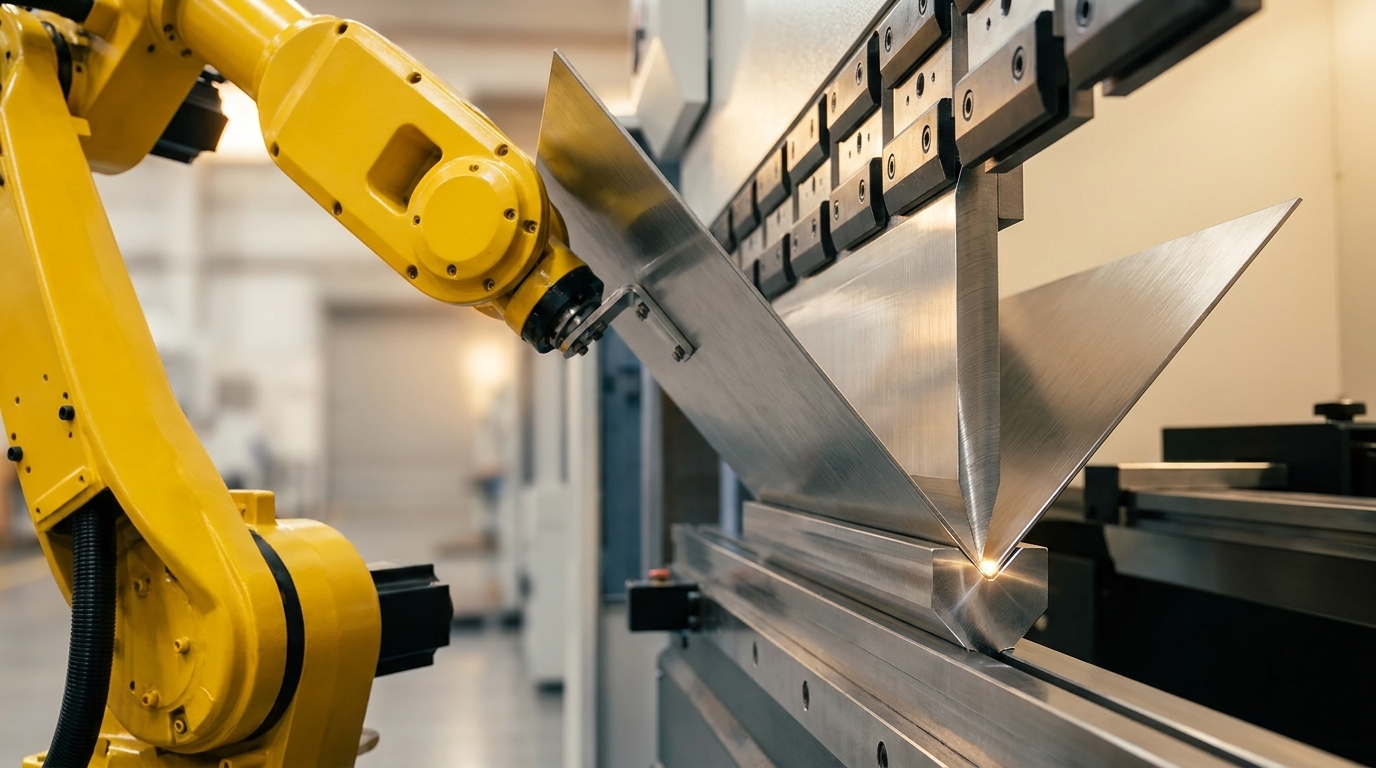
The fabrication sequence starts with precision cutting and punching to create base components with tight tolerances. Press brake forming then shapes complex geometries while holding dimensional consistency that protects internal component fit. Welding operations, including laser, MIG and friction stir techniques, join components while maintaining structural integrity and sealing performance.
After cutting, forming and welding, precision sheet metal battery enclosures receive surface treatments such as anodizing for aluminum or electroplating for steel. They then undergo air leak or immersion testing to confirm sealing performance before final assembly.
Quality checkpoints throughout the workflow confirm dimensional accuracy and surface finish. Rack-mounted BESS enclosures require tight tolerances to match standardized 19-inch racks, support proper airflow and prevent mechanical stress on electrical connectors.
Start your project with end-to-end battery enclosure fabrication that maintains quality control from raw material through final assembly.
Finishing and Light Electromechanical Assembly Under One Roof
Integrated finishing and light electromechanical assembly reduce vendor count and shorten lead times for battery enclosure programs. Finishing processes for battery enclosures include anodizing aluminum casings to increase oxide layer thickness, electroplating steel casings and applying corrosion-resistant coatings.
Powder coating delivers durable, scratch-resistant surfaces that perform well in harsh environments. Powder coating serves as the industry standard finish for steel battery racks and cabinets, providing durable, scratch-resistant and acid-corrosion-resistant surfaces in environments with lead-acid battery emissions.
Light electromechanical assembly for battery enclosures includes joining stamped components by welding or mechanical fastening, then mounting accessories such as top covers, explosion-proof valves, terminals and connectors. This integrated workstream supports consistent fit and finish while preserving enclosure integrity.
Fabcon’s in-house finishing capabilities include powder coating, wet paint, anodizing and specialized coatings performed in controlled environments. Light electromechanical assembly services cover hardware insertion, wiring integration and component mounting, which produces battery enclosures ready for field installation.
Quality, Traceability and Regulatory Compliance
Battery enclosures for energy storage and EV infrastructure must meet strict quality and traceability standards to satisfy safety and regulatory requirements. OSHA standard 1910.305(j)(7) requires provisions for diffusion and ventilation of gases from storage batteries to prevent explosive mixtures inside enclosures.
OSHA 1910.305(e)(1) states that cabinets, cutout boxes, fittings, boxes and panelboard enclosures in damp or wet locations must prevent moisture or water from entering and accumulating. These rules drive design specifications for sealing performance and environmental protection.
Fabcon maintains ISO 9001:2015 and AS9100D certifications with quality management systems that provide full traceability for materials, processes and testing. ITAR registration supports defense and critical infrastructure programs that require enhanced security and documentation.
Quality verification after fabrication and finishing includes air leak testing, which pressurizes sealed enclosures and monitors pressure loss, and immersion or water pressure testing to confirm IP67 or IP68 sealing performance. These steps confirm that enclosures meet environmental protection requirements for outdoor installations.
Scaling from Prototype to Mid-Volume Production
Agile production cells support efficient scaling from prototype quantities to mid-volume production without the constraints of large contract manufacturers. As the North American market expands toward $50 billion by 2031, projects above 500 MWh in North America are growing at 29.0 percent CAGR, which increases demand for scalable enclosure platforms that move from pilot units to large system deployments.
Flexible manufacturing approaches handle changing volumes, mixed SKUs and evolving bills of materials that appear in energy storage development programs. Rigid production lines often require high minimums and long setup times, while agile cells adapt to program requirements and maintain consistent quality.
Fabcon’s 220,000 square feet of manufacturing space supports scalable production from prototype through mid-volume runs. Flexible production cells reduce the overhead and rigidity of large contract manufacturers while providing the infrastructure and capabilities needed for complex battery enclosure projects.
Explore scalable fabrication options that grow with evolving program requirements.
Checklist for Evaluating Battery Enclosure Fabrication Partners
Engineering and supply chain teams can evaluate potential battery enclosure fabrication partners using criteria that address technical capability, quality systems and program support:
-
Design for manufacturability collaboration and engineering support
-
Integrated fabrication, finishing and light assembly in a single facility
-
ISO 9001:2015, AS9100D or equivalent quality certifications
-
Material traceability and documentation systems
-
Prototype-to-mid-volume production scaling capabilities
-
Environmental testing and IP rating verification
-
Lead time reliability and delivery performance history
-
Domestic manufacturing location and supply chain control
-
Experience with energy storage and EV infrastructure applications
-
Responsive customer support and program management
Suppliers should show proven experience with precision sheet metal fabrication, thermal management needs and environmental protection standards for battery enclosures. Integrated capabilities reduce vendor count and cut coordination delays that affect project schedules.
Conclusion: Selecting an Integrated Domestic Fabrication Partner
Rapid growth in U.S. energy storage and EV infrastructure creates strong opportunities for organizations that manage the technical and supply chain demands of custom battery enclosure fabrication. Fragmented supply chains and design-to-manufacturing gaps increase project risk and slow critical deployments.
Fabcon’s vertically integrated U.S. facilities deliver complete battery enclosure solutions from design collaboration through final assembly. The 220,000 square feet of manufacturing space, ISO 9001:2015 and AS9100D certifications and end-to-end capabilities support quality traceability and reliable delivery performance.
Domestic fabrication partners that understand technical requirements and market dynamics help programs reach deployment targets with confidence. Get a quote for integrated battery enclosure fabrication that accelerates program timelines and reduces supply chain complexity.
Frequently Asked Questions
How does early DFM collaboration affect battery enclosure lead times?
Early design for manufacturability collaboration reduces battery enclosure lead times by resolving manufacturing challenges before production. When engineering teams work with fabrication partners during design, they refine part geometry, material selection and assembly methods to remove rework and production delays.
This proactive work prevents costly design changes during tooling or production phases that extend schedules. DFM collaboration also supports accurate quoting and production planning, which allows fabrication teams to prepare tooling and materials in advance. The result is a streamlined workflow that delivers finished enclosures faster than traditional design-then-quote models.
What material choices best support thermal management in utility-scale battery storage enclosures?
Aluminum alloys, particularly 6061-T6, provide strong thermal management performance for utility-scale battery storage enclosures because of high thermal conductivity and low weight. Aluminum’s conductivity supports efficient heat dissipation from battery cells, which helps maintain stable operating temperatures and extends system life.
Steel enclosures offer greater structural strength and fire performance but often require supplemental cooling because of lower thermal conductivity. For specialized applications, composite materials provide electrical isolation and thermal barriers between modules at higher cost. The final choice depends on thermal loads, environmental conditions and structural requirements, and effective thermal management reduces overheating, slows capacity loss and supports safe operation.
Which certifications are required for EV battery enclosure manufacturers serving U.S. infrastructure projects?
EV battery enclosure manufacturers serving U.S. infrastructure projects typically require ISO 9001:2015 quality management certification as a baseline for consistent processes and quality control. Projects with federal funding or critical infrastructure often call for AS9100D certification, which builds on ISO 9001 with added requirements for risk management and configuration control.
ITAR registration applies to defense-related or security-sensitive applications. UL and CSA compliance confirm that enclosures meet electrical safety standards, while IP67 or IP68 ratings verify environmental sealing. Some programs also require automotive standards such as IATF 16949 or other industry-specific certifications, so teams benefit from confirming requirements early in procurement.
How can companies reduce vendor count while maintaining quality traceability for custom battery enclosures?
Companies reduce vendor count and maintain quality traceability by working with vertically integrated manufacturers that provide fabrication, finishing and light assembly in one facility. This approach removes the need to coordinate separate suppliers for sheet metal work, coating, hardware insertion and wiring integration. Integrated manufacturers maintain quality systems that track materials, processes and testing across the full production workflow, which supports traceability from raw materials to finished assemblies.
Digital quality tools provide real-time visibility into production status and quality metrics, while standardized documentation keeps records consistent. Single-source suppliers with strong certifications can match the traceability of multiple specialized vendors while reducing coordination complexity and quality handoff issues.
What factors should be considered when selecting between aluminum and steel for battery enclosure applications?
Selection between aluminum and steel for battery enclosures depends on thermal needs, structural loads, environmental conditions and cost. Aluminum offers higher thermal conductivity for heat dissipation, lower weight for transport and installation and natural corrosion resistance in many environments. Steel provides higher structural strength for impact resistance, stronger fire containment and lower material cost for large enclosures.
Environmental factors such as coastal salt exposure, chemical atmospheres and temperature extremes affect durability and coating requirements. Application-specific needs include mounting loads, seismic performance, electromagnetic shielding and maintenance access. The final decision should balance performance with total cost of ownership, including material, fabrication, finishing and long-term maintenance over the system’s service life.