
Key Takeaways
-
CNC punching uses computer-controlled turret presses to create precise holes, slots and formed features in sheet metal at high speed.
-
The process excels at rapid production of ventilation holes, mounting patterns and three-dimensional forms like louvers without secondary forming.
-
Material selection and thickness shape punchability, edge quality and tolerances across carbon steel, stainless steel and aluminum alloys.
-
Compared with laser cutting, CNC punching offers stronger forming capability and faster processing for parts with many identical holes, though deburring is often required.
-
Fabcon provides expert CNC punching services and vertically integrated fabrication that streamlines complex precision sheet metal programs.
Step-by-Step CNC Punching Sheet Metal Workflow
The CNC punching process follows a clear sequence that turns programmed designs into finished sheet metal components.
-
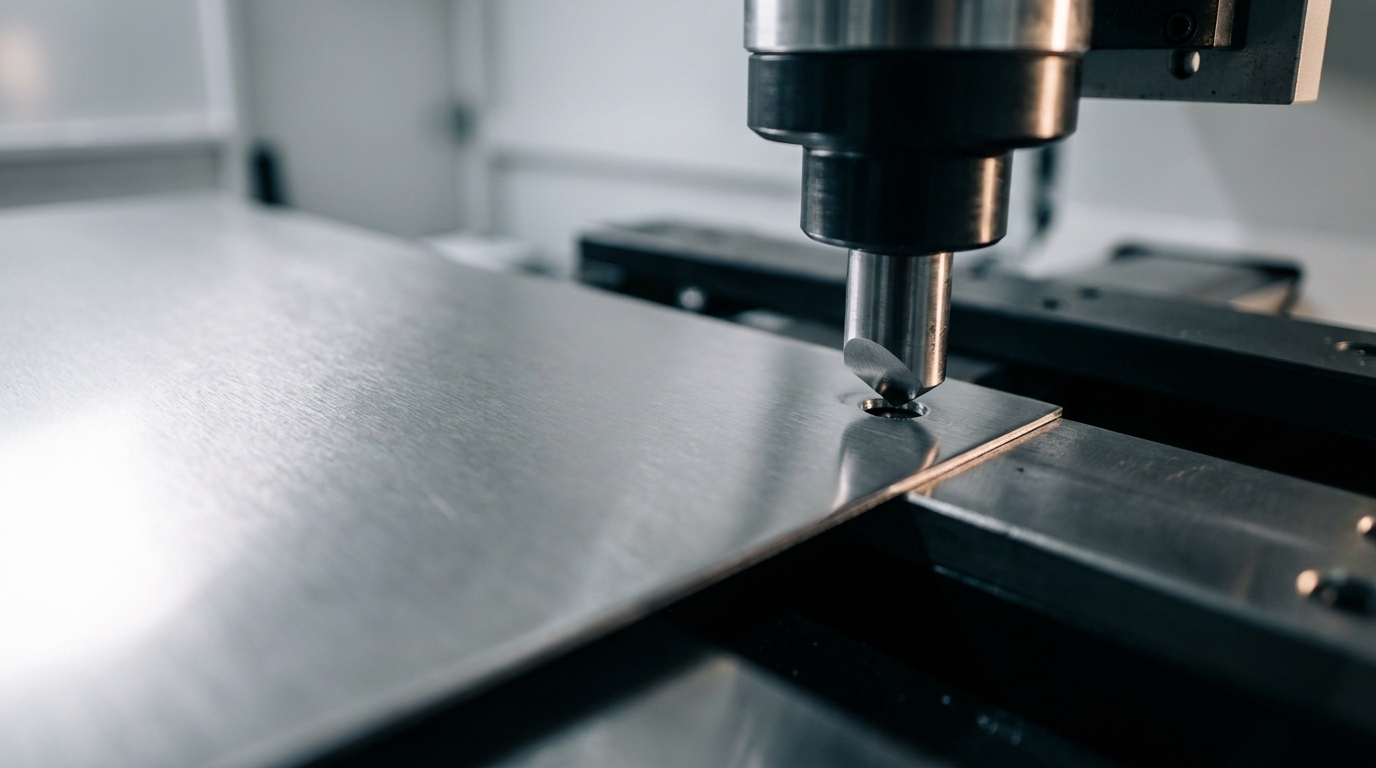
Material loading: Operators position sheet metal on the machine table using pneumatic clamps or magnetic hold-downs that secure the workpiece while allowing precise X-Y positioning.
-
Tool selection: The CNC controller rotates the turret to place the required punch and die set beneath the ram based on the programmed sequence.
-
Positioning: Servo-driven axes move the sheet so the target location aligns with the selected tooling.
-
Punching operation: The ram drives the punch through the material and into the die, creating the programmed feature in a single stroke.
-
Cycle repetition: The machine repeats this cycle for each feature until the program finishes.
Tooling choices strongly influence process success and part quality. Standard punch and die sets handle common hole sizes and shapes, while specialized tooling supports forming operations such as countersinks, dimples and louvers. Corner radii and feature spacing must match available tooling to avoid expensive custom tools and schedule impact.
Pattern complexity then shapes programming efficiency and cycle time. Simple rectangular arrays run quickly and need few tool changes. Complex geometries that require frequent tool changes or sheet repositioning slow production and increase wear. Effective programming links tooling limits with pattern layout to reduce turret rotation and sheet movement, which raises throughput.
Material and Thickness Choices That Affect CNC Punching
Material and thickness choices define what CNC punching can achieve for precision sheet metal work. Carbon steel, stainless steel and aluminum alloys dominate production and each behaves differently under the punch.
Carbon steel provides strong punchability across common thickness ranges. Its consistent properties and moderate hardness limit tool wear and support clean, repeatable holes, so many shops treat it as the baseline material.
Stainless steel, by contrast, demands closer attention to work hardening and tool selection. It punches in similar thickness ranges to carbon steel but generates more heat and needs sharper tooling to maintain edge quality and control burr height.
Aluminum alloys punch cleanly with low burr formation, which suits applications that require smooth edges. Lower strength allows thicker sections to run at reduced punch loads, which extends tool life and supports lighter tooling setups.
Material thickness also shapes tolerances and feature quality. Thin material can distort around punched features and may need support strategies. Thick sections require higher tonnage, limit fine detail and can restrict the complexity of formed features.
Advantages of CNC Punching in Precision Sheet Metal Production
CNC punching offers clear advantages for precision sheet metal fabrication when parts contain many repeated features or formed elements. These strengths make it a strong fit for specific component families.
High-speed production stands out as a core benefit. Turret presses process parts with numerous holes faster than most alternatives, which suits server rack doors, electrical enclosures and ventilation panels used in data center and infrastructure programs.
Three-dimensional forming capability further separates CNC punching from cutting-only processes. A single setup can handle louvering, beading, embossing, stiffeners, bosses, flanges, countersinks and shallow draws, which reduces secondary bending and handling.
Repeatability and consistency come from the mechanical nature of each hit. With proper tooling and setup, every stroke produces the same result, which protects dimensional consistency across large production runs and supports precise mounting patterns and mating features.
Material properties remain stable because turret punching is a cold process. It avoids heat-affected zones and thermal distortion that can appear with thermal cutting, which benefits structural and electrical performance.
Infrastructure and technology programs gain from this mix of speed, forming and consistency. Energy storage cabinets rely on rapid hole production for ventilation and mounting. Traffic safety components use formed features for reinforcement and mounting points. Data center projects apply the same capabilities for high-volume panels and doors that combine airflow control with structural strength.
Explore CNC punching solutions for high-volume ventilation panels, electrical enclosures and infrastructure components.
CNC Punching vs Laser Cutting for Sheet Metal Parts
CNC punching and laser cutting serve different needs, so process selection should match part geometry, volume and quality targets. Each method offers strengths that align with specific design profiles.
Speed performance depends on geometry. CNC turret punching usually runs faster than laser cutting for parts dominated by holes in carbon steel, especially when features repeat. Laser cutting becomes faster for complex contours and profiles where punching would need extensive nibbling.
Edge quality also differs. Turret punching creates sheared edges with micro-serrations and burrs that often require deburring. Laser cutting produces narrow kerfs with smooth, burr-free edges that may need no secondary finishing.
Forming capability gives CNC punching a decisive edge over laser cutting, which only produces 2D cuts and needs secondary forming. Earlier sections described how turret presses form louvers and other 3D features during the punching cycle.
Material utilization typically favors laser cutting for complex parts. Tight nesting, common-line cutting and full use of sheet edges reduce scrap, while punching needs clamp zones and skeleton structures that consume material.
Setup flexibility also differs. Fiber lasers cut directly from a DXF file and handle design changes with minimal setup. Punching requires specific tooling for each feature size, which adds planning and inventory needs.
Operational factors round out the comparison. Turret presses generate more noise and need regular mechanical maintenance, including tool sharpening and turret alignment. Fiber lasers run more quietly and focus on optics cleaning and general preventive care.
Process choice should match part characteristics. Parts dominated by holes usually favor CNC punching on speed and cost. Parts dominated by contours or intricate perimeters often favor fiber laser cutting on throughput and flexibility.
Common CNC Punching Limits and Practical Workarounds
CNC punching carries inherent limits that affect part quality, efficiency and design freedom. Clear awareness of these limits supports better designs and smoother production.
Edge quality limits stem from the mechanical shearing action. Turret punching produces a slight burr and a sheared edge, especially as thickness increases or tools wear. Many programs plan deburring or finishing steps, which add cost and time but improve safety and fit.
Tool wear affects both quality and economics. Punch and die sets wear over time, which raises burr height and shifts dimensions. Turret punching also needs specific tooling for each feature size, so missing tools can introduce cost and lead time for new sets.
Geometric constraints restrict some designs compared with thermal cutting. Sharp internal corners challenge punching and often require nibbling, which creates scalloped edges and accelerates wear. Complex contours follow the same pattern and may justify hybrid processing.
Formed feature limits further shape design choices. The 3:1 rule for CNC punching states that feature height above the material surface should not exceed three times the material thickness. Exceeding this ratio risks tearing, springback, wrinkling and rapid tool wear.
Mitigation strategies focus on early design collaboration and disciplined process control. Experienced fabricators can review material selection, feature spacing and forming requirements before tooling investment. Regular tool inspection, preventive maintenance and process monitoring help maintain consistent results. Hybrid approaches that combine punching for standard features with laser cutting for complex contours often balance cost and quality.
DFM Practices That Improve CNC Punching Results
Design for manufacturability in CNC punching centers on feature spacing, material behavior and tooling limits. Strong DFM reduces cost, stabilizes quality and shortens launch timelines.
Hole spacing and pattern layout directly influence tool life and part integrity. Minimum spacing should protect material flow and strength around punched holes. Standard press brake tooling requires any feature to sit 3 to 4 times the material thickness away from a bend edge to prevent deformation or loss of function.
Corner radius choices also matter. Sharp internal corners require nibbling, which roughens edges and accelerates punch wear. Designing with standard tool radii removes custom tooling needs and improves surface finish.
Tolerances should reflect both function and process capability. Turret punching supports tight hole and positional tolerances in the ±0.05 to 0.15 mm range, although accuracy can shift with tool wear, nibbling or large-part repositioning. Effective DFM applies tight tolerances only where function requires them and relaxes noncritical dimensions.
Formed feature design must follow material and process limits. As noted earlier, the 3:1 rule constrains formed feature height relative to material thickness. Designs that exceed this ratio often need alternative forming methods or multiple smaller features.
Tool standardization supports faster setups and lower tooling cost. Parts that use standard punch sizes and shapes avoid custom tool lead times and gain from better tool utilization across programs.
Pattern optimization ties these ideas together. Grouping similar features reduces tool changes. Designing with standard shapes limits nibbling. Locating critical features outside clamp zones protects accuracy. Maintaining adequate skeleton material keeps parts stable during processing.
Early collaboration with manufacturing partners strengthens each of these choices. Integrated engineering support highlights risks and improvement options before production, which reduces rework and protects schedules.
Connect with fabrication engineers who can review designs for punching efficiency before tooling investment.
Where CNC Punching Excels in Real-World Applications
CNC punching supports critical components across infrastructure and technology markets where precision, durability and hole-intensive designs drive decisions.
Data center infrastructure uses CNC punching for server rack doors, cable management panels and airflow control components. Dense ventilation patterns and integrated louvers support thermal management, while high-volume capacity aligns with hyperscale and edge deployments.
Energy storage and power distribution systems depend on punched weatherproof enclosures, battery cabinet ventilation and electrical panel components. Precise mounting patterns support heavy equipment, and formed reinforcements and sealing features protect performance in harsh environments.
Traffic safety and transportation infrastructure apply CNC punching to guardrails, barrier systems and signage mounting hardware. Formed features add strength, and punched patterns support drainage and weight reduction while meeting structural requirements.
Medical device manufacturers use precision hole patterns and formed features for equipment carts, laboratory furniture and diagnostic equipment enclosures. Clean edges and consistent patterns support cleanliness and regulatory needs.
Telecommunications infrastructure relies on punched antenna mounts, equipment enclosures and cable management components. Accurate hole patterns protect RF performance and environmental sealing, while formed structural elements meet wind and seismic demands.
Industrial OEMs apply CNC punching to control panels, machinery guards and equipment enclosures. Standard and custom hole patterns combine with formed features that enhance usability and structural performance.
Benefits of a Vertically Integrated U.S. CNC Punching Partner
Vertically integrated U.S. fabricators provide strong advantages for CNC punching programs in infrastructure and technology markets. Consolidated fabrication, finishing and assembly reduce risk and simplify management.
Simplified supply chains cut vendor coordination and reduce handoff delays between separate suppliers. Integrated operations provide single-point accountability for complete assemblies and reduce purchase order and qualification overhead.
Quality consistency improves when all operations share common quality systems and process controls. ISO 9001:2015 and AS9100D certifications support traceability from raw material through final assembly and remove quality disputes between vendors.
Engineering collaboration benefits from direct access to manufacturing experts. Early DFM input refines designs for efficient punching, identifies cost reduction options and improves quality. Integrated teams shorten design cycles and speed the move from prototype to production.
Prototype-to-production agility supports changing volumes and evolving bills of material. Flexible cells scale without high minimums or long onboarding, which suits technology programs with shifting requirements.
Delivery reliability improves through internal scheduling and reduced reliance on external suppliers. Integrated facilities remove shipping delays between fabrication and finishing, while domestic production supports shorter, more predictable lead times.
Regulatory compliance becomes easier with established U.S. manufacturers that hold relevant certifications and sector experience. Domestic operations provide better visibility into compliance activities and reduce international supply chain risk.
Frequently Asked Questions
How does CNC punching handle forming features like louvers?
CNC punching handles formed features such as louvers, embossments and dimples using specialized tooling during the punching cycle. The machine forms three-dimensional features in the same setup used for hole creation, which removes separate bending operations and reduces handling. Formed features must still follow the 3:1 rule, so feature height cannot exceed three times the material thickness. Tall louvers or deep embossments may need stamping with custom tooling or multi-stage forming. The main advantage lies in combining hole creation and forming in one controlled process.
What design rules help minimize tool wear during high-volume punching?
Several design rules help extend tool life in high-volume work. Designs should avoid heavy nibbling for complex contours and instead use standard tool shapes and radii. Adequate spacing between features protects material integrity and reduces stress on tools. Corner radii should match available tooling rather than sharp internal corners. Material choice should consider hardness, since harder alloys increase wear. Hole patterns should group similar features to reduce frequent tool changes. Designers should also avoid extremely small holes relative to thickness, which create high stress and raise the risk of punch breakage.
When does CNC punching make sense for enclosure components?
CNC punching suits enclosure components that contain many holes, require formed features or run at higher volumes. Server rack doors, electrical panels and ventilation components with dense patterns benefit from fast cycle times and integrated forming for louvers, bosses and reinforcements. Laser cutting becomes a better fit for enclosures with complex perimeters, intricate cutouts or frequent design changes that would demand new tooling. Many programs use a hybrid approach, with punching for repetitive features and laser cutting for unique profiles.
How can early DFM collaboration improve mid-volume sheet metal programs?
Early DFM collaboration improves mid-volume sheet metal programs by uncovering optimization options before tooling and production commitments. Manufacturing partners can adjust designs to reduce tool changes, limit nibbling and improve cycle times. They can align tolerances with process capability and remove unnecessary tight specifications. DFM input can also improve material utilization and encourage standard tooling. Early reviews highlight risks such as features near bends or forming that exceeds material limits. For mid-volume work, these steps reduce per-piece cost, stabilize quality and speed ramp-up while building strong communication for future changes.
Conclusion: Selecting a CNC Punching Partner for Complex Programs
CNC punching delivers strong value for precision fabrication projects that require high hole density, formed features and efficient production. Successful programs align design choices with process capabilities and pair them with effective DFM and the right manufacturing partner.
Key decisions include matching part geometry to punching limits, aligning volume with tooling investment and setting quality expectations that fit the process. Designs that use standard tooling, limit nibbling and apply forming strategically gain the most benefit.
Supply chain performance grows more important as programs move from prototype to production. Vertically integrated U.S. partners provide engineering collaboration, quality consistency and delivery reliability while reducing vendor complexity.
Combining advanced CNC punching with integrated fabrication, finishing and assembly shortens development cycles and improves quality and schedule predictability. This model suits mid-volume programs that need agility without the constraints of large contract manufacturers.
Start your project with a U.S. fabricator offering punching, finishing and assembly under one roof.