
Key Takeaways for Data Center Laser Cutting
-
Sheet metal laser cutting supports precise fabrication of server racks, enclosures and cooling panels that enable AI-driven data center expansion to 200 GW by 2030.
-
Fiber lasers deliver fast cutting speeds, accurate edges and repeatable results on aluminum, stainless steel and carbon steel used in data center hardware.
-
Vertical integration reduces supply chain fragmentation, maintains consistent quality and supports smooth scaling from prototypes to full production.
-
Design for manufacturability improves airflow, structural strength and cost control in high-density racks and edge computing fixtures.
-
Fabcon provides US-based, ISO-certified precision laser cutting aligned with hyperscale data center requirements.
How Data Centers Use Laser-Cut Sheet Metal Components
Modern data centers depend on laser-cut sheet metal across core infrastructure. Server racks and chassis house dense electronic equipment that generates significant heat. These structures require precise perforations that guide airflow and support targeted cooling.
AI workloads increase rack density and power draw, which intensifies thermal loads. As density rises, ventilation patterns must follow engineered layouts that protect components and maintain structural integrity under continuous stress.
Modular enclosures protect electronics while supporting rapid deployment and reconfiguration. These units integrate cable management features and provide electromagnetic interference shielding. Cooling panels and heat exchangers rely on engineered perforation patterns that move air efficiently while preserving panel strength.
Mounting brackets and structural frames carry heavy loads and maintain alignment across large assemblies. Accurate brackets support consistent positioning of servers, power systems and cooling hardware. Cable management trays route power and data connections cleanly. Edge computing fixtures pack this functionality into compact footprints that serve distributed locations.
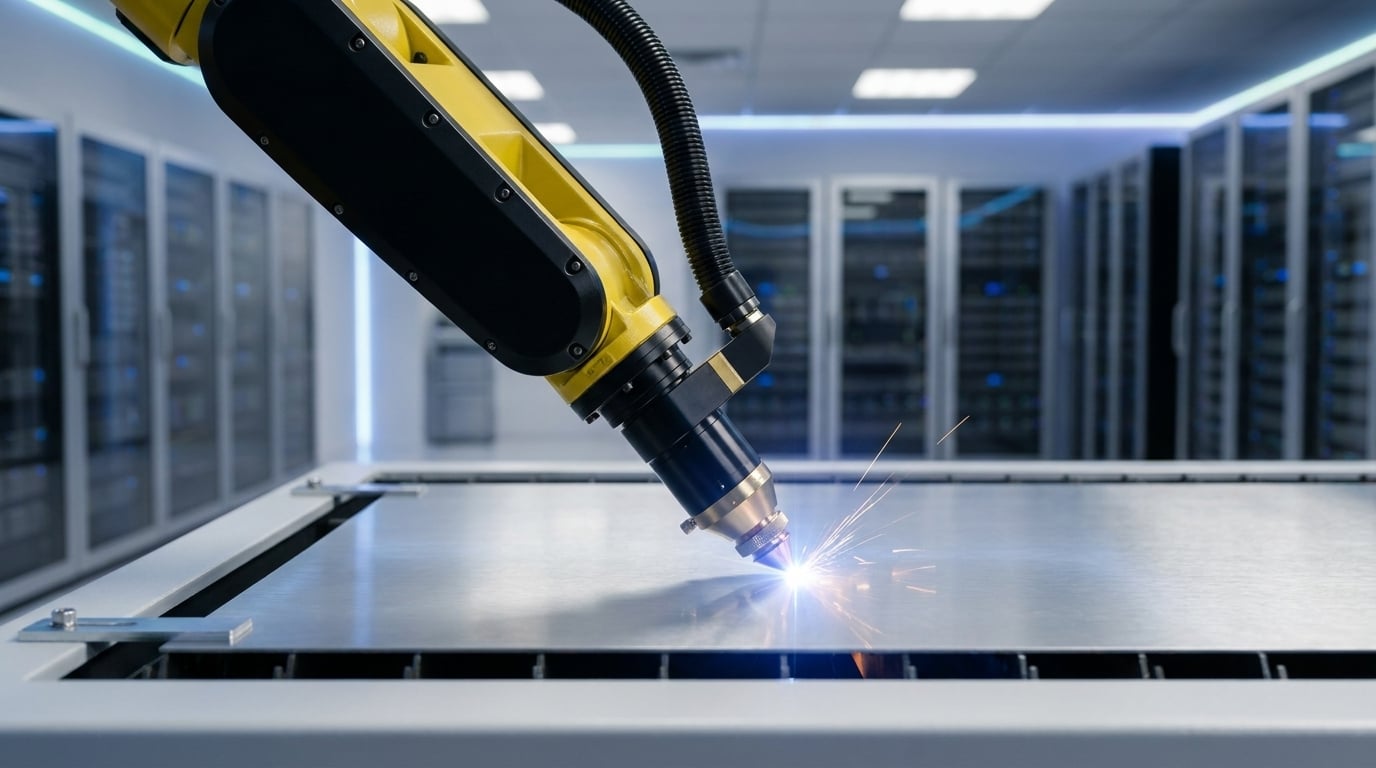
Fiber laser cutting supports these applications with complex geometries and tight tolerances. The process produces smooth, accurate cut surfaces that reduce secondary finishing. Dimensional accuracy holds across high-volume runs and repeat orders. See how fiber laser cutting supports precision data center components.
Performance Advantages of Fiber Laser Cutting
Fiber laser technology outperforms many traditional cutting methods for data center components. High-power fiber lasers cut mild steel faster than plasma cutters. Faster cutting supports shorter lead times for structural parts and enclosures.
Fiber lasers also handle reflective metals common in data centers. Fiber lasers with nitrogen assist cut thin stainless steel at high speeds. This capability supports high-volume fabrication of stainless steel enclosures, cooling panels and airflow components.
Fiber lasers create weld-ready surfaces with minimal heat-affected zones. Reduced heat input limits distortion and preserves material properties near the cut edge. Clean, accurate cuts reduce grinding and deburring, which shortens downstream processing and supports precise assembly of complex systems.
Digital control systems maintain consistent beam positioning and power delivery. This control supports repeatability across long production runs and future reorder cycles. Consistent parts fit together as designed, which protects alignment and performance in dense rack environments.
Fiber lasers also convert electrical power to cutting energy efficiently. Fiber lasers outperform traditional CO2 lasers on energy use and cutting speed. Higher efficiency reduces operating costs for data center enclosure and hardware production.
Material Choices and Design Decisions for Data Center Hardware
Material selection shapes performance, durability and manufacturability of data center components. Aluminum alloys provide strong yet lightweight structures with corrosion resistance for enclosures and support elements. Aluminum 5052 provides better bendability than 6061 for enclosures with tight bends. Improved bendability reduces cracking risk and scrap during forming.
Stainless steel grades 304 and 316 deliver corrosion resistance and electromagnetic shielding. These grades suit cooling systems and environments with moisture or cleaning agents. Carbon steel offers cost advantages for structural frames and brackets where protective coatings manage corrosion.
Design for manufacturability works best when engineering and fabrication teams collaborate early. Holes positioned too close to edges increase cracking risk. Minimum spacing guidelines, matched to each material and thickness, prevent weak points. Bend radius specifications aligned with alloy and gauge further reduce forming defects.
Airflow requirements also guide design decisions. Perforation patterns must balance thermal performance with panel strength and stiffness. Standard gauges and thicknesses simplify production, control cost and support reliable supply. Review Fabcon’s design for manufacturability support for data center projects.
Managing Supply Chain Risk in Data Center Fabrication
Traditional sourcing models for data center components create operational complexity. Fragmented vendor networks require multiple purchase orders, separate delivery schedules and varied quality systems. Each additional supplier increases coordination work and extends lead times during critical deployment windows.
Many job shops focus on basic sheet metal cutting only. Customers then source finishing, assembly and integration from other vendors. Large contract manufacturers may offer broader capabilities but often require high minimum volumes and long onboarding cycles that conflict with fast development timelines.
Quality variation grows when different vendors handle cutting, forming and finishing. Small dimensional shifts at each stage can accumulate and affect fit during assembly. Traceability also becomes harder when parts move through several facilities with different documentation practices.
Vertically integrated manufacturing addresses these issues by consolidating fabrication, finishing and assembly in one organization. This structure reduces handoffs between companies and simplifies communication. Single-source accountability supports consistent quality standards and faster responses to design changes or schedule shifts.
This integrated approach aligns well with data center sheet metal needs, where precision and reliability carry high stakes. Consolidated operations support earlier design for manufacturability input, faster prototype cycles and smoother scaling from pilot builds to production volumes.
Why Fabcon’s US-Based Integrated Model Fits Data Centers
Fabcon applies decades of precision manufacturing experience to data center applications through a vertically integrated model. ISO 9001:2015 and AS9100D certifications support robust quality systems. ITAR registration enables work on defense and critical infrastructure programs.
Fabcon’s Southern California facilities house laser cutting, forming, welding, finishing and assembly in one coordinated footprint. This consolidated structure mirrors the integrated approach described earlier and streamlines coordination and quality control across every stage.
Design for manufacturability collaboration begins early in the project lifecycle. Engineering teams refine designs for production efficiency, cost control and consistent quality. Early input reduces redesign cycles and supports faster development.
Agile production cells adjust to changing volumes and mixed part numbers. This flexibility supports evolving data center technologies and hardware refresh cycles. Facilities also support complex assemblies that combine sheet metal, hardware and electromechanical elements.
US-based manufacturing strengthens supply chain security and responsiveness. Domestic production avoids international shipping delays and supports rapid prototype iterations. Start a conversation about data center fabrication requirements.
Checklist for Selecting a Scalable Laser Cutting Partner
Procurement and engineering teams can use this checklist when evaluating potential partners:
-
Vertical integration that covers cutting, forming, finishing and assembly
-
Proven design for manufacturability expertise with early engineering collaboration
-
Quality certifications such as ISO 9001:2015 and relevant industry standards
-
US-based manufacturing footprint that supports supply chain security and responsiveness
-
Flexible production systems that scale from prototype to full production
-
Robust traceability and documentation for critical infrastructure projects
-
Experience with data center hardware and thermal management requirements
-
History of delivering complex assemblies and electromechanical integration
Frequently Asked Questions
What does laser cutting provide for data center cooling?
Laser cutting creates precise perforations and geometries in cooling panels, heat exchangers and airflow components. These patterns support complex ventilation layouts that improve thermal performance while preserving structural strength. Fiber lasers produce accurate, burr-free edges that reduce secondary finishing and support reliable fit in cooling assemblies.
Which US providers support data center sheet metal fabrication?
Strong providers combine laser cutting capability with integrated fabrication, quality certifications and data center experience. Ideal partners offer design for manufacturability collaboration, flexible scaling and comprehensive finishing. US-based facilities add supply chain security and fast response times for infrastructure work.
How do manufacturers scale laser cutting from prototype to production?
Effective scaling starts with early design for manufacturability collaboration, standardized materials and stable processes. Agile manufacturing cells adjust to changing volumes without the constraints of high minimums. Integrated facilities manage cutting, forming and finishing in one organization, which supports smoother transitions while maintaining quality.
How does design for manufacturability affect data center components?
Design for manufacturability shapes components for efficient production while meeting performance targets. Early collaboration highlights potential issues, improves material use and reduces cost. Strong DFM practices prevent problems such as holes near bend lines, unnecessary tight tolerances and complex features that add expense without functional gains.
How does integrated manufacturing compare with job shops?
Integrated manufacturing brings cutting, forming, finishing and assembly together in one coordinated operation. This structure reduces coordination work and supports consistent quality. Job shops typically focus on cutting only, which requires customers to manage additional vendors for later stages.
The 2026 data center expansion wave depends on precise sheet metal components that support efficient operation and rapid deployment. Laser cutting delivers speed, accuracy and flexibility for these parts and scales from prototype to high-volume production. Vertically integrated manufacturers understand both technical requirements and operational pressures. Connect with Fabcon to explore precision laser cutting for upcoming data center projects.