
Key Takeaways
- Laser cutting supports precise fabrication of critical data center components such as server racks, enclosures and cooling manifolds with tight tolerances and complex geometries.
- Fiber lasers cut reflective materials such as aluminum, copper and galvanized steel while limiting heat-affected zones and producing burr-free edges.
- Design-for-manufacturability (DFM) practices improve nesting, bend reliefs and assembly clearances, which reduces waste and accelerates production.
- Vertical integration reduces supply chain handoffs, which provides single-point accountability, shorter lead times and consistent quality control.
- Fabcon brings more than 45 years of experience in laser cutting and assembly of data center components from prototype through production.
Laser-Cut Components That Anchor Data Center Performance
Server racks form the backbone of data center infrastructure, so precision matters. These structures require accurate mounting holes, strong load-bearing capacity and efficient airflow paths. Traditional punching methods struggle with the complex geometries these demands create. Laser cutting supports intricate ventilation patterns and integrated cable management features that improve cooling and organization. Precision nesting reduces material waste while maintaining the tight tolerances required for reliable equipment mounting.
Equipment enclosures protect sensitive electronics and guide airflow while limiting electromagnetic interference. Laser cutting produces clean, burr-free edges that remove the need for secondary deburring and support reliable gasket sealing. The process handles complex bend patterns and integrated mounting features without sacrificing accuracy. These capabilities streamline assembly and support consistent enclosure performance.
Cooling manifolds and brackets support liquid cooling systems that now serve high-density AI workloads. Hyperscale cloud providers have shifted from power-hungry copper links to optical solutions since approximately 2023. These optical links help manage GPU cluster latency and power draw. Co-packaged optics reduce switch power consumption and increase thermal demands on surrounding hardware. These cooling components require precise flow channels and accurate mounting points, which laser cutting delivers with minimal heat-affected zones.
Manufacturing these precision cooling and structural components at scale requires advanced laser cutting and strong assembly expertise. Fabcon’s experience in chassis and rack fabrication supports seamless integration of laser-cut parts into complete assemblies. The company’s vertically integrated model reduces vendor handoffs that slow data center deployments and complicate quality control. Get a quote for a laser-cut data center components project.
Material Choices for Laser-Cut Data Center Hardware
Fabcon works with materials and processes that meet durability and reliability expectations for demanding data center environments.
Aluminum alloys provide strong thermal conductivity and low weight. These properties support cooling components, removable panels and mobile rack systems. Galvanized steel offers corrosion resistance for structural frames and brackets while maintaining formability for complex shapes.
Material selection checklist for data center components:
- Corrosion resistance in high-humidity environments
- Thermal conductivity for effective heat dissipation
- Electromagnetic shielding performance
- Weight impact on rack loading and handling
- Compatibility with standard fasteners and hardware
Copper alloys support power distribution and grounding systems where electrical conductivity takes priority. These parts often include busbars, grounding straps and contact plates. Fabcon tunes laser parameters for these alloys to achieve clean cuts and stable edge quality.
Precision Gains and Laser Parameters for Data Center Racks
Laser cutting delivers the precision required for accurate equipment mounting and repeatable rack assembly. This accuracy reduces rework, misalignment and installation delays in data center builds.
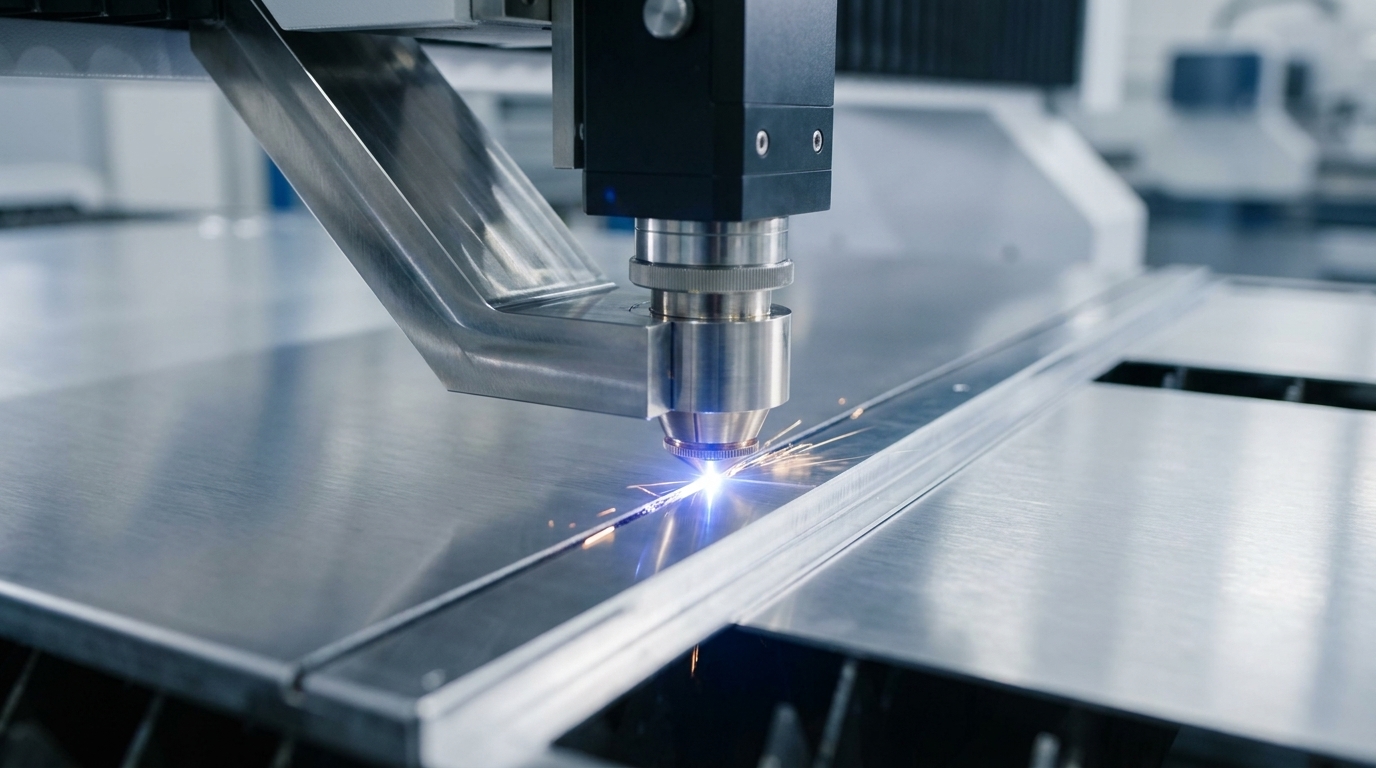
Fiber lasers perform well when cutting reflective materials common in data center hardware. Fiber lasers at a 1 µm wavelength cut brass, pure copper and aluminum more effectively than CO2 lasers. CO2 lasers at 10.6 µm wavelength lose efficiency because reflective surfaces return energy to the source.
Critical parameter considerations include:
- Power settings matched to material thickness and alloy
- Assist gas choice to control edge quality and oxidation
- Cutting speed balanced with tolerance and feature detail
- Beam focus position tuned for consistent kerf width
A minimal heat-affected zone preserves material properties that support structural integrity and flatness. The edge quality achieved by fiber lasers, free of burrs and secondary finishing, shortens production cycles and lowers per-part cost.
DFM Practices for Server Chassis and Enclosure Designs
Design-for-manufacturability collaboration between engineering teams and fabricators prevents redesigns and production delays. Early DFM reviews highlight potential issues with bend sequences, material utilization and assembly interfaces before tooling or fixtures lock in.
Nesting optimization increases material utilization while protecting part quality. Strategic part orientation within laser programs reduces scrap and limits thermal distortion. Common nesting considerations include grain direction alignment, shared cutting paths and thermal balance across the sheet.
Key DFM checklist items:
- Minimum feature sizes that match material thickness
- Bend relief geometry for formed components
- Hole-to-edge distances that prevent distortion
- Assembly clearances that support hardware insertion
- Surface finish requirements that support coating adhesion
Fabcon’s in-house engineering team collaborates with clients during design to improve manufacturability. This early engagement reduces prototype cycles and accelerates deployment schedules for data center programs. The company’s experience with chassis and enclosure builds informs assembly sequences, fastener strategies and material choices.
Prototype validation confirms design intent before production commitments. Rapid laser cutting capacity supports multiple design iterations within compressed development timelines common in data center projects.
Integrated Laser Cutting and Assembly for Supply Chain Stability
Fragmented supply chains create coordination challenges and quality risks in data center component production. Traditional models rely on separate vendors for cutting, forming, finishing and assembly, which extends lead times and complicates root-cause analysis when issues appear.
Fabcon’s vertically integrated approach brings these operations into a single manufacturing environment. This structure reduces vendor handoffs and improves program visibility from raw material through final assembly. The company manages laser cutting, CNC machining, welding, powder coating and electromechanical assembly within one facility.
Integrated benefits include:
- Single point of accountability for complete assemblies
- Short lead times
- Consistent quality control across all operations
- Simplified procurement with single purchase orders
- Improved flexibility for design updates and engineering changes
The company’s ISO 9001:2015 and AS9100D certifications support consistent quality management across all manufacturing processes. This framework provides traceability and documentation that align with critical infrastructure requirements.
Why Fabcon Stands Out for Laser-Cut Data Center Components
Fabcon’s more than 45 years of precision fabrication experience and vertically integrated capabilities position the company as a strong U.S.-based partner for laser-cut data center components. Agile production cells scale from prototype through mid-volume production, while many large contract manufacturers focus on higher volumes with less flexibility.
Recent data center enclosure programs highlight Fabcon’s ability to deliver complex assemblies with integrated cooling features and cable management systems. The engineering team collaborates with clients to refine designs for manufacturability and assembly efficiency. This collaboration supports reliable performance in high-density environments.
Fabcon’s domestic manufacturing footprint reduces supply chain risk and transportation exposure. The company provides responsive customer support and adapts to changing program requirements as designs evolve. Fabcon acts as a strategic partner from initial design through production scaling and ongoing revision cycles.
Frequently Asked Questions
What data center components benefit most from laser cutting?
Server racks, equipment enclosures and cooling manifolds gain the most value from laser cutting because the process supports complex geometries with tight tolerances. These components require precise mounting holes, detailed airflow patterns and clean edges for reliable assembly. Laser cutting removes many secondary operations while enabling design features that traditional punching or plasma cutting cannot achieve.
What is the role of DFM in laser-cut chassis fabrication?
Design-for-manufacturability improves part designs for laser cutting, which reduces material waste and assembly issues. DFM reviews identify potential problems with bend sequences, nesting efficiency and assembly clearances before production begins. Early collaboration between design and manufacturing teams prevents redesigns and shortens time-to-market for data center projects.
How does vertical integration reduce supply chain risks?
Vertical integration reduces vendor handoffs that create delays and quality issues in traditional supply chains. By managing laser cutting, forming, finishing and assembly within one organization, manufacturers provide single-point accountability and stronger program visibility. This consolidated approach, referenced earlier as a key integration benefit, shortens lead times and simplifies procurement for data center operators.
How are lasers used in data center manufacturing?
Lasers cut server racks, equipment chassis, cooling brackets and cable management components with precision that conventional methods cannot match. The technology enables complex airflow patterns, accurate mounting holes and detailed geometries that support thermal management in high-density installations. Laser cutting also supports rapid prototyping for custom data center configurations.
What makes Fabcon different from other fabricators?
Fabcon combines the infrastructure of large contract manufacturers with the agility of smaller fabrication shops. The company’s vertically integrated manufacturing space supports complete assemblies within one facility, which reduces coordination effort. Domestic operations limit supply chain risks common with offshore sourcing. ISO 9001:2015 and AS9100D certifications reinforce consistent quality management across programs.
Get a quote from Fabcon to discuss specific requirements and see how vertically integrated manufacturing strengthens the supply chain.