
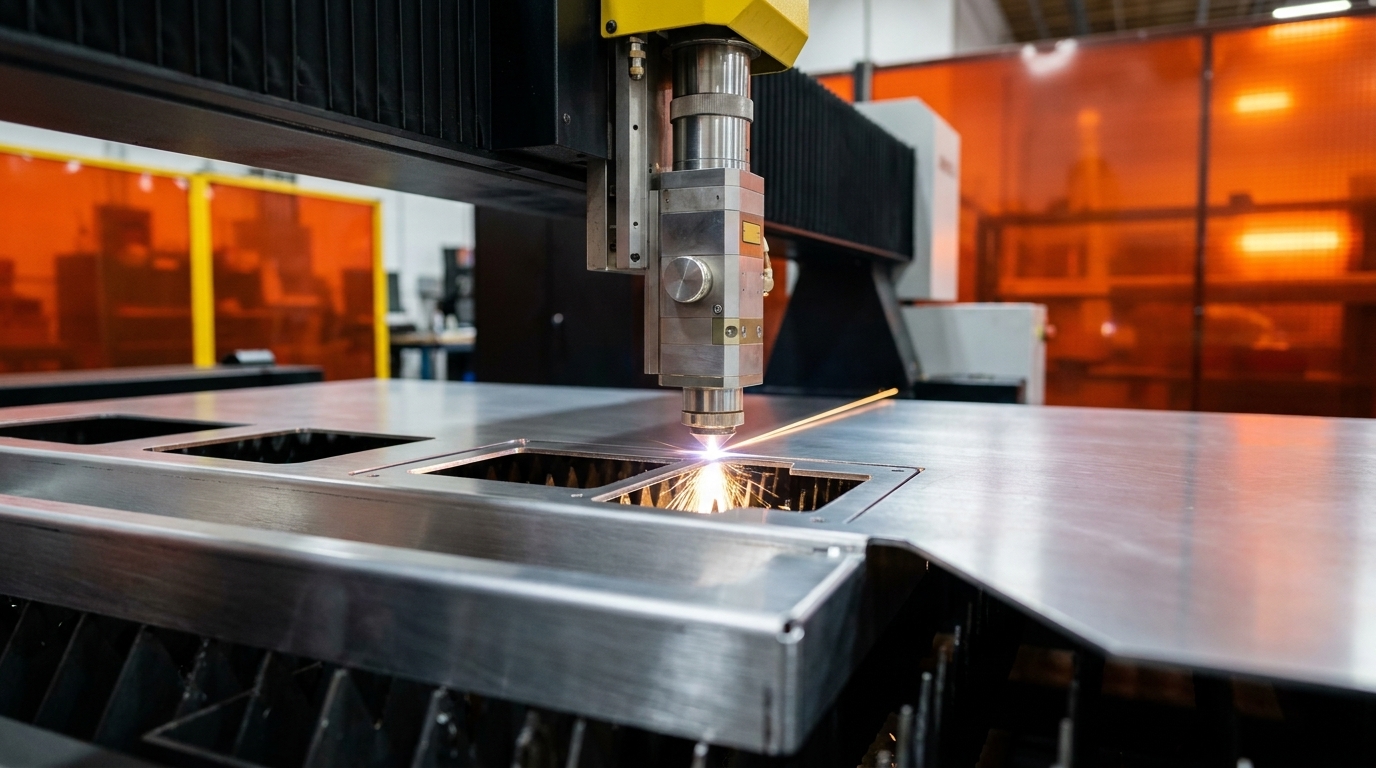
Key takeaways for EV laser cutting
- Laser cutting delivers precise fabrication for EV charging components such as weatherproof enclosures, mounting brackets and power distribution panels.
- Vertically integrated partners reduce vendor fragmentation, which cuts delays and strengthens quality control across fabrication, finishing and assembly.
- Design-for-manufacturability collaboration improves designs early, prevents costly rework and shortens production timelines.
- Advanced fiber lasers cut thick metals and reflective materials with high accuracy for complex EV infrastructure geometries.
- Fabcon provides scalable, ISO-certified laser cutting solutions that support EV growth from prototype through production.
EV infrastructure manufacturing pressures and complexity
EV charging infrastructure manufacturers face mounting pressure as the United States Electric Vehicle Charging Equipment Market grows. Engineering teams struggle with vendor handoffs between metal fabrication, finishing and assembly suppliers. This fragmentation forces supply chain directors to manage multiple purchase orders for single products while operations teams coordinate delivery schedules across disconnected vendor networks. These conditions create quality finger-pointing, timeline delays and cost overruns that compound as programs scale. The adoption of NACS standards and hyperscale charging requirements further complicates component specifications and compliance demands.
Why many traditional vendors fall short on EV charging needs
Most metal fabrication suppliers operate as transactional job shops focused on build-to-print services. These vendors lack engineering depth for design-for-manufacturability collaboration and cannot manage complex integrations such as wiring harnesses, hardware insertion or electromechanical assembly. Customers must coordinate separate suppliers for laser cutting, powder coating, machining and final assembly, which creates delays and gaps in quality accountability.
On the opposite end of the spectrum, large contract manufacturers offer scale but impose rigid minimum volumes, lengthy onboarding processes and inflexible production systems. Their high-volume focus conflicts with the evolving bills of materials and mixed SKU requirements that characterize innovative EV infrastructure programs. Vertically integrated partners bridge this gap between limited job shops and inflexible large manufacturers.
Core laser-cut components in EV charging systems
Laser cutting enables precision fabrication of critical EV charging components.
Weatherproof enclosures protect electrical systems from environmental exposure while maintaining access for maintenance. Mounting brackets and structural frames create secure installation foundations for charging pedestals and wall-mounted units. Cable management systems such as trays and entry plates organize power distribution while supporting safety standards. Ventilation components support proper thermal management for high-power charging systems. Power distribution panels and chassis hold electrical components with tight tolerances that support reliable connections.
Precision laser cutting achieves smooth burr-free edges that reduce secondary finishing requirements and support consistent fit-up. Automated laser cutting systems process sheet metal faster than traditional mechanical cutting methods, which shortens lead times. Optimized nesting software improves material yield and reduces waste to support sustainability goals.
CNC laser cutting technology produces EV charging parts such as enclosures, pillars and support structures from steel, aluminium and stainless steel with high accuracy and consistency. These capabilities support intricate profiles and complex geometries for modern charging station designs while maintaining the structural integrity required for outdoor installations.
Closing design-to-manufacture gaps with DFM
Early design-for-manufacturability collaboration prevents costly rework and production delays by shortening qualification cycles. DFM processes shorten qualification cycles through early alignment between engineering and manufacturing. When engineering teams receive manufacturing input during design phases, they refine bend sequences, material selection and tolerance specifications before releasing parts to production. This approach removes expensive iteration loops that often appear with traditional vendor relationships.
Integrated fabrication partners review designs for laser cutting compatibility and practical production flow. They identify opportunities to consolidate parts, reduce assembly complexity and improve structural performance. This collaboration aligns design intent with manufacturing reality and supports smoother launches.
Reducing vendor fragmentation with integrated fabrication
Vertically integrated laser cutting partners consolidate fragmented processes under one roof. Single-source accountability reduces coordination overhead and strengthens quality control and delivery reliability. Integrated services deliver precision parts with short lead times and compress production timelines compared with multi-vendor approaches.
This consolidation benefits EV infrastructure projects that require weatherproof enclosures with integrated mounting systems, cable management and electrical components. Customers collaborate with one partner that manages fabrication, finishing and assembly for the entire production process.
Quality and compliance requirements for EV components
EV charging infrastructure demands rigorous quality standards for safety and reliability. ISO 9001:2015 and AS9100D certified manufacturing systems provide full traceability and compliance documentation for infrastructure applications. Automated laser systems support compliance with ISO 2768 standards.
Integrated quality management spans laser cutting, forming, finishing and assembly operations. This unified approach maintains consistent standards throughout production and reduces variation. It also limits quality gaps that can occur when components move between separate vendors with different quality systems and standards.
Scaling EV production from prototype to rollout
The rapid expansion of EV infrastructure requires manufacturing partners that scale from prototype to production volumes without rigid minimum order quantities. The global EV charging infrastructure market is projected to experience significant growth, which increases demand for flexible capacity. Agile production cells adapt to changing volumes and evolving product configurations while maintaining quality standards and delivery performance.
Flexible manufacturing systems support these production requirements without the constraints of traditional high-volume lines. This agility enables manufacturers to respond quickly to market demands and technology changes. Explore scalable laser cutting solutions that grow with infrastructure deployment schedules.
Technical laser cutting challenges in EV infrastructure
Thick metal sections and complex geometries present technical challenges for laser cutting applications. Ultra-high-power fiber lasers enable cutting thick stainless steel plate. Advanced fiber laser technology minimizes heat-affected zones while maintaining edge quality on thick materials used for structural components.
Fiber laser cutting machines process reflective metals like copper and brass without pre-treatment. This capability supports electrical components and busbars used in charging systems. Fiber lasers reduce energy consumption and contribute to sustainability objectives.
Why Fabcon stands out in EV laser cutting
Fabcon combines more than 45 years of precision metal fabrication experience with 220,000 square feet of vertically integrated manufacturing facilities in Southern California. The company bridges the gap between limited job shops and inflexible large contract manufacturers by pairing sophisticated infrastructure with responsive service and agile production capabilities.
Fabcon’s integrated approach covers laser cutting, CNC machining, forming, welding, finishing and electromechanical assembly under one roof. This vertical integration removes vendor handoffs and provides single-source accountability for complex EV charging components. The company’s ISO 9001:2015 and AS9100D certifications build on this structure and support the quality and traceability expectations of infrastructure programs.
Fabcon’s agile production cells scale from prototype to mid-volume production without high minimum order quantities or lengthy onboarding processes. This flexibility supports evolving requirements and mixed SKU production across innovative EV infrastructure programs. Request a capabilities review to evaluate Fabcon’s support for EV charging infrastructure components.
Laser cutting for EV infrastructure FAQs
What are common laser cutting applications for EV charging stations?
Laser cutting produces weatherproof enclosures, mounting brackets, structural frames, cable management trays, ventilation components and power distribution panels. These components require precise tolerances and clean edges for reliable assembly and long-term performance in outdoor environments. Laser cutting also supports complex geometries and intricate profiles while maintaining the structural integrity needed for charging infrastructure.
How does laser cutting improve EV enclosure fabrication?
Laser cutting delivers dimensional accuracy within tight tolerances and produces smooth, burr-free edges that reduce secondary finishing requirements. The process supports efficient material nesting that minimizes waste and aligns with sustainability goals. High cutting speeds accelerate production timelines compared with traditional methods while maintaining consistent quality across production batches.
What challenges exist in laser cutting for EV infrastructure?
Thick metal sections and complex geometries can create technical challenges, particularly for structural components that require heavy-gauge materials. Advanced fiber laser technology addresses these challenges through high-power systems that cut thick materials while limiting heat-affected zones. Reflective metals such as copper and aluminum require specialized processing parameters, yet modern fiber lasers handle these materials effectively.
What are the benefits of integrated fabrication for EV components?
Integrated fabrication reduces vendor handoffs by combining laser cutting, forming, finishing and assembly under one roof. This approach cuts coordination overhead, improves quality control and accelerates delivery timelines. Single-source accountability limits quality finger-pointing and supports comprehensive traceability for infrastructure applications that require rigorous documentation.
How should companies choose a US partner for EV metal parts?
Companies should evaluate partners based on vertical integration capabilities, quality certifications, production flexibility and engineering support. Manufacturers that combine laser cutting with finishing and assembly services reduce vendor complexity and simplify program management. Agile production systems that scale from prototype to production volumes without rigid minimum requirements further support EV infrastructure growth. Robust quality certifications and compliance capabilities strengthen performance on infrastructure applications.
Streamlining EV infrastructure with laser cutting
Laser cutting for EV infrastructure delivers the precision, speed and flexibility needed to meet aggressive deployment schedules while maintaining quality standards. Vertically integrated partners reduce vendor fragmentation and design-to-manufacture disconnects that threaten project timelines. As the EV charging market expands toward 2030 targets, manufacturers benefit from responsive partners that combine engineering expertise with comprehensive fabrication capabilities. Request an EV laser cutting quote to streamline infrastructure component production.