
Key Takeaways
- Laser cutting and engraving services solve precision metal challenges in data centers, EV infrastructure and medical devices by holding tight tolerances and limiting heat-affected zones.
- Integrated manufacturers like Fabcon reduce vendor fragmentation, which cuts coordination effort, delays and quality issues.
- Design-for-manufacturability collaboration improves part cost, supports smooth scaling from prototype to production and reduces rework.
- Key cost factors include material type, thickness, design complexity and volume, while integrated services reduce markups and transportation expenses.
- Fabcon provides ISO-certified, U.S.-based laser cutting with end-to-end capabilities, so organizations can get a quote today and streamline supply chains.
The Problem: Gaps in Reliable Laser Cutting and Engraving Supply
Mid-to-large enterprises often face two inadequate options when sourcing precision metal components. Low-complexity job shops offer build-to-print services but lack engineering depth for design-for-manufacturability collaboration. Without that capability, they cannot manage complex system integrations such as wiring or electromechanical assembly, which forces customers to juggle multiple purchase orders and vendors for one finished product. This fragmentation creates vendor handoff delays and quality issues.
Large contract manufacturers provide scale but impose rigid requirements that include high minimum volumes, lengthy onboarding processes and limited flexibility for evolving bills of materials in innovation-led sectors. These constraints slow prototype-to-production transitions and increase program risk by locking customers into fixed specifications that cannot adapt to changing product requirements.
How Modern Metal Laser Cutting and Engraving Work
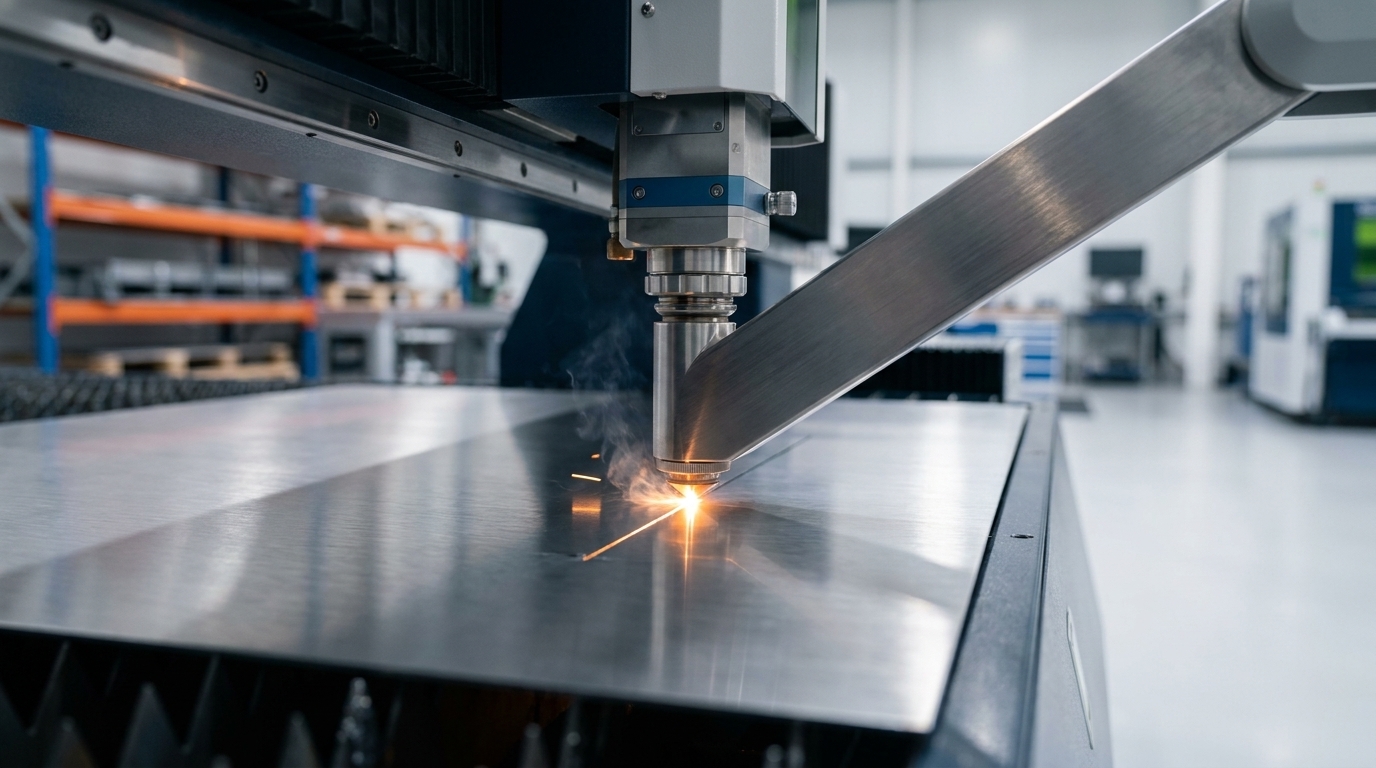
Modern laser cutting and engraving services use fiber laser technology to produce precision cuts and permanent markings on metal components such as enclosures, chassis, brackets and structural frames. Industrial fiber lasers achieve tight tolerances because they create a narrow kerf width and limit heat-affected zones.
Fiber laser systems process carbon steel, stainless steel, aluminum, brass and copper with consistent repeatability. Anti-high-reflection technology optimizes optical paths and thermal management, which prevents reflection damage when cutting reflective materials such as copper, aluminum and brass. These capabilities enable stable processing for electric vehicle battery trays and infrastructure components.
These strengths make fiber laser systems suitable for data center rack-mounted enclosures, medical device assemblies, traffic safety barriers and energy storage systems. Laser cutting performs best on thin-to-medium thickness materials, and proper process control limits thermal distortion.
Technology advances include ultra-high power systems. The North America laser processing market grows as precision manufacturing demand increases across sectors.
Laser Cutting Cost Factors for Metal Components
Several variables influence laser cutting service pricing, and understanding them supports accurate budgeting. Material type, thickness, design complexity and production volume serve as primary cost drivers. Among operating expenses, assist gas represents a key variable in operating costs, especially for thicker materials or high cut quality requirements.
Machine rates depend on laser power and system capability, yet design complexity often has greater impact on pricing because costs depend on machine time rather than material area. A large simple bracket may cost less than a compact part with intricate features that requires slow cutting speeds and frequent pierces.
Thicker materials increase cutting time and cost, while high-volume orders benefit from economies of scale as setup and programming time spreads across more parts. Efficient nesting and common-line cutting further reduce scrap and cycle time.
Design-for-manufacturability collaboration and volume production reduce total ownership costs by aligning part features with efficient processing. Integrated manufacturers remove markup layers and coordination expenses between separate vendors, which supports competitive pricing for complex assemblies. Get fast quotes for volume-optimized laser cutting services.
Core Problems and Fabcon’s Solutions in Metal Laser Cutting
Design-to-Manufacture Disconnect
Design decisions made without manufacturing input often create downstream production issues. This pattern drives costly rework cycles and schedule slips as teams adjust parts after initial builds. Components may include tight tolerances in noncritical areas, features that require secondary machining or configurations that limit efficient nesting and material utilization.
Fabcon’s engineering team engages during the design phase to prevent these issues. The team provides design-for-manufacturability feedback that aligns part geometry with laser cutting strengths and available secondary processes. Early collaboration reduces rework, improves cost efficiency and supports smooth scaling from prototype through production volumes.
Vendor Fragmentation Across the Build
Traditional sourcing often uses separate vendors for laser cutting, finishing, hardware insertion and assembly. Each additional supplier adds purchase orders, delivery schedules and quality standards that require coordination. This complexity increases program risk and makes root-cause analysis difficult when issues appear in the field.
Fabcon operates a single manufacturing environment that includes laser cutting, CNC machining, powder coating and electromechanical assembly. This integrated approach creates single-source accountability, which removes vendor handoffs, shortens lead times and simplifies program management for complex builds.
Quality and Scaling Challenges
Many job shops lack formal quality systems and infrastructure to maintain consistency as programs move from prototype to production. Large contract manufacturers often rely on rigid processes that struggle with changing requirements or mixed SKU production. These conditions create risk for sectors that require documented traceability and stable performance.
Fabcon runs ISO 9001:2015 and AS9100D certified quality systems with full traceability across materials and processes. Agile production cells support prototype work and mid-volume production while maintaining flexibility for evolving bills of materials and program changes.
Lead Time Pressures in Fast-Moving Programs
Compressed development timelines encounter bottlenecks from slow quoting, extended prototyping cycles and supplier scheduling conflicts. External dependencies on multiple vendors compound scheduling risk and threaten launch dates for infrastructure and device programs.
Fabcon’s integrated model supports rapid quoting, quick-turn prototypes and controlled production scaling. U.S.-based facilities and experienced teams provide responsive support and dependable delivery performance for time-critical initiatives.
Why Fabcon Excels at Custom Laser Cutting Services
Fabcon delivers precision metal fabrication that removes the trade-offs between job shop limitations and large contract manufacturer rigidity. The integrated facility combines laser cutting, CNC machining, finishing and assembly to support complex metal assemblies from raw material through final build.
Engineering collaboration from prototype through production focuses on manufacturability and cost efficiency at each stage. Certified quality systems under ISO 9001:2015 and AS9100D provide the assurance and traceability required for infrastructure-critical and regulated applications.
Responsive U.S.-based operations support agile program requirements without the overhead and minimum volume constraints common in global contract manufacturing. Experience in data center infrastructure, electric vehicle components and medical device assemblies demonstrates capability across demanding applications.
How to Evaluate Metal Laser Cutting Services Near Me
Effective evaluation of laser cutting partners starts with engineering depth. Strong engineering teams provide design-for-manufacturability collaboration and refine parts for production efficiency and stable quality. Service scope review then clarifies whether a vendor offers integrated capabilities or will require additional suppliers for finishing and assembly.
Flexibility assessment examines capacity to manage changing volumes, mixed SKU production and evolving program requirements without disruption. U.S. proximity and relevant certifications support responsive communication and compliance with regulatory standards.
Fabcon aligns with these benchmarks through comprehensive engineering support, an integrated manufacturing environment, agile production cells and certified quality systems in strategically located U.S. facilities.
Conclusion: Streamlined Laser Cutting and Engraving with Fabcon
Fragmented laser cutting supply chains create complexity, delays and quality risk for precision metal components. Fabcon’s integrated approach removes vendor handoffs and centralizes responsibility for engineering collaboration, quality systems and schedule performance. Get a quote today for design-for-manufacturability review and integrated laser cutting services that support successful product launches.
FAQ: Laser Cutting and Engraving Services
What are laser cutting services used for in industrial applications?
Industrial laser cutting services produce precision metal components such as enclosures, chassis, brackets, structural frames and complex assemblies for data centers, electric vehicle infrastructure, medical devices and aerospace applications. Fiber laser technology delivers tight tolerances, clean edges and limited heat-affected zones suitable for applications that demand dimensional accuracy and consistent surface quality. Services include cutting operations for part fabrication and engraving for permanent marking, serialization and branding requirements.
How should companies choose metal laser cutting services?
Organizations select laser cutting providers based on engineering capabilities, service scope, quality certifications and operational flexibility. Engineering depth determines the level of design-for-manufacturability collaboration that supports production efficiency and cost control. Service scope assessment clarifies whether vendors provide integrated capabilities such as finishing and assembly or require coordination with additional suppliers. Quality certifications such as ISO 9001:2015 and AS9100D support consistent processes and traceability. Operational flexibility reflects capacity to manage changing volumes, mixed SKU production and evolving program requirements without rigid minimum volume constraints.
What are the benefits of integrated laser cutting and manufacturing services?
Integrated services remove vendor handoffs that create coordination complexity, quality disputes and schedule delays. Single-source accountability streamlines program management through unified quoting, scheduling and quality control. An integrated facility supports rapid prototyping, design-for-manufacturability refinement and smooth scaling from development through production volumes. Cost efficiency improves as markup layers disappear, transportation between vendors decreases and material utilization improves across linked processes. Quality consistency increases through unified process control and traceability systems that span all manufacturing operations.
What lead times can be expected for custom laser cutting projects?
Lead times for custom laser cutting depend on project complexity, material availability, production volume and vendor capacity utilization. Integrated manufacturers often provide shorter lead times because they remove transportation and coordination delays between separate suppliers. Early design-for-manufacturability collaboration also reduces downstream delays from late-stage design changes and process adjustments.
How much do professional laser cutting services cost?
Laser cutting service costs depend on material type and thickness, design complexity, production volume and required finishing operations. Higher volumes enable economies of scale through setup cost amortization and efficient material nesting. Integrated service providers often deliver cost advantages by removing vendor markup layers and transportation expenses between separate operations.