
Key Takeaways for Metal Fabrication Projects
- Cutting, forming and assembly create the core workflow for precision metal fabrication from raw sheet to finished structure.
- Cutting methods deliver different precision and heat effects. Laser limits heat impact, while waterjet removes heat effects and follows specific minimum hole sizes by thickness.
- Forming success depends on springback compensation and minimum bend radii based on material thickness to prevent cracking and maintain consistent shapes.
- Assembly methods such as TIG and MIG welding and mechanical fasteners require DFM planning for access, distortion control and joint strength.
- Implement DFM checklists and partner with Fabcon for vertically integrated fabrication from prototype to production—explore how integrated capabilities streamline your project.
Three Core Types of Metal Fabrication
Cutting, forming and assembly form the foundation of precision metal fabrication. Cutting processes such as laser and CNC separate raw metal to create accurate profiles and features. Forming operations including bending and pressing reshape material without removal. Assembly techniques such as welding and mechanical fastening join individual components into functional structures.
These processes work together in modern fabrication workflows, with CNC systems and agile production cells supporting smooth transitions between operations. Clear understanding of how each process affects tolerances, material properties and design constraints helps engineers design for efficient manufacturing and reliable performance.
1. Cutting Processes for Precision Metal Parts
Cutting processes separate raw metal into precise shapes and profiles using different energy sources. Laser cutting achieves precise tolerances in mild steel with proper machine calibration and kerf compensation. This precision suits fastener holes that require tight specifications in steel and aluminum sheets.
Plasma cutting offers lower precision but handles thick materials effectively with minimum hole diameters equal to material thickness. Waterjet cutting provides high edge quality with no heat-affected zone (HAZ), which suits heat-sensitive materials. Minimum waterjet hole sizes are 0.0625-inch diameter for material thicknesses < 1/2 to 1 inch, 0.125-inch diameter for >1 to 3 inches and 0.1875-inch diameter for >3 inches. CNC punching delivers repeatable results for standard hole patterns and shapes.
Understanding how each cutting method affects heat and edge quality guides process selection for each design.
Engineering Note: Heat-affected zones from plasma cutting can alter material properties near cut edges. Laser cutting limits HAZ while waterjet removes it entirely. Kerf width varies by process and affects final dimensions.
These process-specific characteristics inform design decisions. DFM considerations for cutting include optimizing part nesting to reduce material waste, maintaining hole-to-edge distances of at least 1.5 times material thickness and designing features compatible with standard tooling. Fabcon in-house laser cutting and CNC capabilities support tight tolerances for enclosures, chassis and precision components. Request a quote for precision cutting services that meet project specifications.
2. Forming Processes for Consistent Bends and Shapes
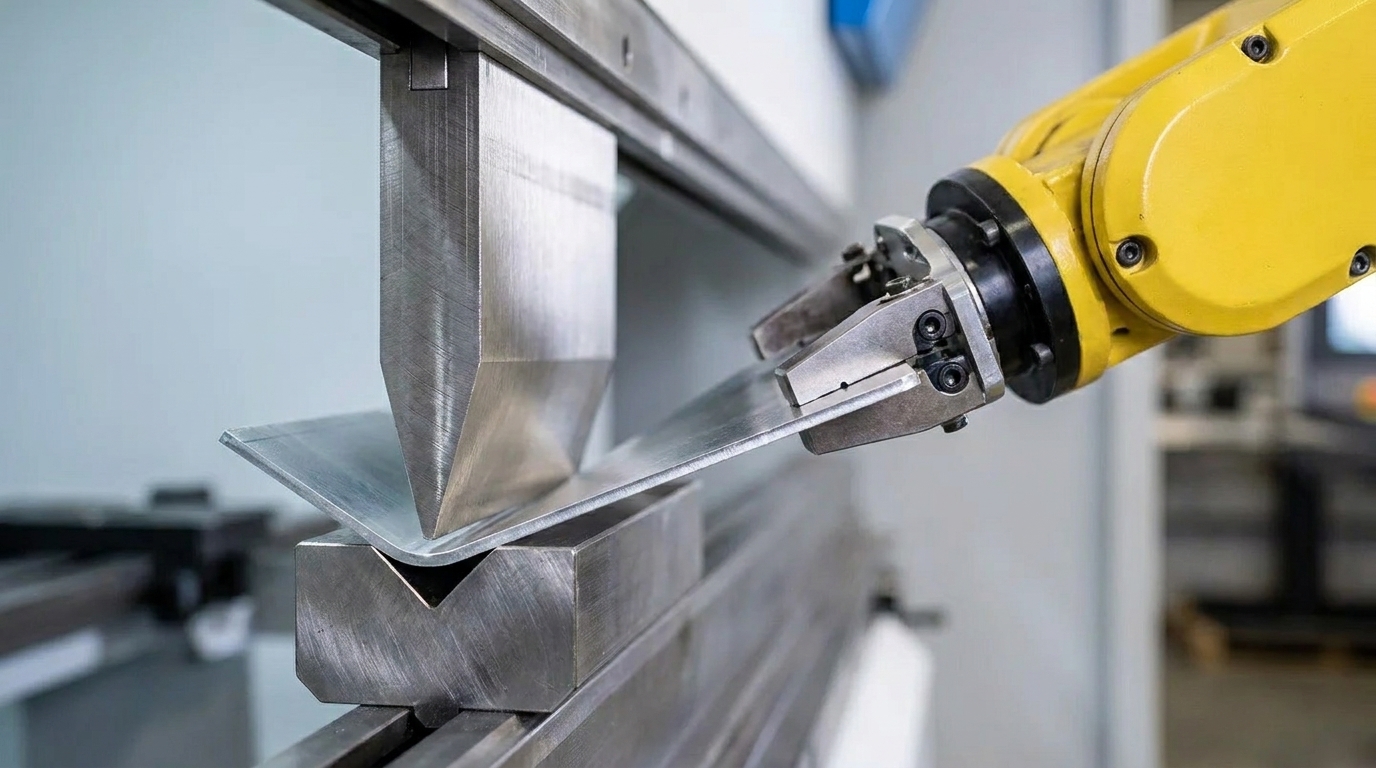
Forming processes reshape metal without removing material and create bends, curves and complex geometries through controlled deformation. Press brake bending dominates sheet metal forming, with springback compensation achieved through overbending techniques where operators bend beyond the target angle to offset elastic recovery.
Modern CNC press brakes build on these techniques with automatic springback compensation and adaptive angle correction through real-time measurement systems. This automation improves consistency across operators and shifts. Stamping processes use dies to form complex shapes in single operations, while roll forming creates consistent profiles for long parts. Minimum bend radius guidelines recommend material thickness multiples for mild steel and aluminum to prevent cracking and maintain reliable forming.
Material behavior during forming affects both design and process planning.
Engineering Note: Material thickness variations can alter springback. K-factor calculations help predict bend allowances, while grain direction affects forming consistency and springback behavior.
DFM guidelines for forming include designing achievable bend radii, avoiding tight angular tolerances where possible and planning bend sequence to prevent interference. Standardizing materials and gauges improves consistency and reduces setup time. Fabcon forming capabilities support complex frames and brackets with consistent quality across production runs.
3. Assembly and Joining Techniques for Engineers
Assembly processes join individual components into functional structures using welding, mechanical fasteners or adhesives. TIG welding provides precision for thin materials and critical joints using nonconsumable tungsten electrodes. MIG welding offers higher deposition rates for thicker sections and production efficiency.
Resistance spot welding delivers rapid cycle times with repeatable results for carbon steel sheets. Mechanical fasteners including rivets, bolts and specialized hardware provide removable joints and support different material combinations. Adhesive bonding suits applications that require vibration damping or joining dissimilar materials.
Distortion and joint design play a central role in assembly quality.
Engineering Note: Weld distortion control requires proper sequencing and often uses stitch welding patterns instead of continuous beads. Joint design affects strength characteristics, with butt joints providing different load capabilities than lap or fillet configurations.
DFM considerations for assembly include ensuring adequate weld access, selecting fastener types that match load requirements and designing joints that limit distortion. Fabcon integrated welding and assembly capabilities reduce handoffs between processes, maintain quality control and support responsive schedules.
DFM Checklists and Smart Material Choices
Boothroyd Dewhurst DFM guidelines emphasize standard hole sizes, threads and material gauges to reduce tooling variety and improve sourcing. These standards create a base for efficient material selection and process planning. Key material considerations include:
Steel offers strong weldability and forming characteristics for structural applications. Aluminum provides low weight with good corrosion resistance and requires specific welding techniques. Stainless steel delivers strong corrosion resistance but shows greater springback during forming operations.
Universal DFM principles start with minimizing part count through functional integration, which reduces assembly complexity. This simplification allows engineers to relax tolerances on noncritical features without affecting function and supports designs that use standard manufacturing processes. These principles translate to specific dimensional guidelines: hole-to-edge spacing should maintain minimum distances based on material thickness, while bend allowances must account for material properties and forming methods.
Scaling from Prototype to Production: Three Principles for Fabrication
Successful scaling integrates cutting, forming and assembly workflows to remove handoffs and reduce lead times from weeks to days. CNC machining plays a central role in U.S. metal fabrication operations, and agile production cells support flexible responses to changing volumes and product configurations.
Principle one maps and connects manufacturing flows under a single coordinated system. These connected flows create the base for principle two, which uses CNC systems and automated material handling to maintain consistency as production volumes grow. With consistent processes in place, principle three applies vertical integration strategies that consolidate suppliers and reduce coordination complexity at higher volumes.
Why Fabcon Excels in Integrated Metal Fabrication
Fabcon operates 220,000 square feet of vertically integrated manufacturing space across two California facilities and combines in-house laser cutting, forming, welding and assembly capabilities. Founded in 1977, the company maintains ISO 9001:2015 and AS9100D certifications and serves data centers, electric vehicle infrastructure and medical device manufacturers.
This integrated approach solves common engineering challenges including design-to-manufacturing disconnects, fragmented vendor management and scaling difficulties. Early DFM collaboration reduces rework, while single-source accountability removes handoff delays. One purchase order can cover fabrication, finishing and assembly operations.
Fabcon agile production cells adapt to changing volumes and mixed SKUs without the rigidity of large contract manufacturers. This flexibility supports prototype-to-production transitions while maintaining the quality standards required for infrastructure-critical applications. Connect with Fabcon engineering team to discuss how comprehensive fabrication expertise supports project objectives from concept through production.
Frequently Asked Questions
What are the three types of metal fabrication?
The three main types are cutting, forming and assembly. Cutting covers laser, plasma and waterjet separation of raw metal. Forming includes bending and pressing to reshape without material removal. Assembly covers welding and fastening to join components. Each process supports specific functions in creating precision metal components from raw materials to finished assemblies.
How does integrated fabrication differ from using multiple job shops?
Integrated fabrication consolidates cutting, forming, welding and finishing under one roof with single-source accountability. Job shops often handle basic metal work, which forces engineers to manage multiple vendors, coordinate handoffs and address quality disputes between suppliers. Integration removes many of these coordination challenges.
What role does DFM play in metal fabrication success?
Design for manufacturing collaboration between engineers and fabricators improves designs before production begins. Effective DFM reduces manufacturing costs by addressing issues such as bend sequences, tolerance specifications and material selection early in the design process.
What certifications matter for aerospace and medical device fabrication?
AS9100D certification demonstrates aerospace quality management systems, while ISO 9001:2015 provides general quality assurance frameworks. These certifications support traceability, process control and compliance with regulatory requirements that matter for mission-critical and medical applications.
How do agile production cells enable scaling flexibility?
Agile cells use flexible manufacturing equipment and workflows that adapt to changing volumes, mixed product configurations and evolving bills of materials. These cells support prototype-to-production transitions without high minimum orders or extensive retooling.
Conclusion: Turning Fabrication Knowledge into Reliable Output
The three main types of metal fabrication, cutting, forming and assembly, provide the foundation for precision manufacturing in infrastructure and technology applications. Engineers who understand these processes and apply effective DFM practices can reduce rework, shorten development cycles and scale production efficiently. Partnering with vertically integrated fabricators such as Fabcon reduces vendor complexity while maintaining the quality and responsiveness required for demanding applications. Connect with Fabcon engineering team to discuss how comprehensive metal fabrication expertise supports objectives from concept through production.