
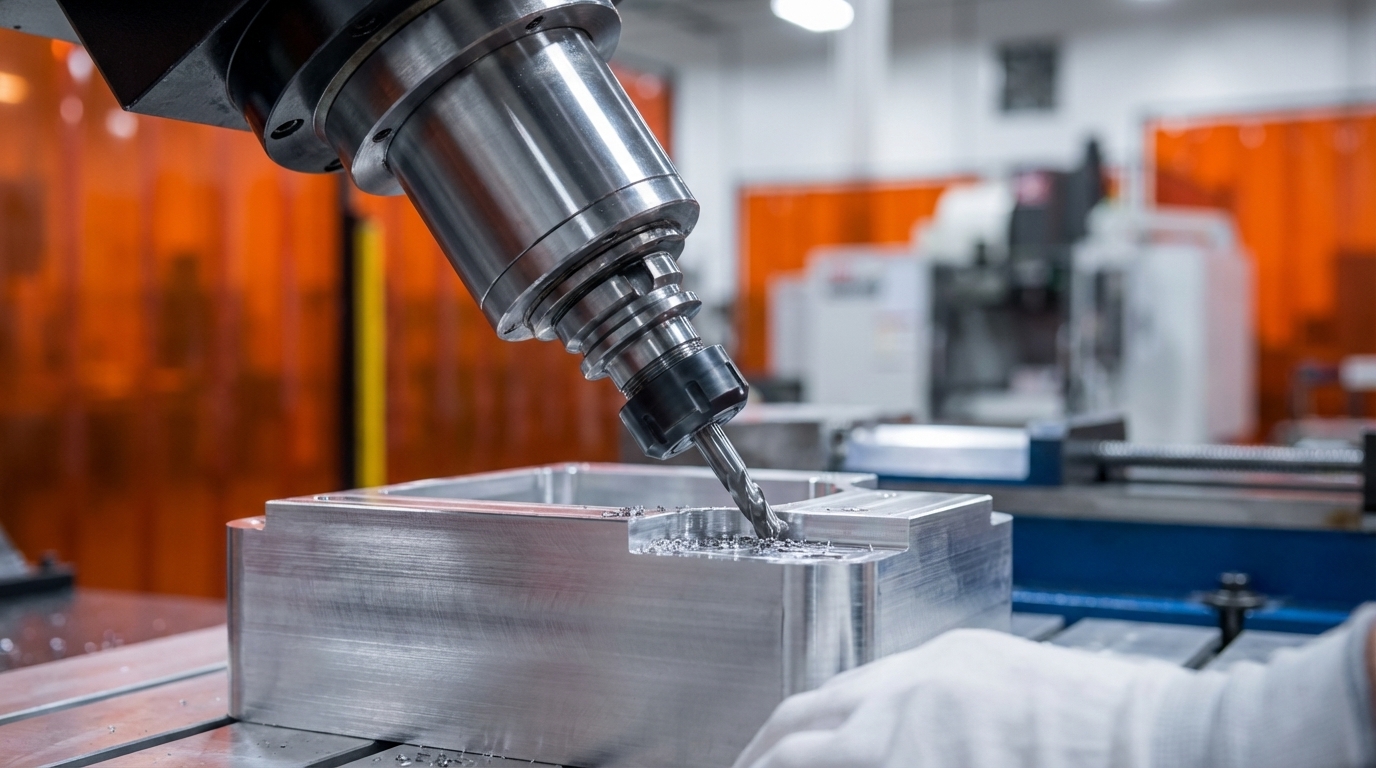
Key Takeaways: Metal 3D Printing vs. CNC and Sheet Metal
- Metal 3D printing supports complex geometries but often costs $120-600 per unit and requires 4-8 weeks for functional parts.
- CNC machining typically delivers parts in 2-5 days, holds ±0.005mm tolerances, and costs $50-500 for prototypes, which suits most applications.
- Sheet metal fabrication excels for enclosures, chassis, and brackets, with fast turnaround and straightforward scaling to production volumes.
- Metal 3D printing struggles with post-processing, quality consistency, and quantities above 10-20 units, so alternatives cover about 80% of prototyping needs more cost-effectively.
- For rapid prototypes that scale cleanly to production, explore Fabcon’s integrated sheet metal and CNC services today.
Pros and Cons of Metal 3D Printing for Rapid Prototyping
Advantages:
- Supports complex internal channels, lattice structures, and topology-optimized geometries that traditional methods cannot easily produce.
- Eliminates tooling costs, which removes a major upfront expense common with traditional manufacturing.
- Delivers functional Inconel DMLS metal prototypes in 4-8 weeks, or 2-3 weeks for simpler, less critical parts.
- Uses material efficiently with high utilization rates and minimal scrap.
Disadvantages:
- Drives high per-part costs, typically $120-600 for automotive components.
- Requires expensive equipment, with operational costs of $100–$400 per hour for metal 3D printing equipment plus industrial metal 3D printer production cells costing $200,000 to $1 million+ in 2026.
- Demands extensive post-processing such as support removal, heat treatment, and surface finishing.
- Scales poorly for production volumes because of slow build times and batch limitations.
The following comparison highlights how metal 3D printing’s timelines and costs differ from faster, more economical options.
| Manufacturing Method | Lead Time | Cost Per Part | Surface Quality |
|---|---|---|---|
| Metal 3D Printing | 4-8 weeks | $120-600 | Requires post-processing |
| CNC Machining | 3 days | $50-$500 per part for prototypes (1-10 units) | Production-ready finish |
| Sheet Metal (Fabcon) | Rapid | Competitive | Powder coat ready |
Key Disadvantages and When Metal 3D Printing Is Not Worth It
Metal 3D printing often costs 50-70% more than CNC machining for mid-complexity parts. Steel brackets can reach $500-2,000 for 1-10 units compared to $1-8 for CNC steel brackets at similar quantities. The technology also struggles with high-volume prototyping, tight tolerances, and smooth surface finishes needed for functional testing.
Quality consistency challenges and heavy post-processing make metal 3D printing a poor fit for simple geometries, enclosures, brackets, and chassis components that dominate rapid prototyping. Skip metal 3D printing for parts that require tight tolerances, smooth finishes, or volumes above 10-20 units. Sheet metal fabrication and CNC machining provide better economics and faster iteration cycles for conventional geometries.
Request a prototype review from Fabcon for ISO-certified CNC and sheet metal parts with rapid turnaround.
Given these limitations, a direct comparison of all three methods clarifies which approach works best for specific prototyping scenarios.
Metal 3D Printing vs. CNC Machining vs. Sheet Metal Fabrication
This comparison across lead time, cost, tolerance, and scalability shows why CNC machining and sheet metal fabrication dominate rapid prototyping.
| Method | Lead Time | Cost Range | Tolerance | Scalability |
|---|---|---|---|---|
| Metal 3D Printing | 4-8 weeks | $500-2,000 | ±0.2mm typical | Poor for volumes >50 |
| CNC Machining | 2-5 days | $50-$500 per part for prototypes (1-10 units) | ±0.005mm achievable | Excellent scaling |
| Sheet Metal | Rapid | Competitive | Standard tolerances | Seamless proto-to-production |
Sheet metal fabrication works especially well for enclosures, chassis, brackets, and structural components that represent most rapid prototyping needs. CNC machining delivers high precision and realistic material properties for functional testing. Metal 3D printing remains useful for niche applications that require complex internal features or very low volumes.
The Best Alternative: Vertically Integrated Sheet Metal and CNC for Prototyping
Fabcon’s integrated model removes the vendor handoffs and scalability limits that slow metal 3D printing workflows. The company operates from 220,000 square feet of manufacturing space with ISO 9001:2015 and AS9100D certifications. Fabcon combines laser cutting, CNC machining, forming, welding, and assembly in one facility. This structure supports rapid prototype lead times while keeping production-ready processes that scale from single prototypes to 500+ unit production runs.
The vertically integrated model also addresses the core pain points of fragmented 3D printing supply chains. When DFM collaboration happens in-house, engineers catch manufacturability issues before they become costly rework, which reduces back-and-forth between vendors. Single-PO accountability then removes coordination delays, since one purchase order covers everything from laser cutting through final assembly. As a result, agile production cells adapt to evolving BOMs without the rigidity common in large contract manufacturers. Engineering teams gain real manufacturability feedback during design, and procurement managers gain simpler vendor relationships and predictable lead times.
Request a rapid prototyping assessment from Fabcon to move from prototype to production with US-based manufacturing that delivers speed, quality, and accountability.
Fabcon Case Studies: MedTech, EV, and Telecom Results
A leading data center infrastructure company partnered with Fabcon to prototype custom server enclosures and achieved 48-hour turnaround from design approval to functional prototypes. The integrated sheet metal and assembly approach cut costs by 40% compared with quoted 3D printing options. It also allowed seamless scaling to 500-unit production volumes without design changes or vendor transitions.
An electric vehicle charging infrastructure manufacturer used Fabcon’s DFM expertise to refine chassis designs during the prototype phase. This collaboration reduced material costs by 25% and doubled the speed of the production ramp compared to their previous 3D printing workflow. Fabcon’s 45+ years of precision manufacturing experience and Southern California facilities provided the agility and accountability needed for compressed product launch timelines.
Decision Framework: When to Choose Each Manufacturing Method
Use this framework to match your prototype requirements with the method that offers the right balance of speed, cost, and capability.
| Application | Best Method | Key Advantage |
|---|---|---|
| Complex internal channels | Metal 3D Printing | Design freedom |
| Precision machined features | CNC Machining | Tight tolerances |
| Enclosures & assemblies | Sheet Metal (Fabcon) | Speed & scalability |
| Mid-volume prototypes | Integrated Manufacturing | Proto-to-production |
Hybrid strategies that pair 3D printed form studies with Fabcon’s functional prototyping often deliver strong results for complex programs that require both design validation and production readiness.
Frequently Asked Questions
What are the main disadvantages of metal 3D printing for rapid prototyping?
Metal 3D printing carries significant cost and scalability drawbacks for rapid prototyping. Per-part costs often range from $120-600, which makes many parts 50-70% more expensive than CNC machining or sheet metal fabrication. The process also requires heavy post-processing such as support removal, heat treatment, and surface finishing, which adds days to project timelines. Limited build volumes restrict larger prototypes and multiple iterations. Quality consistency issues and porosity can compromise functional testing, and moving from 3D printed prototypes to production-ready manufacturing usually requires a complete process redesign.
How does metal 3D printing compare to CNC machining for prototype development?
CNC machining usually delivers better economics and performance for rapid prototyping. Typical lead times run 2-5 days, and CNC achieves tighter tolerances of ±0.005mm versus ±0.2mm for many metal 3D printing processes. CNC also provides better surface finishes and isotropic material properties that closely match production parts. Costs often fall in the $50-$500 per part range for prototypes (1-10 units), while equivalent 3D printed components can cost $500-2,000. CNC scales directly from prototype to production without major process changes, while 3D printing usually requires a new workflow that introduces risk and delay.
Is 3D printing rapid prototyping worth the investment for most companies?
Most companies see stronger ROI from integrated sheet metal and CNC solutions than from metal 3D printing. High per-part costs, scalability limits, and post-processing demands make metal 3D printing suitable mainly for ultra-complex geometries or very low volumes. Vertically integrated manufacturers like Fabcon combine speed, cost control, and production readiness. Rapid lead times, lower costs, and smooth scaling from prototype to production create better value for about 80% of rapid prototyping applications.
What are typical costs for metal 3D printing prototypes in 2026?
Metal 3D printing prototype costs remain high in 2026. Automotive components often range from $120-600 per unit, and complex parts can reach $500-2,000 for small quantities. Material costs play a major role, with titanium powder at $250-400 per kilogram and operational costs of $100–$400 per hour depending on the technology. Industrial metal 3D printer production cells cost $200,000 to $1 million+ in 2026, which drives high per-part economics. These factors keep 3D printing uncompetitive for most rapid prototyping work where sheet metal fabrication and CNC machining deliver similar functionality at 40-60% lower cost.
How does Fabcon support rapid prototyping better than 3D printing?
Fabcon’s vertically integrated approach removes many of the constraints that limit metal 3D printing. Rapid lead times match or exceed typical 3D printing schedules while using production-ready processes and materials. Costs often run 40-60% lower than metal 3D printing, with better surface finishes and tighter dimensional accuracy. Integrated DFM collaboration reduces rework, and single-vendor accountability avoids the coordination problems common with fragmented 3D printing supply chains. Most importantly, prototypes move directly into production volumes without process changes, vendor switches, or major design modifications.
Conclusion: Choosing the Right Path for Rapid Prototyping
Metal 3D printing supports niche applications with ultra-complex geometries, yet it rarely delivers strong ROI for mainstream rapid prototyping. Fabcon’s integrated sheet metal fabrication and CNC machining provide better speed, cost control, and scalability for the many applications that involve enclosures, chassis, brackets, and structural components. The combination of rapid lead times, ISO certifications, and smooth prototype-to-production scaling makes integrated manufacturing a strong choice for teams that prioritize speed, quality, and accountability.
Ready for prototypes that perform in production? Partner with Fabcon for US-based, end-to-end manufacturing that removes vendor handoffs and accelerates product launches. Start your project today for rapid prototyping that scales.