
Last updated: April 17, 2026
Key Takeaways
- Fragmented suppliers slow complex assemblies for aerospace, medical, and EV applications and increase quality issues during supply chain volatility.
- Job shops lack assembly integration and large CMs lock you into rigid schedules; U.S.-based vertical integration delivers agile production.
- Precision laser cutting holds ±0.05 to ±0.2 mm tolerances on metals up to 25 mm thick and supports fast turnaround with fiber lasers.
- Fabcon’s U.S. vertical integration from cutting through assembly removes coordination overhead and shortens lead times from weeks to days.
- Partner with Fabcon for fast turnaround precision laser cutting backed by ISO 9001 and AS9100D certified capabilities.
The Problem: Sourcing Precision Laser Cutting for Complex Assemblies in 2026
Modern complex assemblies require more than basic sheet metal cutting. Data center rack enclosures need precise cable management features. EV charging station chassis require integrated wiring pathways. Medical device carts must accommodate complex electromechanical components. These applications demand tight tolerances, fast prototype-to-production transitions, and compliance with UL, CSA, and other industry standards.
The current supplier landscape forces difficult trade-offs. Job shops offer low costs but lack assembly capabilities and design-for-manufacturability expertise. Large contract manufacturers provide broad services but impose high minimum order quantities, lengthy onboarding, and rigid production schedules that do not support iterative product development.
Supply chain fragmentation intensifies these challenges. Managing separate vendors for laser cutting, CNC machining, powder coating, and assembly adds coordination work, extends lead times, and raises quality risks. When issues arise, determining root cause across multiple suppliers becomes difficult, which encourages finger-pointing and delays resolution.
Why Job Shops and Big CMs Fall Short for Complex Assemblies
These fragmentation challenges stem from fundamental limitations in how different supplier types operate. Job shops excel at basic laser cutting but stop short of the integration capabilities required for complex assemblies. They usually lack the equipment, expertise, and quality systems needed for electromechanical assembly, precision finishing, and design collaboration.
Large contract manufacturers offer comprehensive capabilities but rely on rigid processes designed for high-volume, stable programs. Those processes conflict with the agile, iterative approach required for innovative products.
The ideal solution combines the responsiveness of a job shop with the breadth of a large CM. This model requires U.S.-based vertical integration that spans laser cutting, CNC machining, finishing, and assembly under one roof. Key capabilities include processing aluminum and steel at structural thicknesses suitable for complex assemblies with tolerances of ±0.05 to ±0.2 mm depending on material thickness and reliable rapid turnarounds.
| Capability | Specification | Benefit |
|---|---|---|
| Material Range | Steel up to 25mm, aluminum up to 25mm | Supports diverse assembly requirements |
| Tolerances | ±0.05 to ±0.1 mm for 1-3 mm thin metals, ±0.1 to ±0.2 mm for 3-6 mm thicknesses | Ensures precise fit and function |
| Turnaround | Rapid standard turnarounds with rush options | Accelerates product development cycles |
How the Precision Laser Cutting Process Supports Complex Assemblies
Effective precision laser cutting for complex assemblies starts with a design-for-manufacturability review. Engineering teams collaborate to refine part geometry, reduce secondary operations, and confirm assembly compatibility. This early work prevents costly rework and speeds downstream processes.
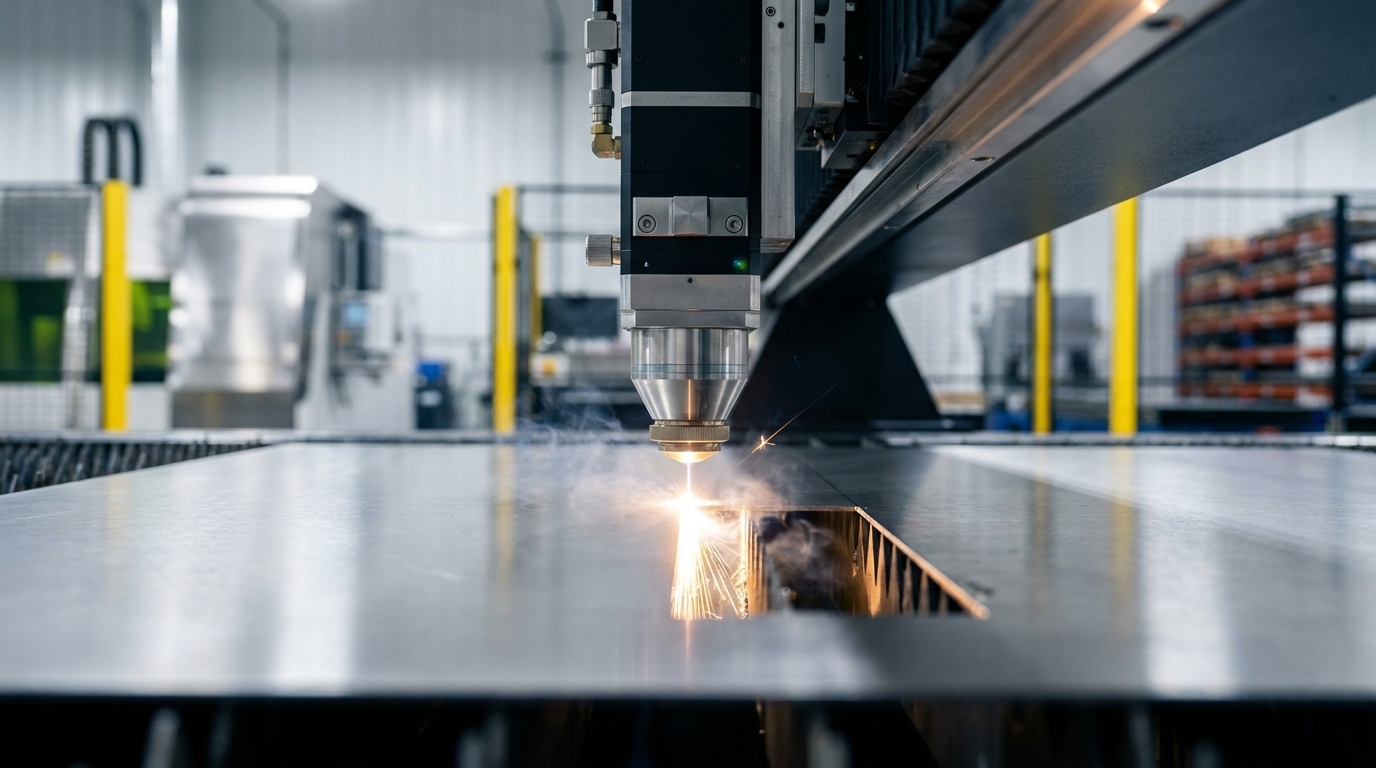
Modern fiber laser systems provide the speed and accuracy needed for complex geometries. High-power fiber lasers increase cutting speeds for lightweight materials like aluminum and high-strength steel while maintaining the precision required for intricate features. Automated nesting software improves material utilization and reduces scrap.
Why Laser Cutting Fits Complex Geometries
Laser cutting produces complex geometries with minimal tooling. Fiber lasers process thin metals under 6mm at speeds up to 40 m/min while maintaining ±0.1mm tolerance. This capability supports rapid iteration during product development. The process creates clean edges with small heat-affected zones, which reduces secondary finishing.
Integrated Cutting and Assembly for Faster Turnarounds
Vertical integration creates a seamless transition from laser cutting to assembly operations. Parts move directly from cutting to forming, welding, or machining without transportation delays or setup variation between vendors. This integration reduces total lead times and improves dimensional consistency across the assembly process.
A data center rack enclosure illustrates the impact. The project requires laser-cut panels, CNC-machined mounting points, powder coating, and cable management assembly. An integrated facility can complete prototype-to-100 unit production in 10 days. Separate suppliers often require 4 to 6 weeks for the same scope.
See how vertical integration can accelerate your next project by requesting a quote from Fabcon.
Fabcon’s Vertically Integrated Advantages for Engineering and Procurement Teams
Fabcon solves common engineering and procurement pain points through comprehensive vertical integration. Design-for-manufacturability collaboration reduces rework by identifying improvement opportunities early in the design cycle. Integrated operations shorten schedules from several weeks to a matter of days compared to separated processes that can stretch projects from three to six weeks.
Fabcon operates 220,000 square feet across two Southern California facilities. The team combines more than 45 years of precision fabrication experience with modern equipment and robust quality systems. ISO 9001:2015 and AS9100D certifications support traceability and compliance for EV infrastructure, medical devices, and data center equipment.
Fabcon’s key advantages work together as a single system. Single-source accountability removes vendor coordination overhead and simplifies communication. Just-in-time production capabilities support smooth scaling from prototype through mid-volume production. In-house engineering provides real-time design feedback that improves manufacturability. Integrated quality systems maintain consistency across every process step.
- Single-source accountability eliminates vendor coordination overhead
- Just-in-time production capabilities support prototype-to-mid-volume scaling
- In-house engineering provides real-time design optimization feedback
- Integrated quality systems ensure consistency across all processes
Comparing Providers for Precision Laser-Cut Assemblies
| Provider Type | Lead Times | Integration Level | Compliance |
|---|---|---|---|
| Job Shops | 3-7 days cutting only | Laser cutting only | Basic quality |
| Mid-Tier (e.g., Pinnacle) | 5-10 days | Limited assembly | ISO 9001 |
| Large CMs | 4-8 weeks | Full integration | Multiple certs |
| Fabcon | Rapid lead times | Full vertical integration | ISO 9001:2015, AS9100D |
Vetting Precision Laser Cutting Partners for Complex Assemblies
Effective partner selection reduces risk and protects program timelines. When evaluating precision laser cutting partners for complex assemblies, verify certifications, conduct facility visits, and request customer references. Your assessment should focus on several critical areas that affect quality, schedule, and scalability.
Key evaluation criteria include:
- Quality certifications relevant to your industry
- Engineering support for design optimization
- Integrated capabilities spanning your full requirements
- Demonstrated experience with similar assemblies
- Geographic proximity for collaboration and logistics
Evaluate Fabcon’s capabilities for your specific requirements by requesting a detailed quote.
Conclusion: Use Integrated Precision Laser Cutting to Accelerate Complex Assemblies
Complex assemblies require more than basic laser cutting. These programs need integrated manufacturing partners who deliver precision, speed, and coordinated control across every process. Fabcon’s vertically integrated approach removes the trade-offs between job shop limitations and large CM rigidity and provides the agility and breadth required for today’s demanding applications.
Use this evaluation framework to compare potential partners and confirm that your precision laser cutting supplier can support your complete assembly requirements. Request a quote from Fabcon today and see how an integrated approach can accelerate your next project.
Frequently Asked Questions
What are typical lead times for precision laser cutting on complex assemblies?
Standard lead times for precision laser cutting with integrated assembly usually fall within a few days for most applications, with rush options available for urgent needs. These timeframes assume parts are ready for production and include basic finishing operations. Complex assemblies that require extensive secondary operations such as welding, machining, or electromechanical integration may need additional time depending on complexity. Vertically integrated facilities typically deliver faster turnarounds than fragmented supply chains because they remove handoffs and transportation delays.
How does the design-for-manufacturability process work for laser-cut assemblies?
The DFM process starts with early collaboration between your engineering team and the manufacturer’s technical staff. Both teams review part geometry, material selection, tolerance requirements, and assembly methods to identify improvement opportunities. Key considerations include minimizing bend count, standardizing features across parts, ensuring proper clearances for tooling access, and designing for efficient nesting. The goal is to reduce manufacturing complexity while maintaining functionality, which lowers costs and improves quality. Effective DFM collaboration can reduce manufacturing costs by 15 to 30 percent and shorten development cycles.
What tolerances are achievable with modern precision laser cutting for assemblies?
Modern fiber laser systems achieve tolerances of ±0.05 to ±0.1 mm for 1-3 mm thin metals and ±0.1 to ±0.2 mm for 3-6 mm thicknesses. Tolerances become looser as material thickness increases, reaching ±0.2 to ±0.3 mm for 6-12 mm thick materials and ±0.3 to ±0.5 mm for materials over 12 mm thick. Positional accuracy between features typically falls between ±0.03 and ±0.05 mm on high-end systems. These tolerances support most assembly applications, though critical interfaces may still require secondary machining for tighter specifications. The key is matching tolerance requirements to functional needs instead of over-specifying precision.
How does vertical integration reduce supply chain risks compared to using multiple vendors?
Vertical integration removes the coordination complexity and quality handoff risks that occur in multi-vendor supply chains. With integrated operations, one provider holds accountability for quality, schedule, and performance across all processes. This structure eliminates transportation damage risks, reduces setup variation between operations, and improves control over lead times. During supply chain disruptions, vertically integrated facilities can adjust internally and maintain production continuity, while fragmented supply chains often face cascading delays when any single vendor encounters problems.
What advantages does U.S.-based manufacturing provide for precision laser cutting versus overseas options?
U.S.-based precision laser cutting offers several advantages for complex assemblies. Domestic suppliers support faster communication and collaboration during design phases, reduced shipping times and costs, stronger intellectual property protection, and compliance with domestic content requirements for government and infrastructure projects. Quality control often remains more consistent due to established regulatory frameworks and easier facility auditing. U.S. facilities also support rapid prototyping and design iteration that overseas suppliers struggle to match because of time zone differences and communication barriers. For applications that require ITAR compliance or AS9100D certification, domestic sourcing usually simplifies qualification and ongoing compliance.