
Last updated: April 17, 2026
Key Takeaways
- Fiber lasers dominate 2026 metal fabrication with 3-5x faster cutting speeds, 50% lower costs, and precise engraving on steel and aluminum.
- Enterprise workhorses like Trumpf TruLaser 3030 (up to 35 mm steel) and Bystronic ByStar (50 mm steel) deliver high throughput and ROI in 18-24 months.
- Power scales with thickness: 2-6 kW for thin materials and up to 15-20 kW for thick stainless steel and aluminum.
- AI nesting, automation, and 100,000+ hour laser life cut waste and operating costs by 25-30% in high-volume production.
- Partner with Fabcon to integrate these lasers into end-to-end U.S. fabrication assemblies with shorter, more reliable lead times.
Why Fiber Lasers Lead Industrial Metal Fabrication in 2026
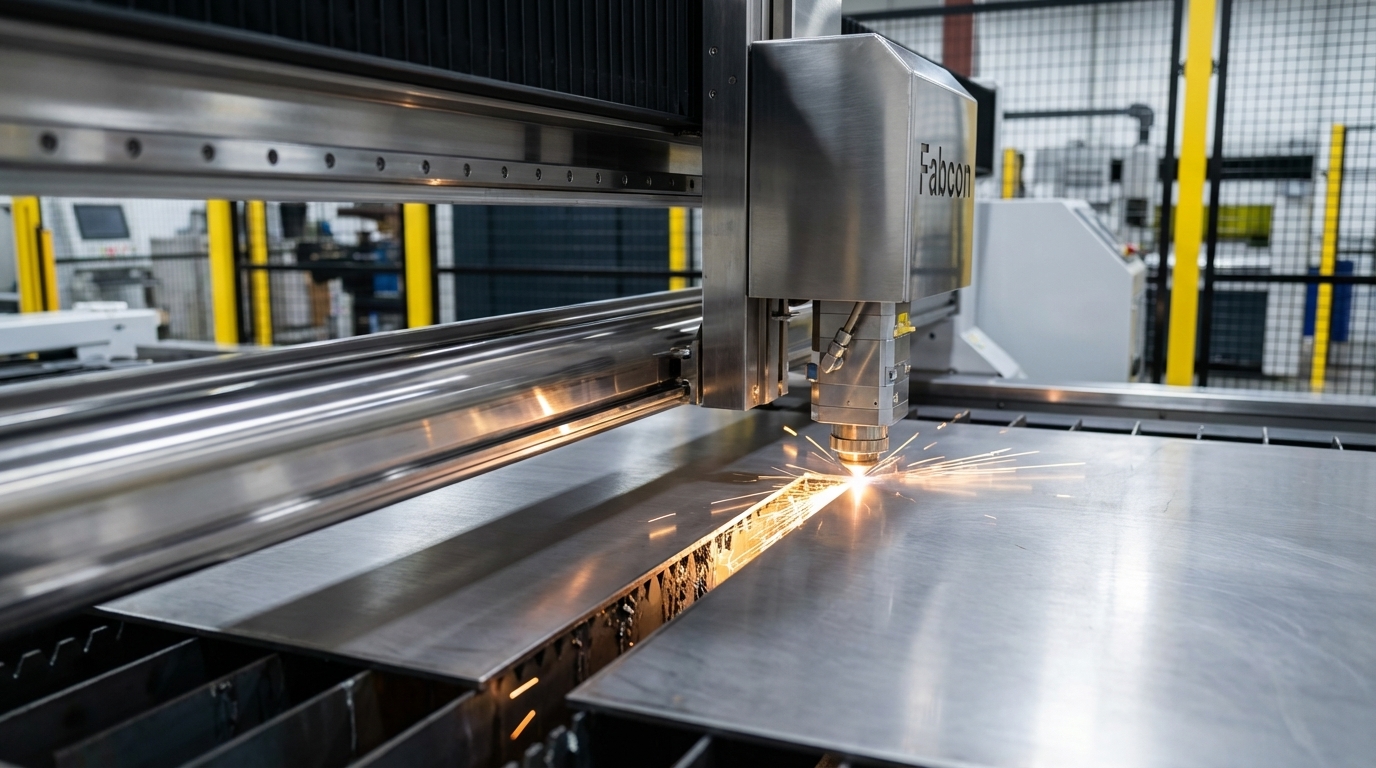
Fiber lasers deliver 3-5 times faster cutting speeds and 50% lower operating costs compared to CO2 and diode systems. These performance gains come from more efficient laser generation and tighter beam delivery. For metal engraving, fiber sources provide precise depth control and clean detail on steel, stainless steel, and aluminum.
Power requirements scale with material thickness and type. Systems in the 2-6 kW range handle thin materials, 8-12 kW units cut mild steel efficiently, and 15-20 kW platforms process thick stainless steel and aluminum. Matching power to your material mix protects edge quality and keeps cycle times predictable.
Modern 2026 systems pair this power with AI-driven controls. Advanced laser platforms automatically adjust power, speed, and focus based on material type, which reduces setup time and operator error. These adjustments create faster, more consistent workflows across shifts.
Engraving capabilities now support demanding traceability standards in aerospace and medical markets. Ultra-short pulses enable high-precision engraving with minimal heat impact, so parts retain mechanical properties while carrying permanent, readable marks.
The following ten systems show how these fiber laser advantages translate into real production performance for metal fabrication and engraving.
Top 10 Industrial Laser Cutters & Engravers for Metal Fabrication 2026
1. Trumpf TruLaser Series 3030 (6-20 kW)
Trumpf’s flagship delivers high precision and repeatability on standard bed sizes, powered by TruFiber laser technology ranging from 10 W to 12 kW. This power range supports cutting up to 35 mm steel and 30 mm aluminum while holding tight tolerances. Integrated engraving capabilities meet aerospace traceability requirements with consistent mark quality. Combined speed and accuracy often deliver ROI in 18-24 months through roughly 40% throughput gains. These strengths make the TruLaser 3030 a strong fit for Fabcon’s high-mix cells serving data center rack production.
2. Bystronic ByStar Fiber (8-15 kW)
ByStar Fiber pairs Swiss-engineered precision with high power for demanding shops. The platform processes material up to 50 mm steel thickness while maintaining high speeds on thin gauge sheet. Built-in automation includes pallet changers and intelligent nesting that support lights-out production. Engraving depth control enables permanent marking on stainless components for industrial and regulated markets. Energy efficiency upgrades cut operating costs by about 25% compared to earlier ByStar generations.
3. Amada ENSIS Evo (4-12 kW)
Amada’s ENSIS Evo combines cutting and engraving in one platform tuned for mixed-material production. The system handles a wide range of steel and aluminum thicknesses while delivering smooth, burr-free edges. Integrated vision systems align engraving to features and cut paths with high accuracy. This combination of flexibility and precision supports job shops and OEMs that run frequent changeovers. Amada remains a prominent global fiber laser cutting machine manufacturer with strong service coverage.
4. Mazak Optiplex 3015 DDL (6-12 kW)
Mazak’s direct diode laser technology provides consistent beam quality across the full power range. The Optiplex 3015 DDL supports robust thickness capabilities for both steel and aluminum, which suits general fabrication and OEM work. The 2026 model adds enhanced automation with robotic loading systems that reduce manual handling. Engraving applications benefit from precise depth control and high-speed marking, so part identification keeps pace with cutting throughput.
5. Han’s Laser G3015F (6-20 kW)
Han’s Laser delivers enterprise-grade performance at competitive pricing with the G3015F. This system processes thick steel with excellent cut quality suitable for structural and heavy equipment components. Advanced software integration supports complex nesting layouts and detailed engraving patterns. Han’s Laser ranks among the top five global manufacturers with significant market presence, which gives buyers confidence in long-term support.
6. IPG Genesis Series (10-40 kW)
IPG Photonics’ Genesis Series targets heavy fabrication and plate processing. IPG unveiled high-power lasers that offer 60% floor space savings and improved reliability, which matters in crowded production halls. The Genesis platform delivers cutting capacity for very thick steel while preserving edge quality and straightness. Specialized engraving modes support deep marking for parts that face harsh service environments.
7. Prima Power Platino Fiber (4-15 kW)
Prima Power’s Platino Fiber combines Italian precision engineering with flexible automation. The system handles up to 20 mm mild steel and offers integrated punch-laser capabilities for complex geometries. Engraving functions include variable depth control and high-resolution marking, which supports branding and traceability on the same line. A compact footprint suits facilities with limited floor space.
8. LVD Electra FL (3-12 kW)
The LVD Electra FL emphasizes operator safety and straightforward operation. The platform achieves maximum steel thickness with consistent repeatability, which simplifies process planning. Advanced engraving capabilities support medical device marking where clarity and permanence are critical. Energy-efficient operation reduces overall facility power demand and helps control utility costs.
9. Salvagnini L5 (6-20 kW)
Salvagnini’s L5 supports integrated sheet metal processing in flexible manufacturing cells. The system combines cutting, engraving, and forming to reduce part handling and work-in-process inventory. Thickness capacity includes 30 mm steel and 25 mm aluminum, which covers most structural and enclosure work. Automated material handling and cell-level control help maximize productivity across long production runs.
10. Cincinnati CL-940 (8-15 kW)
The Cincinnati CL-940 pairs American manufacturing reliability with modern fiber laser performance. The system processes 3/4″ mild steel and 1/4″ aluminum with consistent edge quality and minimal rework. Integrated engraving systems support part identification and traceability without secondary operations. A strong North American service network helps keep downtime low for multi-shift users.
The table below compares core specifications for five of these systems so you can quickly see how power range relates to maximum steel thickness, cutting speed, and price positioning.
| Model | Power Range (kW) | Max Steel Thickness (mm) | Cutting Speed (m/min) | Price Range |
|---|---|---|---|---|
| Trumpf TruLaser 3030 | 6-20 | 35 | 25 | Varies |
| Bystronic ByStar Fiber | 8-15 | 50 | 25 | Varies |
| Amada ENSIS Evo | 4-12 | 25 | 20 | Varies |
| Mazak Optiplex 3015 | 6-12 | 25 | 22 | Varies |
| Han’s Laser G3015F | 6-20 | 35 | 24 | Varies |
Key Buying Factors for Production Shops: Power, Automation, ROI
Power & Thickness Guide
Power selection should follow your material thickness and mix. Power requirements scale directly with material thickness: 2-4 kW systems suit mild steel thicker than 5 mm, 2000-4000 watts work for stainless steel over 5 mm, and 3000-4000 watts handle aluminum exceeding 5 mm up to 8 mm. These power levels also influence cutting speed. A 1000 watt source cuts 5 mm carbon steel at 1.8-2.1 m/min, while a 500 watt system can process thinner 2 mm stainless at higher speeds because it needs less power to penetrate the material.
Automation for High-Volume Production
Automation features drive consistent throughput in multi-shift environments. Automated exchange tables load new sheets while the previous sheet is still cutting, which significantly increases output. Pallet changers and intelligent nesting often deliver around $50,000 in annual savings through lower setup time and reduced material waste. Intelligent manufacturing solutions add another 20–30% production efficiency, which complements the cost reductions mentioned earlier.
Total Cost Breakdown and Power Thresholds
Total cost of ownership stays manageable when you combine efficient hardware with smart utilization. Operating costs, including amortization, labor, overhead, maintenance, electricity, and consumables, remain low in well-managed operations largely because fiber laser sources are rated for 100,000+ hours of operation, far longer than CO2 alternatives. This long service life reduces replacement frequency and spreads capital cost over more parts. For enterprise-scale production, systems below 4 kW usually fall short because lower throughput and shorter effective lifespan outweigh their lower purchase price.
Integrating High-Performance Lasers into Your Workflow
Successful laser integration starts with Design-for-Manufacturability collaboration and clear nesting strategies. Fiber lasers deliver higher precision with ±0.1 mm tolerances, narrow kerf, and small heat-affected zones, which supports tight assemblies. Modern systems produce weld-ready edges that remove many grinding and secondary processing steps.
Fabcon deploys these top laser systems inside agile manufacturing cells that support prototype-to-production transitions. Integrated CNC machining, finishing, and assembly capabilities sit alongside laser cutting, which removes handoffs between vendors. This integrated approach eliminates supply chain fragmentation and delivers roughly 30% faster lead times while maintaining ISO 9001:2015 and AS9100D compliance for medical, EV, and data center applications. Get a quote for comprehensive laser-cut fabrication services.
Conclusion: Choosing the Right Laser and Partner
The 2026 landscape favors high-power fiber lasers from established manufacturers such as Trumpf, Bystronic, and Amada for enterprise metal fabrication. These systems supply the speed, precision, and automation that modern manufacturing demands across industries. Fabcon’s experience implementing and integrating these technologies helps convert that capability into real ROI through end-to-end fabrication and assembly services.
Contact Fabcon for DFM consultation on laser-cut enclosures and assemblies and receive quotes in days with U.S.-made reliability. Get a quote to upgrade your metal fabrication capabilities with a single integrated partner.
Frequently Asked Questions
What is the best laser cutter for thick metal fabrication?
For thick metal fabrication, 15-20 kW fiber lasers excel at cutting steel up to 40 mm and aluminum up to 25 mm thickness. These high-power systems maintain strong edge quality and cutting speeds that outperform plasma alternatives. The Trumpf TruLaser series and IPG Genesis platforms represent current technology leaders for heavy-duty applications.
Which fiber laser engraver works best for steel marking?
Fiber lasers operating between 20-100 watts provide reliable steel engraving performance for most applications. These systems create permanent, high-contrast marks without damaging the base material. Variable pulse control supports different marking depths for traceability in aerospace and medical device manufacturing.
Are 2026 laser models worth upgrading from older systems?
2026 fiber laser models usually justify an upgrade from systems more than five years old. New platforms deliver 30-50% better energy efficiency, AI-powered automation, and improved beam quality. Modern designs also extend component lifecycles, reduce maintenance requirements, and include integrated software that streamlines production workflows.
How do I calculate ROI for a 10 kW fiber laser investment?
ROI calculations should combine initial equipment cost, installation expenses, and ongoing operating costs with expected productivity gains and labor savings. A typical 10 kW system costing about $800,000 can generate around $20,000 in monthly savings through higher throughput and shorter processing time. High-utilization environments often achieve payback in 18-24 months.
Why choose Fabcon over traditional job shops for laser cutting?
Fabcon provides end-to-end integration from laser cutting through final assembly, which removes vendor handoffs that cause delays and quality issues. Its 220,000 square foot facilities house the latest fiber laser technology alongside CNC machining, powder coating, and electromechanical assembly capabilities. This integrated approach delivers roughly 30% faster lead times while maintaining strict quality standards for critical applications.