
Key Takeaways
- Use a practical 7-step process to handle materials, DFM, cutting, bending, joining, quality control, finishing, and scaling for EV, data center, and medical applications.
- Apply DFM rules such as proper bend radii (≥1× thickness for aluminum), safe hole placement (≥2× thickness from edges), and K-factor calibration to prevent cracking and ensure manufacturability.
- Rely on advanced methods like fiber laser cutting for ±0.005″ tolerances, springback compensation in bending, and AI vision systems for quality control to maintain consistent precision.
- Choose an integrated manufacturing model to remove vendor handoffs, cut lead times by 30–50%, and hold tolerances from prototype through mid-volume production.
- Leverage Fabcon’s 45+ years of ISO 9001:2015 and AS9100D certified expertise to keep design, fabrication, and finishing under one roof.
What is Precision Sheet Metal Fabrication?
Precision sheet metal fabrication uses high-tolerance processes to turn flat metal sheets into custom parts, enclosures, and assemblies with dimensional accuracy typically ranging from ±0.003″ to ±0.010″. This integrated workflow combines computer-aided design, laser cutting, CNC bending, welding, finishing, and electromechanical assembly to support technology-driven industries that demand consistent quality and reliable performance.
The seven-step mastery framework covers materials selection and design for manufacturability, precision cutting techniques, bending and forming optimization, joining and assembly integration, quality control implementation, finishing processes, and production scaling strategies. Each step builds on the previous one so projects move smoothly from prototype development into mid-volume manufacturing.
1. Match Materials and DFM to Real-World Use
Material selection sets the stage for successful precision sheet metal fabrication. Aluminum alloys like 5052 and 6061 provide excellent formability for enclosures and brackets, while 300-series stainless steel delivers corrosion resistance for medical and food service applications. Design for manufacturability guidelines recommend bend radii ≥1× thickness for aluminum and ≥1.5× thickness for stainless steel to prevent cracking during forming operations.
Critical DFM principles include maintaining hole-to-edge distances ≥2× material thickness, positioning holes ≥6× thickness from bend lines, and using standard sheet thicknesses to avoid custom tooling costs. K-factor calibration between 0.30-0.45 ensures accurate flat pattern development, while geometric dimensioning and tolerancing (GD&T) per ASME Y14.5 communicates functional requirements without over-constraining manufacturing flexibility.
The following checklist highlights frequent DFM issues and practical fixes so you can avoid design errors that slow projects and inflate cost.
DFM Checklist for Precision Fabrication
|
Design Aspect |
Best Practice |
Common Pitfall |
Fabcon Solution |
|
Bend Radius |
≥1× thickness (Al), ≥1.5× (SS) |
Cracking from tight radii |
Material-specific tooling |
|
Hole Placement |
≥2× thickness from edges |
Distortion during forming |
Early DFM collaboration |
|
Tolerance Application |
±0.005″ only where needed |
Blanket tight tolerances |
Function-based specifications |
|
Flange Length |
≥4× thickness minimum |
Tooling grip failures |
Validated work instructions |
Fabcon’s engineering team joins early in the design phase to improve manufacturability for EV charging enclosures, data center racks, and medical equipment housings. This early involvement prevents costly redesigns and keeps the move from prototype to production volumes on schedule.
2. Use Precision Cutting to Set Up Every Downstream Step
Fiber laser systems with up to 60kW resonators deliver weld-ready edge quality while cutting thick steel at unprecedented speeds, enabling hole-to-thickness ratios as tight as 1:4. Laser cutting achieves tolerances of ±0.005″ on cut features with minimal heat-affected zones, which suits precision electronics enclosures and medical device components.
Waterjet cutting provides superior edge quality for thick materials without thermal distortion, and CNC punching supports high-speed production for standard hole patterns and simple geometries. The 3-4-5 squareness verification method confirms rectangular parts maintain proper geometry, using 3, 4, and 5 unit measurements to verify 90-degree corners within acceptable tolerances.
Fabcon’s integrated cutting capabilities remove vendor handoffs that typically add 2–3 days to project timelines. Advanced nesting software improves material utilization while maintaining part quality, which supports both prototype quantities and mid-volume production runs for data center infrastructure and telecommunications equipment.
3. Control Bending and Forming for Stable Results
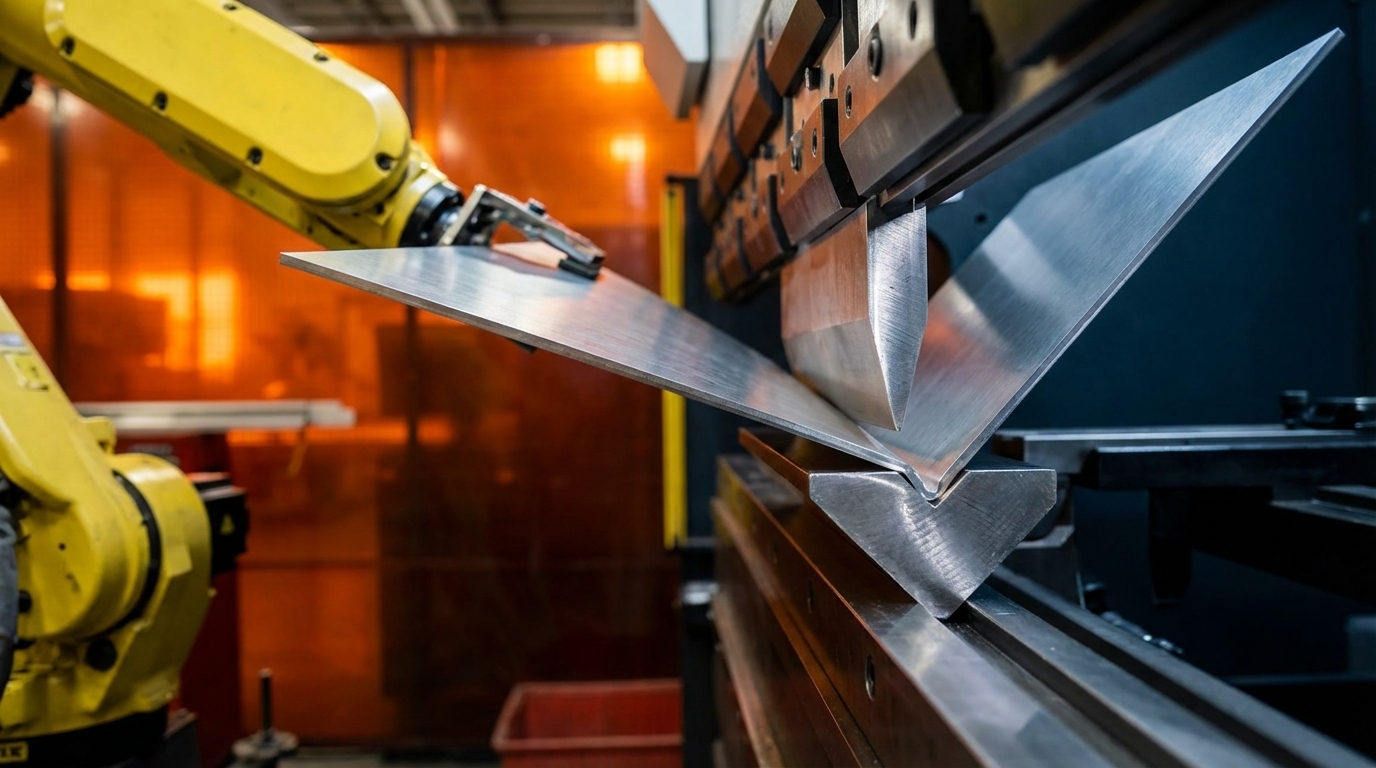
Once precision-cut blanks are ready, the forming process turns flat sheets into three-dimensional parts. Press brake operations require precise control of springback compensation and bend allowance calculations to achieve dimensional accuracy. Formed dimension tolerances of ±0.010″ are achievable through proper tooling selection and CNC programming that accounts for material properties and thickness variations.
Springback compensation changes with material grade and thickness, and harder alloys need greater overbending to reach final angles. The K-factor calibration discussed earlier uses test coupons to validate flat pattern accuracy across different materials and thicknesses, which prevents dimensional drift in production quantities.
Common forming pitfalls include insufficient bend relief at corners, which causes material tearing, and inadequate flange support during bending operations. These issues compound when manufacturers lack proper tooling or process control. Fabcon’s CNC press brakes with precision tooling eliminate these risks and deliver repeatable results for medical cart assemblies and EV charging station enclosures while maintaining tight tolerances across production runs.
4. Build Reliable Assemblies with Robust Joining
Welding processes must balance joint strength with heat input to prevent distortion in precision assemblies. TIG welding provides superior control for thin materials and critical joints, while MIG welding offers higher productivity for structural applications. Proper joint design with appropriate root openings and backing supports full penetration without excessive heat input.
Hardware insertion using self-clinching fasteners removes secondary operations while maintaining assembly strength. Manufacturer specifications for centerline-to-edge distances prevent cracking or pull-out failures during installation and service life.
Electromechanical assembly integration combines mechanical fabrication with wiring harnesses, electronic components, and system-level testing. Fabcon’s one-roof approach prevents handoff errors common in fragmented supply chains, as demonstrated in Traffix traffic control enclosures where mechanical and electrical integration occurs simultaneously.
5. Lock In Quality with Layered Inspection
Verifying that assembled components meet specifications requires systematic inspection at multiple stages. Coordinate measuring machines (CMMs) provide dimensional verification for critical features, while laser micrometers and optical comparators enable real-time verification during production. First article inspection establishes baseline measurements and validates manufacturing processes before full production release.
AI-based vision systems detect defects automatically, which reduces inspection time and improves consistency compared to manual methods. Statistical process control tracks dimensional trends and triggers corrective actions before parts exceed tolerance limits.
Choosing the right tolerance level for each feature type prevents over-engineering while still meeting functional requirements. The chart below summarizes standard and precision options for common feature categories.
Standard Tolerance Chart
|
Feature Type |
Standard Tolerance |
Precision Option |
Application |
|
Cut Features |
±0.005″ |
±0.003″ |
Mating surfaces |
|
Formed Dimensions |
±0.010″ |
±0.005″ |
Assembly interfaces |
|
Angular |
±1° |
±0.5° |
Precision tooling |
|
Holes Across Bends |
±0.030″ |
±0.015″ |
Multi-bend parts |
Fabcon’s AS9100D certification ensures full traceability for aerospace and defense applications, and ISO 9001:2015 compliance supports medical device and telecommunications customers that require documented quality systems.
6. Finish Surfaces for Protection and Branding
Surface preparation directly affects coating adhesion and final appearance quality. Surface finish standards range from Ra 1.6–6.3 µm for waterjet cutting to Ra 0.1–0.4 µm for electropolishing, and specific requirements vary by application and environment.
Powder coating provides durable protection for outdoor applications, while wet paint systems offer superior color matching and texture options for projects where aesthetics matter most. After the base coating is applied, screen printing adds permanent identification and branding elements that withstand environmental exposure and cleaning protocols.
Fabcon’s integrated finishing capabilities remove transportation delays and quality variations that often appear when outsourcing coating operations. Energy storage enclosures and data center equipment benefit from consistent finish quality and shorter delivery schedules.
7. Scale from Prototype to Production with Agile Cells
Fully integrated fabrication cells connect cutting, bending, and material handling with robotic automation to support high-mix, mid-volume production requirements. Agile manufacturing cells adapt to changing product configurations without the rigid minimum order quantities typical of large contract manufacturers.
Robotic welding increases structural throughput by 50% while CNC automation with AI reduces first-article approval cycles by up to 30%, which enables faster transitions from prototype to production volumes.
Production scaling pitfalls include inadequate capacity planning and inflexible tooling that cannot support design changes. Fabcon’s agile production cells handle evolving bills of materials and volume fluctuations without the constraints of traditional high-volume manufacturing lines.
Common Pitfalls and Practical Fixes
Fragmented supply chains create vendor handoff delays and quality finger-pointing when issues arise. Neglecting material thickness and bend allowance leads to dimensional inaccuracies and poor assembly fit, which drives costly rework and schedule slips.
Hole placement too close to bend lines causes distortion or cracking, and overly tight tolerances across all features inflate costs significantly without functional benefit. Blanket tight tolerances of ±0.005″ or tighter assume secondary operations and drive high costs even when technically achievable.
Fabcon’s integrated model eliminates handoff errors while reducing lead times by 30–50% compared to fragmented vendor networks. Early DFM collaboration removes design issues that cause production delays and quality problems.
Why Fabcon is the Right Partner for Sheet Metal Mastery
Fabcon’s unified facilities in Santa Ana and Valencia combine fabrication, machining, assembly, and finishing in a single coordinated operation, which removes the vendor coordination challenges that plague fragmented supply chains. ISO 9001:2015 and AS9100D certifications support customers in EV infrastructure, telecommunications, and medical device manufacturing that require documented quality systems and full traceability.
The company’s agile production cells scale from prototype through mid-volume production without the rigid minimum order quantities and long lead times typical of large contract manufacturers. Request a quote to see how this one-roof model shortens your schedule and stabilizes delivery performance.
Frequently Asked Questions
What is DFM for sheet metal fabrication?
Design for Manufacturability (DFM) for sheet metal focuses on part geometry, material selection, and tolerance specifications that reduce manufacturing complexity and cost. Key principles include using appropriate bend radii based on material thickness, maintaining adequate hole-to-edge distances, specifying realistic tolerances only where functionally required, and selecting standard material thicknesses to avoid custom tooling.
Effective DFM collaboration between design engineers and fabricators during the early design phase prevents costly redesigns and keeps the transition from prototype to production smooth.
What are typical sheet metal tolerances for precision fabrication?
Standard precision sheet metal tolerances often include ±0.005″ for cut features, ±0.010″ for formed dimensions, and ±1° for angular measurements. Tighter tolerances of ±0.003″ are achievable for critical mating surfaces but usually require secondary operations that increase cost and lead time.
Holes across multiple bends typically need looser tolerances due to accumulated variation, while features within a single bend can hold tighter accuracy. The key is applying tight tolerances only where functionally necessary instead of specifying blanket precision across all dimensions.
How long are typical lead times for precision sheet metal prototypes?
Precision sheet metal prototype lead times usually range from 5–15 business days depending on complexity, material availability, and finishing requirements. Simple brackets and enclosures with standard materials often complete in 5–7 days, while complex assemblies that require multiple forming operations, welding, and custom finishing may need 10–15 days. Integrated manufacturers like Fabcon often achieve faster turnaround by removing the vendor coordination delays described earlier.
What is the difference between ISO 9001 and AS9100D certification?
ISO 9001:2015 is the international standard for quality management systems across all industries and focuses on customer satisfaction, process improvement, and documented procedures. AS9100D builds on ISO 9001 with additional aerospace-specific requirements that include configuration management, risk management, and product safety considerations.
AS9100D certification demonstrates capability to meet the stringent quality and traceability requirements of aerospace and defense customers, while ISO 9001 provides the foundation for quality systems in commercial applications such as medical devices, telecommunications, and industrial equipment.
How do you scale sheet metal fabrication from prototype to mid-volume production?
Scaling sheet metal fabrication requires a shift from manual processes to automated production cells while maintaining quality consistency. Key strategies include implementing CNC programming for repeatable operations, establishing statistical process control for dimensional monitoring, improving material flow and inventory management, and developing standardized work instructions.
Agile manufacturing cells provide flexibility to handle design changes and volume swings without the rigid minimum order quantities of traditional high-volume lines. Success depends on early production planning, validated tooling, and integrated quality systems that grow with volume requirements.
Mastering precision sheet metal fabrication depends on consistent execution across materials selection, cutting, forming, assembly, quality control, finishing, and production scaling. This seven-step roadmap gives you a clear structure for improving in-house capabilities or choosing manufacturing partners that deliver consistent quality and reliable performance.
Fabcon’s integrated approach removes the fragmentation and handoff errors that slow traditional supply chains, delivering precision components and assemblies for infrastructure-critical applications. Start your next project with Fabcon to eliminate coordination headaches and keep production on schedule.