
Last updated: April 17, 2026
Key Takeaways
- The Faraday cage effect blocks powder from reaching recesses in complex metal assemblies, causing uneven coverage and salt spray failures below AAMA 2604 standards.
- Tribo charging guns outperform corona systems on recessed and intricate parts by overcoming the electrostatic barriers that limit coverage.
- Robotic automation increases output by up to 20%, while iron phosphate pretreatment supports adhesion that exceeds 1,000 hours in ASTM B117 testing.
- Vertically integrated providers like Fabcon cut lead times by 25–30% through single-source fabrication, coating, and assembly under ISO 9001:2015 and AS9100D certification.
- Partner with Fabcon for vertically integrated powder coating solutions that streamline your supply chain and deliver uniform coverage on complex assemblies.
Core Challenges in Powder Coating Complex Metal Assemblies
The Faraday cage effect creates the primary obstacle in coating complex geometries, where edges build quickly and can back-ionize before recesses coat. This electrostatic phenomenon blocks powder penetration into recessed areas, creating uneven coverage where outer edges exceed 100 microns thickness and interiors remain under 20 microns or bare.
Outgassing from weldments compounds these issues during curing, and heat-sensitive substrates limit allowable processing temperatures. DIY powder coating on stainless steel often produces high scrap rates for beginners, and a single coating failure can significantly inflate per-unit costs due to rework.
| Challenge | Root Cause | Impact |
|---|---|---|
| Faraday Cage Effect | Electrostatic field concentration | Elevated scrap rates, adhesion failure |
| Outgassing | Trapped moisture/oils in welds | Pinhole defects, coating delamination |
| Uneven Geometries | Complex part design | 30% cost premium for complex shapes |
Fabcon’s design-for-manufacturability (DFM) collaboration and in-house process control mitigate these challenges by refining part geometry and maintaining consistent pretreatment-to-cure parameters. Addressing these challenges requires specific equipment choices and tuned process settings that work together across the entire line.
Essential Technologies for Uniform Coverage on Complex Parts
Tribo Charging Spray Guns vs. Corona Systems
Tribo charging technology excels in coating recessed areas by using friction-based powder charging instead of external electrodes. Tribo guns provide better coverage on small parts or complex geometries than corona guns because they avoid ion wind that disrupts powder delivery into tight spaces.
Tribomatic static charging provides better penetration into recessed areas than corona charging, which has difficulty with deep recesses due to the Faraday cage effect. Tribo guns overcome the Faraday cage limitations described earlier by using friction-based charging rather than corona discharge, allowing powder to reach recessed areas that corona systems often fail to coat effectively.
| Gun Type | Recess Penetration | Transfer Efficiency | Best Application |
|---|---|---|---|
| Tribo | Very good for complex shapes | Lower than corona | Complex assemblies, recesses |
| Corona | More difficult for recesses | Higher than Tribo | Flat surfaces, high-speed lines |
Robotics and Automated Coating Cells
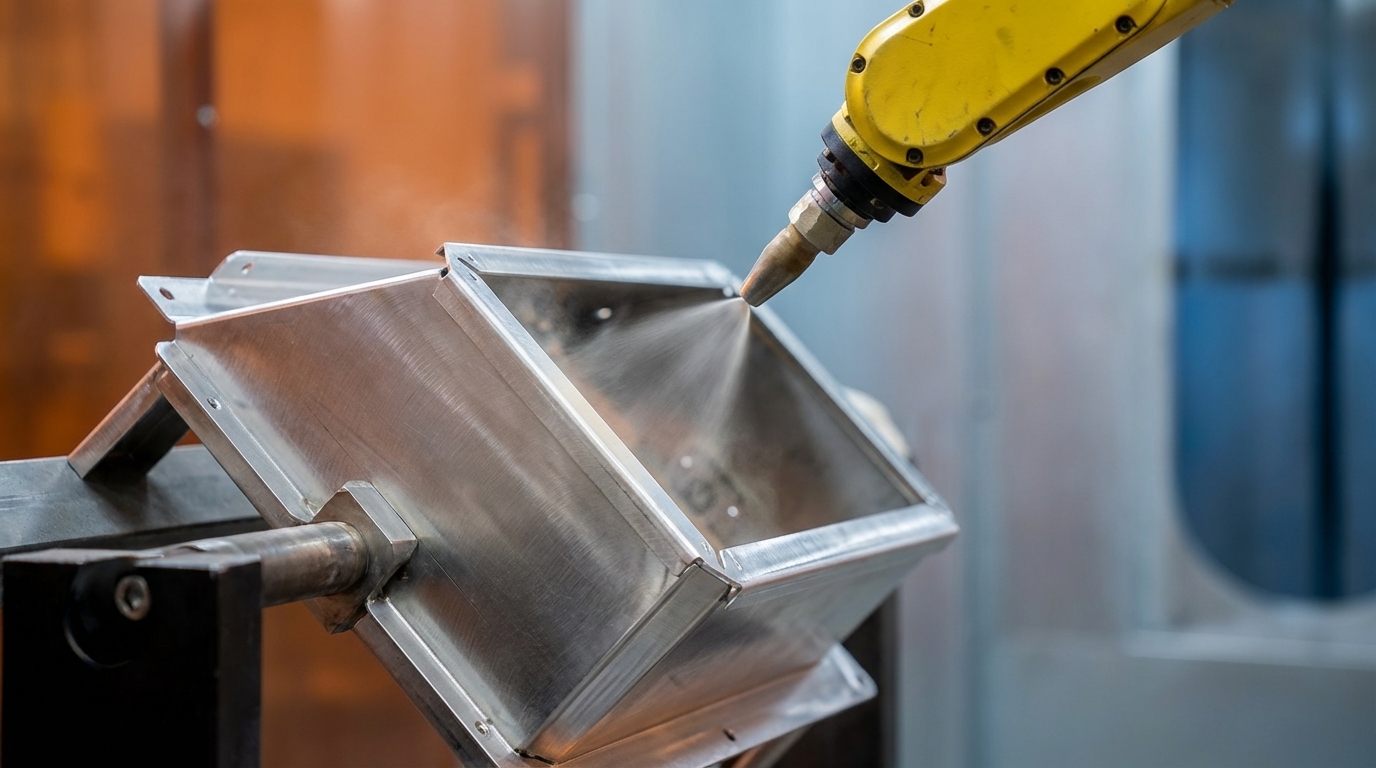
Robotic powder coating systems deliver measurable productivity gains for mid-volume production while stabilizing quality. Robot painting systems elevate output levels by up to 20% and can reduce operational costs through efficiency gains. These systems connect with manufacturing execution systems (MES) to provide real-time coating thickness monitoring and material consumption tracking.
Auto-learning programming and machine learning algorithms in autonomous robotic painting systems significantly raise throughput while lowering human error and rework rates. Fabcon’s automated coating line handles complex assemblies after fabrication and maintains consistent quality through integrated process control.
Pretreatment and Masking Practices That Protect Performance
Effective pretreatment starts with thorough substrate cleaning to remove oils, grease, and contaminants. A conversion coating such as iron phosphate or zinc phosphate is applied after cleaning to enhance corrosion resistance and promote adhesion, enabling properly pretreated surfaces to exceed 1,000 hours in ASTM B117 salt spray testing for aerospace, military, and high-exposure environments.
Essential pretreatment sequence: Start with alkaline degreasing to remove manufacturing oils, then use abrasive blasting to create the surface profile needed for mechanical adhesion. Apply iron or zinc phosphate conversion coating to this prepared surface, followed by thorough rinsing and drying to prevent contamination. Finish the sequence with precision masking of threaded areas and other features that must remain coating-free.
Fabcon’s integrated fabrication-to-pretreatment workflow eliminates contamination between process steps and reduces defect rates compared to multi-vendor approaches. Get a quote for streamlined pretreatment integration.
2026 Trends Reshaping Industrial Powder Coating
Sustainable coating technologies now drive market expansion and equipment investment. Demand for powder curing ovens is rising as manufacturers upgrade to support low-temperature curing and heat recovery technologies. Low-temperature formulations cure below 300°F and allow coating of heat-sensitive assemblies without damaging the substrate.
Powder recovery and reclaim systems represent the fastest-growing equipment segment, driven by material cost control, waste minimization, and sustainability compliance. The global powder coating equipment market is projected to reach USD 5.03 billion by 2034 at a CAGR of 6.8%, and US reshoring trends favor agile domestic providers such as Fabcon’s California facilities.
Why Vertically Integrated Solutions Win for Complex Assemblies
Vertically integrated coating partners shorten lead times and improve quality for complex assemblies. Traditional supply chains split fabrication and finishing across multiple vendors, which creates quality handoff risks and extends lead times. Job shops typically lack finishing capabilities, and large contract manufacturers often impose rigid minimum volumes and lengthy onboarding that do not fit mid-volume programs.
Fabcon’s 220,000 square foot vertically integrated facilities combine fabrication, pretreatment, powder coating, and assembly under ISO 9001:2015 and AS9100D certification. This integration delivers measurable advantages that show up in both schedule and quality metrics.
Data center enclosure case study: Integrated fabrication and coating reduced assembly lead times by 25% through controlled pretreatment-to-cure parameters while ensuring uniform rack finishes. EV chassis assembly project: Single-source fabrication and powder coating cut overall lead times by 30% by eliminating the extra vendor handoff required for weld-through coating verification, with weld-through durability exceeding customer specifications through optimized pretreatment chemistry.
Fabcon maintains strong on-time delivery with low rework rates through process integration that removes vendor handoff delays. Get a quote for industrial powder coating solutions for complex metal assemblies and streamline your supply chain with a single accountable partner.
Vendor Selection Checklist for Complex Assembly Coating
Selecting the right industrial powder coating partner requires evaluation of integrated capabilities that extend beyond basic coating services:
- In-house integration: Fabrication through assembly under one roof
- Quality certifications: ISO 9001:2015 and AS9100D compliance
- Mid-volume scalability: Flexible production cells supporting 100–10,000 piece runs
- DFM collaboration: Engineering support that improves manufacturability and coating access
- US-based facilities: Domestic supply chain security and responsive communication
Fabcon, established in 1977 with two California facilities, leads in vertically integrated powder coating solutions for complex metal assemblies.
Frequently Asked Questions
Best industrial powder coating gun for recesses
Tribo charging guns provide superior performance for coating recessed areas in complex assemblies. Corona guns can create electrostatic barriers, while Tribo systems use friction-based charging to mechanically propel powder into cavities. This approach reduces the Faraday cage effect that causes uneven coverage. Integrated coating systems like Fabcon’s combine Tribo technology with tuned pretreatment and curing parameters for consistent recess coverage.
Finding reliable powder coating for complex assemblies in the USA
Vertically integrated US manufacturers that combine fabrication, pretreatment, and powder coating under one roof provide the most reliable results for complex assemblies. This integration removes quality handoffs between vendors and supports consistent process control. Fabcon operates 220,000 square feet of integrated facilities in California and provides end-to-end solutions from design collaboration through final assembly. Key qualifications include ISO certifications, DFM engineering support, and proven experience with complex geometries.
Ways to avoid Faraday cage effects in powder coating
Faraday cage mitigation depends on both equipment choice and process optimization. Set electrostatic gun voltage to 40–60 kV for complex parts, use Tribo charging systems for better recess penetration, and apply proper pretreatment to maintain substrate conductivity. Part design adjustments such as adding small radii to sharp internal corners also improve coverage. Integrated coating providers can coordinate these parameters across the entire process chain.
Expected lead times and costs for complex assembly coating
Vertically integrated providers typically offer about 30% shorter lead times than multi-vendor approaches because they remove handoffs between fabrication and finishing. Costs vary with part complexity, but integrated solutions often deliver better total value through reduced rework and faster time-to-market. Fabcon’s single-source approach cuts coordination time while maintaining quality standards, with typical lead times of 2–4 weeks for mid-volume production runs.
Quality standards for industrial powder coating
Industrial powder coating must meet ASTM B117 salt spray testing standards for corrosion resistance. Quality systems should include ISO 9001:2015 certification for traceability and process control. AS9100D certification adds aerospace-grade requirements for critical applications. Proper pretreatment and application techniques help coatings exceed these standards while maintaining consistent thickness and adhesion across complex geometries.
Conclusion: Integrated Powder Coating That Keeps Complex Assemblies On-Spec
Fabcon leads the market in industrial powder coating solutions for complex metal assemblies through vertically integrated manufacturing that removes supply chain fragmentation. The California facilities combine precision fabrication, tuned pretreatment, advanced coating technologies, and final assembly under ISO-certified quality systems. Get a quote for industrial powder coating solutions for complex metal assemblies and see how integrated manufacturing accelerates time-to-market while maintaining consistent quality on every build.