
Last updated: April 17, 2026
Key Takeaways
- Custom powder coating protects metal enclosures better than liquid paint, with stronger corrosion resistance, UV protection, and durability for data center, EV, and medical applications.
- Common finishes include TGIC-polyester for outdoor use, epoxy for corrosive environments, and textured coatings for medical equipment, with 2026 trends favoring eco-friendly EV battery coatings.
- The process uses surface prep, electrostatic application, and 400°F curing, which delivers uniform coverage on complex parts while holding tight tolerances.
- Powder coating delivers a 15-20 year lifespan, 70% better corrosion resistance, and near-zero VOCs compared to liquid paint’s 5-10 years and higher emissions.
- Fabcon’s vertically integrated facilities with ISO and AS9100 certifications remove vendor handoffs; get a quote from Fabcon to accelerate your enclosure projects.
How Custom Powder Coating Protects Metal Enclosures
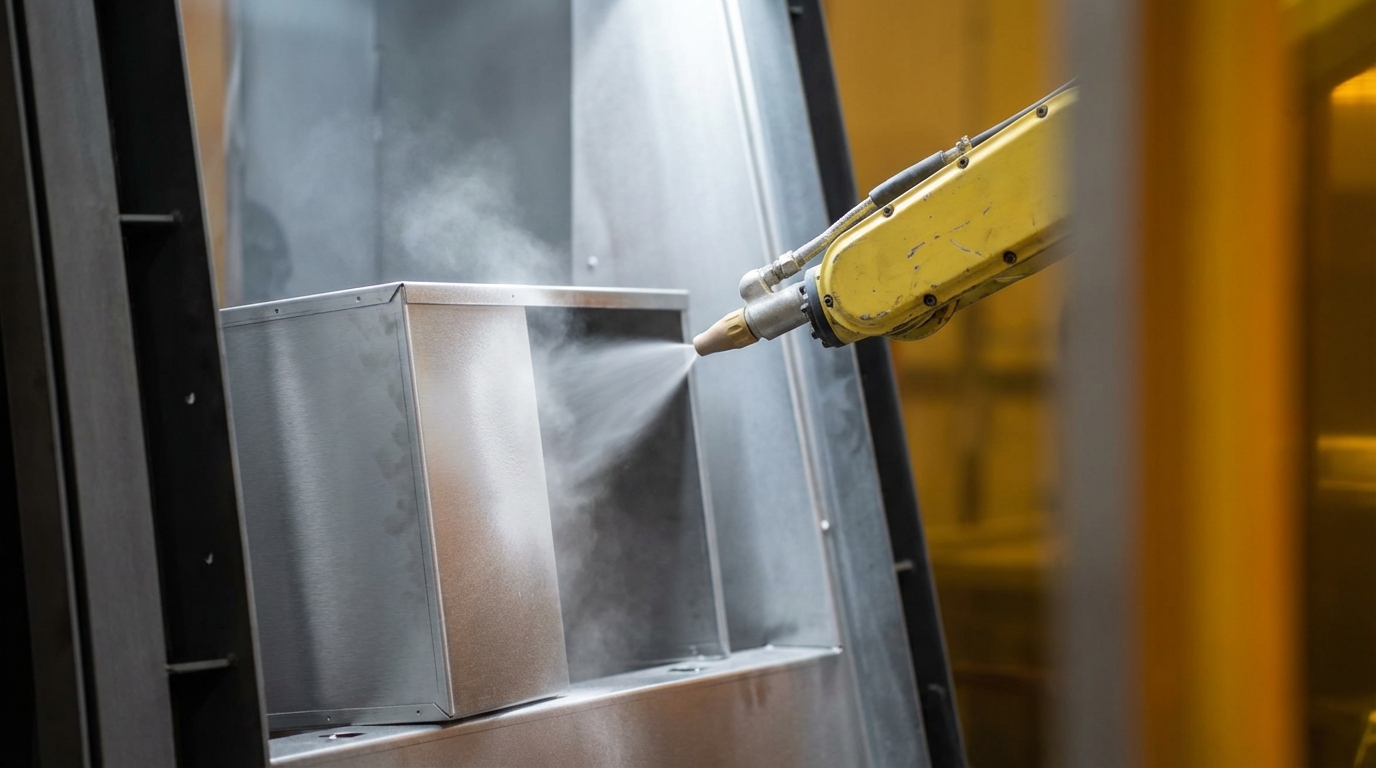
Custom powder coating applies electrostatically charged polymer particles to metal surfaces, then cures them in an oven at 350-400°F to create a durable protective finish. Unlike liquid paint that relies on solvent evaporation, powder coating forms chemically cross-linked polymer films in a single curing process, which improves adhesion and keeps film thickness consistent. This approach works especially well for metal cabinets, chassis, and enclosures where heat dissipation, tight tolerances, and long-term durability matter. The electrostatic application covers complex geometries completely while preserving dimensional accuracy for rack-mounted equipment and precision assemblies.
Best Powder Coating Finishes for Specific Enclosure Environments
Finish selection starts with where the enclosure will operate and what stresses it will face. Thin TGIC-polyester powders provide strong fade, chip, and scratch resistance in high-traffic commercial environments, which makes them a solid choice for data center applications and outdoor cabinets. Epoxy powder coatings maintain structural integrity in corrosive outdoor environments for utility enclosures and solar panel frames, where chemicals and moisture are constant threats. The EV infrastructure sector increasingly uses thermosetting powders for their heat resistance and chemical resistance against electrolytes and coolants. Looking ahead to 2026, manufacturers are adopting eco-friendly powder coating techniques with very low environmental impact and specialized formulations for EV battery enclosures that need thermal stability and mechanical durability.
The table below shows how common finish types align with application needs and corrosion performance.
| Finish Type | Key Properties | Best Applications | Corrosion Rating |
|---|---|---|---|
| Polyester | UV stable, flexible | Outdoor/data centers | High fade resistance |
| Epoxy | Chemical/impact resistant | Harsh/EV enclosures | High corrosion resistance |
| Textured | Fingerprint resistant | Medical equipment | High UV/scratch resistance |
Step-by-Step Powder Coating Process for Enclosures
The powder coating process follows a defined sequence to deliver consistent results on metal enclosures. First, surface preparation uses degreasing and media blasting to remove contaminants and create a profile that promotes adhesion. Second, masking protects threaded holes, mounting surfaces, and critical dimensions from coating buildup that could affect fit. Third, electrostatic spray application charges powder particles that attract to grounded metal surfaces, which produces uniform coverage on complex shapes. Fourth, powder coating particles melt during oven curing where parts are placed in a 400°F oven until the metal temperature reaches 400°F, then held for 10-30 minutes, forming a continuous protective layer. Finally, inspection checks coating thickness between 2-5 mils and identifies any defects. Design-for-manufacturability planning addresses clearances for coating thickness, grounding points, and access to surfaces for even coverage. Fabcon’s in-house process removes handoffs between fabrication and finishing, which shortens lead times and reduces quality risks.
Key Powder Coating Requirements in High-Stakes Industries
High-stakes industries apply additional powder coating requirements to protect performance and safety. Heat dissipation requirements in data center racks drive specific coating thicknesses that preserve thermal conductivity while still providing corrosion protection. Beyond thermal management, outdoor and harsh environments introduce extra protective needs, and NEMA 4X-rated enclosures require corrosion resistance beyond standard environmental protection for outdoor installations and chemical exposure. EV infrastructure brings a different challenge, since enclosures must resist vandalism and extreme weather while maintaining electrical safety standards. Medical applications shift the focus to contamination control, which demands traceability and compliance with strict cleanliness standards. Fabcon’s ITAR registration and AS9100D certification support precision manufacturing and documentation for aerospace and defense, while ISO 9001:2015 systems provide full traceability for medical and infrastructure projects.
Costs of Custom Powder Coating for Metal Enclosures
Powder coating costs depend on project specifications and volume. Key cost drivers include part size and shape, metal type, surface preparation, coating type and finish, and job complexity. Prototype quantities often run $8–$45 per square foot because setup time spreads across a small batch. Production volumes lower the cost per square foot through economies of scale and standardized processing. When surfaces are heavily contaminated or previously coated, sandblasting can add $1.50 to $7 per square foot for cleaning. Fabcon offers transparent pricing without hidden surcharges and provides fast quotes that support compressed development schedules. Get a quote for your specific enclosure requirements.
The table below compares typical cost ranges by volume tier and highlights the main factors behind each range.
| Volume Tier | Cost Range ($/sq ft) | Key Factors |
|---|---|---|
| Prototype | $8–$45 | Setup costs, complexity |
| Production | Lower costs through economies of scale | Volume, standardization |
Pros, Cons, and Expected Lifespan of Powder-Coated Enclosures
Powder coating delivers strong long-term value for metal enclosures even with higher upfront costs. It often provides excellent corrosion resistance in ASTM B117 salt spray testing, which translates to 15-20 year service life in typical outdoor environments. Powder-coated surfaces show 30-40% greater scratch resistance and 70% better corrosion resistance than traditional coatings, so the chip-resistant finish protects appearance and structure over time. The main tradeoffs involve higher initial investment for specialized equipment and curing ovens and some size limits for very large assemblies, although most enclosure sizes fit standard systems.
The table below summarizes the main advantages and limitations that matter for enclosure projects.
| Aspect | Advantages | Limitations |
|---|---|---|
| Durability | Strong salt spray resistance | Higher upfront cost |
| Maintenance | Longer intervals between maintenance | Difficult local repair |
Powder Coating vs. Painting Metal Enclosures
Powder coating outperforms traditional liquid painting for metal enclosures across durability, environmental impact, and efficiency. Near-zero VOC emissions make powder coating environmentally superior compared to traditional coatings, which reduces regulatory and worker-safety concerns. Powder coating first-pass transfer efficiency typically ranges from 50% to 80% (or possibly higher) for large, flat items such as panels, cabinets, and appliance parts. The single-coat process cuts labor and avoids inter-coat adhesion problems that often appear in multi-layer paint systems. This extended lifespan substantially exceeds liquid paint’s typical 5-10 year service life and lowers lifecycle costs and maintenance demands.
The table below compares key performance metrics for powder coating and liquid paint on metal enclosures.
| Performance Metric | Powder Coating | Liquid Paint |
|---|---|---|
| VOC Emissions | Near-zero | Higher |
| Transfer Efficiency | 50% to 80% (or higher for large surfaces) | 30-50% |
Choosing a Custom Powder Coating Supplier You Can Trust
Supplier selection should focus on capabilities that support complex enclosure programs, not just basic finishing. Vertical integration removes vendor handoffs and quality finger-pointing between fabrication, coating, and assembly operations. Integration alone does not guarantee quality, so certifications such as ISO 9001:2015 and AS9100D confirm that these processes follow systematic quality management and traceability standards for high-stakes applications. U.S.-based manufacturing then adds supply chain agility and responsiveness that global contract manufacturers struggle to match when timelines tighten. Fabcon combines 45+ years of experience with in-house design, fabrication, powder coating, and electromechanical assembly. Unlike job shops that stop at basic metal work or large CMs with rigid processes, Fabcon supports data center, EV, and medical device manufacturers with end-to-end solutions while maintaining the agility and accountability of a dedicated U.S. partner. Get a quote from Fabcon to see how integrated manufacturing simplifies your next program.
Frequently Asked Questions
Can you powder coat metal cabinets?
Yes, powder coating works very well for metal cabinets and enclosures. The electrostatic application process covers complex geometries while preserving the dimensional accuracy needed for rack-mounted equipment and precision assemblies. Powder coating performs best where heat dissipation, tight tolerances, and long-term durability are critical, which makes it a preferred finish for data center racks, electrical enclosures, and industrial cabinets.
What does custom powder coating cost for enclosures?
Custom powder coating costs depend on volume and part complexity. Prototype quantities often cost $8–$45 per square foot because setup time spreads across a small run, while production volumes achieve lower costs per square foot through economies of scale. Surface preparation, coating type, and geometric complexity also affect pricing. Size, material type, and finish specifications further influence the final quote.
How long does powder coating last on metal enclosures?
As noted earlier, powder coating provides 15-20 years of service life on metal enclosures in typical outdoor environments. The finish offers strong performance in salt spray testing and better impact resistance than traditional liquid paints. Proper surface preparation and application technique support maximum longevity, while the cross-linked polymer film preserves both protection and appearance over the enclosure’s life.
What are the downsides of powder coating enclosures?
Powder coating carries higher initial investment than liquid paint because it requires specialized equipment and curing ovens. Very large assemblies may not fit standard ovens, although most enclosure sizes fall within typical capacity. Local repairs can be difficult and often require stripping and recoating instead of simple touch-ups. Many projects still favor powder coating because reduced maintenance and longer service life offset these drawbacks.
What are the most common powder coating problems?
Poor surface preparation causes most powder coating failures, including inadequate cleaning, shallow profile depth, and contamination. Design issues such as sharp edges, deep recesses, and weak grounding points can also create uneven coverage. Incorrect curing temperature or time reduces adhesion and durability. Early design-for-manufacturability collaboration helps avoid these problems and supports reliable coating performance.
What are Fabcon’s powder coating capabilities and lead times?
Fabcon offers end-to-end powder coating services integrated with precision fabrication and electromechanical assembly in a single facility. This vertically integrated approach removes vendor handoffs and shortens lead times compared to fragmented supply chains. In-house capabilities include surface preparation, electrostatic application, oven curing, and quality inspection backed by ISO 9001:2015 and AS9100D certifications. Fast quoting and prototype services support aggressive development schedules.
Conclusion
Custom powder coating for metal enclosures delivers stronger durability, better environmental compliance, and higher long-term value than traditional liquid painting systems. The electrostatic application process creates uniform coverage and robust corrosion resistance for data center, EV infrastructure, and medical device applications. Fabcon’s vertically integrated manufacturing reduces supply chain complexity and accelerates time-to-market with in-house fabrication, coating, and assembly. Get a quote to streamline your next enclosure project from prototype through production.