
Last updated: April 17, 2026
Key Takeaways
- Enterprise engineers need precision CNC services for metal enclosures in data centers, EV infrastructure, and medical housings, and they prioritize delivery certainty over lowest quotes.
- Aluminum 6061/7075 supports lightweight thermal management, while stainless steel 316 delivers strong corrosion resistance in harsh environments.
- Fabcon ranks #1 among top CNC services because it combines CNC machining, sheet metal fabrication, assembly, and short US-based lead times.
- DFM collaboration and integrated capabilities prevent rework, shorten lead times, and support quality certifications like ISO 9001:2015 and AS9100D.
- Partner with Fabcon for vertically-integrated precision metal enclosures that scale from prototype to production without vendor handoffs.
Best Materials for CNC Metal Enclosures: Aluminum vs Stainless Steel
Material selection determines enclosure performance, and wrong choices can cause aluminum corrosion in EV applications or inadequate stainless durability in medical environments. To avoid these failures, engineers must match material properties to application demands. Aluminum alloys 6061 and 7075 offer exceptional strength-to-weight ratio and thermal management capabilities, which makes them ideal for data center applications that require heat dissipation. For harsher conditions, stainless steel 316 provides superior corrosion and heat resistance that supports outdoor EV charging infrastructure and medical equipment.
The following table compares the most common materials for CNC enclosures and shows how their properties align with specific CNC advantages.
| Material | Properties & Best Applications | CNC Advantages |
|---|---|---|
| 6061-T6 Aluminum | Lightweight, excellent thermal conductivity, corrosion-resistant, and ideal for electronic enclosures | Highly machinable with smooth surface finish |
| 304/316 Stainless Steel | High strength and wear resistance for medical and marine applications | Excellent durability and maintains tight tolerances |
| 7075-T6 Aluminum | High strength-to-weight for aerospace-grade applications | ±0.005–±0.02 mm tolerances achievable |
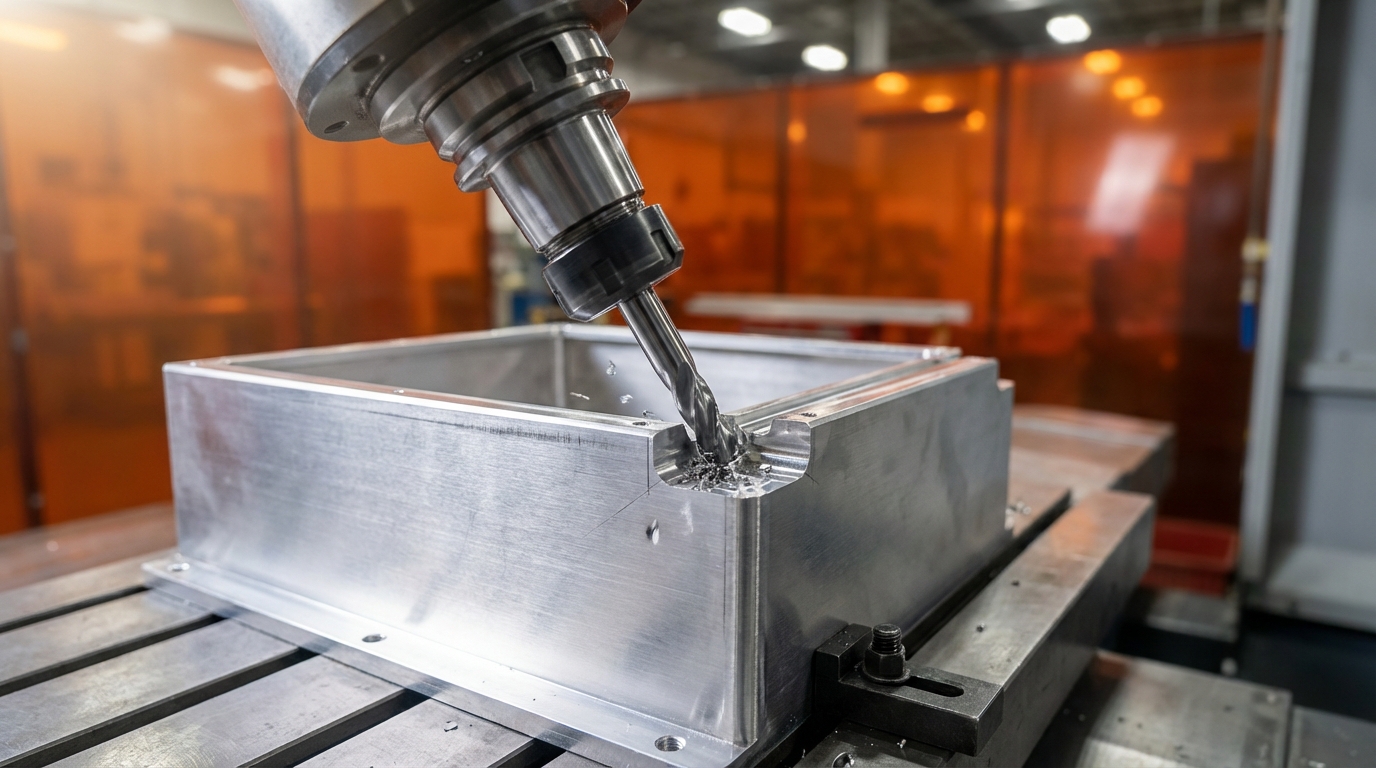
Once you select the right material for your enclosure, the machining process becomes equally critical. CNC milling supports enclosure precision and delivers tight tolerances for complex slots and mounting interfaces. Unlike laser cutting, milling provides strong edge quality for thick materials and enables precise holes, threads, and interface surfaces that support proper assembly. 5-axis CNC milling enables complex geometry single-setup machining with better surface finish and reduced machining time, which suits intricate enclosures that require multiple angles and features.
Top 5 CNC Machining Services Ranked for Metal Enclosures 2026
This ranking focuses on DFM collaboration, vertical integration, lead times, certifications, and scalability for mid-volume programs. The list addresses the gap between transactional job shops that lack assembly capabilities and rigid large contract manufacturers that require high minimums.
| Rank/Service | Tolerances | Lead Time | Integration Level | Best For |
|---|---|---|---|---|
| #1 Fabcon | High precision | Short lead times | CNC + Sheet Metal + Assembly | Data center racks, EV housings, medical enclosures |
| #2 Protolabs | ±0.13 mm (±0.005 in.) standard | 3-5 days quick-turn | CNC only, no assembly | Rapid prototyping, simple geometries |
| #3 Xometry | +/- .005” for metal, +/- .010” for plastic | Varies by project | Fragmented network | One-off parts, cost-sensitive projects |
| #4 Fictiv | Precision tolerances | as fast as 1-2 days | Global sourcing platform | High-volume, price-focused |
| #5 Pinnacle Precision | ±0.02mm achievable | Project-specific | Build-to-print + light assembly | Mid-tier precision projects |
Fabcon leads with 220,000 sq ft of US-based vertically-integrated facilities, combining ISO 9001:2015 and AS9100D certifications with more than 45 years of precision manufacturing experience. Fabcon extends beyond basic CNC services and provides CNC machining, sheet metal fabrication, powder coating, and electromechanical assembly under one roof. This structure removes vendor handoffs that extend lead times and supports system-level quality control from prototype through production.
Data center rack manufacturers gain from Fabcon’s ability to machine precision mounting interfaces while also fabricating structural components and completing final assembly with wiring integration. EV infrastructure projects use Fabcon’s experience with weather-resistant stainless steel enclosures that include integrated cooling and cable management systems. The vertically-integrated model enables efficient delivery cycles compared to longer timelines that fragmented suppliers often create.
While Fabcon offers this comprehensive approach, the other ranked services each have clear limitations. Protolabs excels in rapid prototyping with 3-5 day lead times but lacks assembly capabilities, which forces customers to manage additional vendors for complete enclosure systems. Xometry’s marketplace model can create quality inconsistencies across its fragmented network. Fictiv’s global sourcing introduces supply chain risks that do not fit critical infrastructure applications.
DFM Collaboration and Procurement Checklist for CNC Enclosures
Design-for-manufacturability collaboration prevents costly rework and supports scalable production. Competent CNC suppliers provide DFM knowledge that improves designs and reduces production costs, which matters for complex enclosure geometries that require multiple setups.
When you evaluate a supplier’s DFM capabilities, focus on the following four checkpoints that separate integrated manufacturers from basic job shops.
| DFM Check | Why Critical | Fabcon Advantage | Industry Standard |
|---|---|---|---|
| Optimize bend radii | Tolerance trade-offs | Pre-production iteration can reduce rework | 0.030 inches for material thicknesses up to 0.125 inches |
| Vendor integration | Eliminates handoff delays | CNC and assembly under one roof | Multiple vendor coordination |
| Material certification | Traceability for critical applications | ISO 9001:2015 documentation | Mill certs required |
| Assembly planning | Hardware insertion compatibility | Integrated assembly capabilities | Separate assembly vendor |
Procurement teams should evaluate suppliers on US-based capabilities, quality certifications, and assembly integration rather than lowest quotes. Request a DFM consultation from Fabcon to refine your enclosure design before production begins and reduce downstream rework and schedule risk.
Real Results from Vertically-Integrated CNC Enclosure Programs
Fabcon’s vertically-integrated approach delivered a data center enclosure project faster than traditional fragmented sourcing by combining CNC machining of precision mounting interfaces with sheet metal fabrication and final assembly that included cable management systems. Mid-volume aluminum enclosure projects demonstrate this advantage, with one recent program completing in weeks instead of the months quoted by a traditional multi-vendor approach.
The CNC machines market continues expanding as precision requirements grow in aerospace, automotive, and infrastructure sectors. Advanced 5-axis systems support complex enclosure geometries with single-setup machining, which reduces handling and improves dimensional accuracy that is critical for system-level integration.
Conclusion: Scale Metal Enclosures with Integrated CNC Manufacturing
Fragmented supply chains and hobbyist-focused search results waste engineering time on critical enclosure projects. Fabcon’s #1-ranked vertically-integrated CNC machining combines precision milling, sheet metal fabrication, and assembly capabilities for faster project delivery without the rigidity of large contract manufacturers. With these quality certifications backed by more than 45 years of US-based manufacturing experience, Fabcon delivers the reliability and agility that modern infrastructure programs require.
Get a quote for your metal enclosure project today and experience the difference of true vertical integration, with precision CNC machining, quality finishing, and complete assembly under one accountable roof.
Frequently Asked Questions
What is the best CNC process for aluminum enclosures?
CNC milling works well for aluminum enclosures and achieves tight tolerances on 6061-T6 aluminum with excellent surface finish and thermal management properties. Fabcon’s integrated milling capabilities handle complex geometries, precise mounting holes, and interface surfaces while maintaining tight tolerances throughout production. This process also supports single-setup machining for complex enclosures, which reduces handling and improves dimensional accuracy compared to multiple-operation approaches.
What are typical lead times for CNC machined metal enclosures?
Fabcon delivers CNC machined metal enclosures efficiently through vertically-integrated US-based manufacturing, compared to longer timelines from fragmented suppliers that require coordination across multiple vendors. Quick-turn prototypes can complete in 3-5 days. Production volumes benefit from streamlined workflows that combine CNC machining, finishing, and assembly under one roof. Lead time reliability comes from controlling the entire process internally rather than depending on external vendor schedules.
Are there reliable US options for stainless steel enclosures?
Fabcon’s Southern California facilities provide comprehensive stainless steel enclosure manufacturing, and quality certifications ensure traceability. The company machines 304 and 316 stainless steel grades that suit medical, food service, and harsh environment applications while maintaining tight tolerances and strong surface finishes. Integrated capabilities include CNC machining, welding, finishing, and assembly for complete enclosure systems delivered from US-based facilities.
Why is the cheapest CNC option not always the best choice?
Reliability and total cost matter more than initial quotes for critical enclosure applications. Low-cost vendors often create downstream expenses through quality issues, schedule delays, and rework requirements that exceed initial savings. Fabcon’s integrated approach removes vendor handoffs, reduces rework through DFM collaboration, and provides consistent quality backed by established certifications. The result is predictable delivery, near-zero defects, and total cost savings despite higher initial investment in a reliable manufacturing partner.
How should I evaluate CNC suppliers for complex enclosure projects?
Evaluate suppliers on vertical integration capabilities, quality certifications, and US-based manufacturing rather than lowest quotes alone. Look for ISO 9001:2015 certification, DFM collaboration capabilities, and the ability to handle CNC machining, finishing, and assembly under one roof. Fabcon’s 220,000 sq ft facilities, more than 45 years of experience, and AS9100D certification show the infrastructure and expertise required for complex enclosure projects that demand precision, reliability, and scalable production from prototype through mid-volume manufacturing.